


Affitti brevi, il flop della cedolare al 26%: vale solo 17 milioni di gettito extra
di Dario Aquaro e Cristiano Dell’Oste

4' min read
4' min read
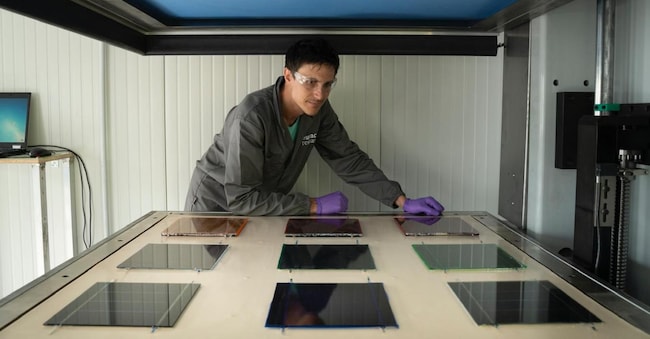
A support for companies in the development of non-standard photovoltaic modules: this is the Eurac Research laboratory, realised with PNRR funds allocated to the Extended Partnership NEST - Network 4 Energy Sustainable Transition and designed to support companies in the development of non-standard photovoltaic modules. The fully operational laboratory was presented at the Italian Photovoltaic Network conference, organised this year by Eurac Research in Bolzano. The event brought together around 250 people in Bolzano representing companies, professionals, associations and research centres active in the solar sector, as well as representatives of spoke 1 "Solar" of the NEST Foundation.
'From now on,' commented Francesco Cupertino, Rector of the Politecnico di Bari and Chairman of the NEST Foundation Board of Directors, 'we have a new tool to strengthen public-private research in the field of renewable energies, a pillar of the country's transition to a sustainable development model. Thanks to Pnrr funds we are helping to build a national network of cutting-edge infrastructures, such as the Eurac Research laboratory, in which to bring together multidisciplinary knowledge that will be invaluable for achieving the major goals of the coming years and that will also go beyond Pnrr itself. In fact, collaboration between universities, companies and research bodies will enable us to build an Italian ecosystem of innovation and knowledge more quickly. This collaboration model will be the key to success for the development of the new technologies and skills that the energy transition requires, as well as a model to follow in the future, to keep up with further developments,' Cupertino concludes.
But how does the laboratory work? It starts with the cells and the materials needed to connect and protect them, and then arrives at a prototype photovoltaic module ready to be installed and tested. Thanks to this new infrastructure - which completes Eurac Research's series of photovoltaic laboratories - the renewable energy experts at the South Tyrolean research centre can support companies at every stage of the supply chain: in the laboratory, the characteristics of the starting materials can be analysed, the effectiveness of the combinations of components can be assessed, and photovoltaic modules up to one square metre can be assembled in a special oven. The infrastructure also makes it possible to test the prototypes produced, installing them on ad hoc structures, but also to study their integration in façades, roofs or other architectural solutions and in power grids.
Making a quality photovoltaic module prototype starts with a careful choice of ingredients. How much light do the layers protecting the cells let through? How do they behave with temperature and how quickly do they age? In the laboratory of Eurac Research, the materials can be examined in detail before they are assembled and then the recipe is continued. The cells are laid out on Teflon sheets and connected with conductive tape that collects the electrical energy they produce. Then they are wrapped with so-called 'encapsulants', polymeric materials whose function is to protect them. At this point, the outer layers are added: the support at the base and the cover glass, which can be transparent or coloured to integrate better with the architecture of the building. The module thus assembled ends up in the laminator, an oven that must bake at the right temperature and only for the necessary time, so as not to damage the final product. To finish, the resulting module is also analysed, in the laboratory but also in the outdoor area that reproduces a real plant.
The workshop is especially designed to support companies in the development of customised modules to meet specific needs. These include, for example, modules with coloured glass, which are designed to fit into special architectural contexts such as historic buildings, or modules for agri-voltaics which are installed above cultivated land and must therefore produce energy without completely shielding solar radiation towards the plants.

