
Planet Farms is stepping up its expansion into overseas facilities and investing in cotton and coffee
Construction is getting under way in the UK, followed by Sweden and the United States. The plant in Cirimido (Como), which cost 62.5 million, has reached full production capacity, generating a turnover of 20 million

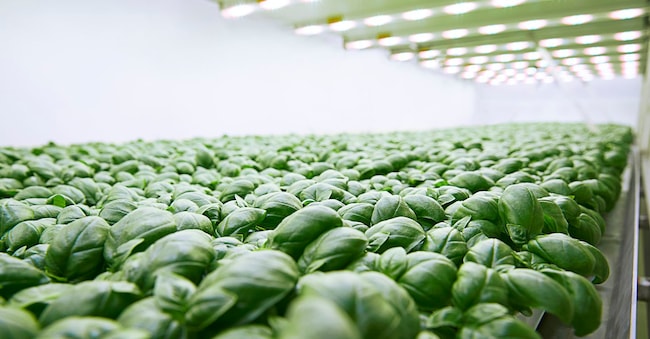
The fire that destroyed the Cavenago plant (Monza and Brianza) in January 2024 is now nothing more than a bad memory. In fact, it now seems to highlight even more clearly the resilience of Planet Farms’ business model, which managed to get back on its feet in record time by speeding up the construction of the Cirimido (Como), which now, just over two years after its opening, produces 90,000 packs of bagged salads every day using a state-of-the-art, highly automated vertical farming system in a controlled atmosphere, which eliminates the need for pesticides and plant protection products.
Cirimido at full throttle
“We are operating at full production capacity, even though demand from Italia and abroad is much higher. Once the new plant in England is ready (work is due to start shortly and be completed in the first half of 2028, ed.), we will be able to free up more production for the Italian market,” says Luca Travaglini, co-founder and co-CEO of the company alongside Daniele Benatoff. Or for other markets to ‘conquer’. Currently, Planet Farms exports around a third of its production to the UK, Northern European countries, Switzerland and Spain. ““Our strategy is to export temporarily only to those markets where we want to prepare and test the ground, before subsequently moving production there. In England and Sweden, the response has been excellent and quicker than in Italia, where we are nevertheless doing very well, now also with private labels and the out-of-home sector,” continues Travaglini. So much so that “the Cavenago site will be rebuilt, but the priority now is overseas, and following our launch in the UK, we will open a factory in Sweden at the end of 2028, and then in the US”.
The Cirimido site cost 62.5 million and the other planned sites are expected to cost a similar amount: a figure that highlights the scale of the investment, resulting from the joint venture signed last year with Swiss Life for the development of indoor facilities abroad, with an initial capital of around 200 million euros. Swiss Life has committed to contributing up to 125 million and now owns one-third of Planet Farms Infrastructure (the remaining two-thirds are controlled by the holding company owned by the founders and a group of industrial investors).
Break-even and investments
“Annualised turnover has reached 20 million,” says Benatoff, “and, above all, this year we have broken even and Cirimido has now been generating positive EBITDA for several months. It can be estimated that the new plants will generate revenues similar to the current ones, given that if they were already operational, we would probably be able to utilise them to full capacity straight away.”
An indirect response to those who doubted the potential to generate value, given, on the one hand, that the price of the products is higher than the average for salads from fresh-cut produce — although the product is not strictly comparable in terms of its intrinsic characteristics (it is not washed as it is produced in a sterile environment and is never touched by human hands, nor watered from above) and ‘relative prices are nevertheless falling over time’ - as well as operating costs, which are particularly high in terms of energy consumption. Productivity and profitability increase with scalability and technological improvement, say the founders, who have protected themselves in terms of energy costs through long-term contracts and hedging, made possible by the ability to forecast requirements over time.
‘The environmental impact is, in any case, minimal,’ emphasises Travaglini, ‘compared to that of the process involved in bagged salads, which are generally transported hundreds of kilometres before being packaged and which generate more waste, as well as consuming vastly more water.’


