Church

What is plenary indulgence and why did Leo XIV grant it

Pope Leo XIV granted plenary indulgence to the crowd in St Peter's Square, a significant act in Catholic doctrine

by Enrico Bronzo

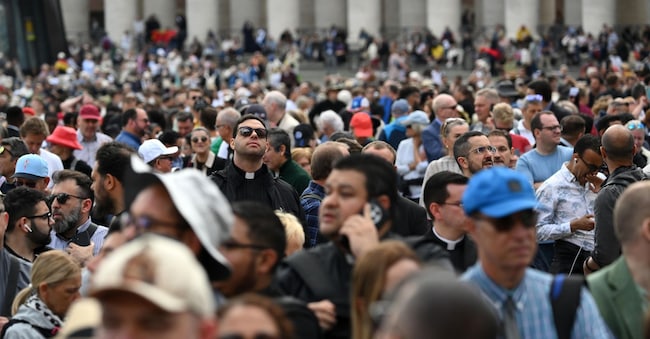
Folla in piazza San Pietro l’8 maggio 2025. Ansa/Ettore Ferrari (cardinale, cardinali, San Pietro, Vaticano, comignolo, fumo, nero)

3' min read

3' min read

Pope Leo XIV from the balcony of St. Peter's on 8 May 2025 granted a plenary indulgence to the crowd that had gathered in the square to await the 'Habemus Papam'.

From the moment of the white smoke, in just under an hour, an extraordinary influx ofover 150,000 people poured into the entire area.

Loading...

This is a central concept in Catholic doctrine, linked to the total remission of the temporal penalty due for sins already confessed and forgiven.

The last plenary indulgence was granted in Urbi et Orbi on Easter Day by Pope Francis, the day before his death.

Rules on Indulgences from the Manual of Indulgences. norms and concessions (Vatican City 2008).

Here are some of the 28 standards:

1. - An indulgence is the remission before God of the temporal punishment for sins, already remitted as to guilt, which the faithful, duly disposed and under certain conditions, acquire through the intervention of the Church, which, as the minister of redemption, authoritatively dispenses and applies the treasury of the satisfactions of Christ and the saints.

2. - The indulgence is partial or plenary according to whether it releases in part or in full from the temporal punishment due for sins.

3. - Each member of the faithful may gain both partial and plenary indulgences for himself or apply them to the deceased as a form of suffrage.

4. - The believer who, at least with a contrite heart, performs an action to which a partial indulgence is attached, obtains, in addition to the remission of the temporal punishment he receives by his action, an equal remission of punishment through the intervention of the Church.

14. - If a visit to a church or oratory is requested in order to acquire the indulgence established for a specific day, this visit may be made from midday of the eve until midnight of the established day.

15. - The faithful may gain an indulgence if they devoutly use one of the following objects of piety conveniently blessed: crucifix or cross, crown, scapular, medal.

20. - To obtain a plenary indulgence, in addition to the exclusion of any affection to sin, even venial sin, it is necessary to perform the indulgent work and fulfil the three conditions: sacramental confession, Eucharistic communion and prayer according to the intentions of the Supreme Pontiff..

§ 2. With a single sacramental confession, several plenary indulgences may be acquired; by contrast, with a single Eucharistic communion and a single prayer according to the intentions of the Supreme Pontiff, only one plenary indulgence may be acquired.

§ 3. The three conditions may be fulfilled several days before or after the prescribed work is done; however, it is fitting that communion and prayer according to the intentions of the Supreme Pontiff be made on the same day on which the work is done.

§ If the full disposition is lacking or the requested work is not performed and the three conditions are not fulfilled, the indulgence will be only partial, except as prescribed in norms 24 and 25 for the "impeded".

§ 5. The condition of praying according to the intentions of the Supreme Pontiff, reciting an Our Father and a Hail Mary according to his intentions, is fully fulfilled; however, the freedom is left to the individual faithful to recite any other prayer according to the piety and devotion of each one.

Here is the original text of the 28 Church Standards.

Copyright reserved ©
Loading...

Brand connect

Loading...

Newsletter

Notizie e approfondimenti sugli avvenimenti politici, economici e finanziari.

Iscriviti