

Pneumococcal pneumonia: a serious and complex infection that is all too often underestimated
Over 15,000 deaths a year and nearly 2.5 million hospital admissions: an installation in the alleyways of Genoa and Macerata serves as a reminder that the disease can be prevented through vaccination

Key points
Our lungs work silently and automatically every day to keep us alive, but how well do we really look after them? To mark World Pneumonia Day, the global day dedicated to raising awareness of pneumonia, it is vital to draw attention to a serious, complex and all too often underestimated respiratory infection: pneumococcal pneumonia. Epidemiological data paint a picture that calls for prompt and structured action.
Pneumonia statistics
According to the ISTISAN 26 Report, 15,450 deaths from pneumonia were recorded in Italia in 2023. Of these, 96 per cent (14,894 deaths) were among the over-65s. At the same time, an analysis of the decade 2010–2019 reveals nearly 2.5 million hospital admissions for pneumonia, confirming that the infection remains a constant threat to the National Health Service. Adults account for around 90 per cent of all hospital admissions (over 2.2 million cases), with the impact increasing exponentially with advancing age: the very elderly age group (75–86 years) alone accounts for 30 per cent of total hospital admissions. In this context, Streptococcus pneumoniae (pneumococcus) remains the primary causative agent, single-handedly responsible for around 20 per cent of bacterial cases, followed by other bacterial pathogens (17 per cent), Mycoplasma (13 per cent) and Pseudomonas (12 per cent). This is a condition that not only puts the lives of the most vulnerable at risk, but also chronically compromises respiratory function and a person’s independence.
An awareness campaign
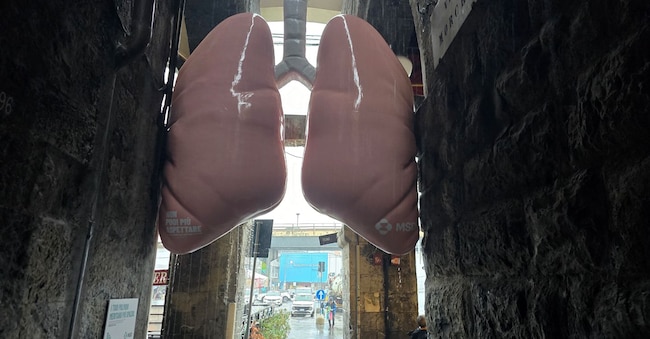
To shed light on these figures and break the silence, we also need forms of communication that break away from traditional patterns, as in the case of the campaign ‘You Can’t Wait Any Longer’, promoted by MSD, which featured the symbolic installation of two large, air-filled lungs in the narrow streets of Vico Morchi in Genoa and Traversa Armaroli in Macerata to visually convey this sense of constriction experienced during the illness. Placing this urban statement in Liguria (a region with one of the highest old-age indices in the world, around 270 elderly people for every 100 young people, surpassed only by Japan) and in the Marche (one of the regions with the highest life expectancy) highlights precisely the need to ‘make room’ for respiratory health in areas with the highest density of elderly residents.
The role of prevention
The good news is that pneumococcal pneumonia is a preventable condition. Pneumococcal vaccination is currently the most effective and safest means of primary prevention available to us. Scientific evidence and innovation in the field of vaccinology provide us with increasingly targeted solutions to protect infants, people with underlying health conditions and the elderly. It is crucial to remember that the National Vaccination Prevention Plan (PNPV) guarantees that the pneumococcal vaccination is provided free of charge to at-risk groups and adults over 65. In this regard, it is worth emphasising that a vaccine specifically designed for use in these groups has recently become available in Italia. Protecting oneself is not merely an individual choice, but a right accessible to all and a collective responsibility to ensure the sustainability of our healthcare system.
Vaccine stocks below critical levels
Whilst healthcare policy on paper places Italia amongst the most advanced countries in Europe in terms of the availability and free provision of vaccines, the epidemiological data paint a very different picture. The National Pneumococcal Vaccination Programme (PNPV) and the inclusion of pneumococcal vaccination in the Essential Levels of Care (LEA) should guarantee a uniform right to vaccination from north to south. In reality, however, the active provision of the vaccine comes up against a fragmented implementation system, where the most vulnerable sections of the population pay the highest price. National monitoring and regional surveys nevertheless show vaccination uptake well below critical levels: in various parts of the country, vaccination coverage among the elderly struggles to exceed half the ideal target, leaving hundreds of thousands of citizens exposed to the most severe forms of community-acquired pneumonia (CAP) and invasive pneumococcal disease (IPD).

