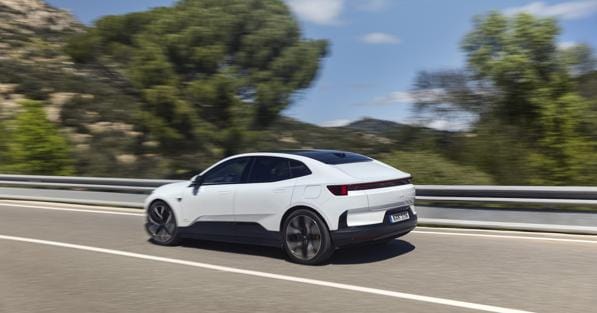
Polestar 4, the test. Here's what the electric coupe offers, how it goes and how much it costs
It is not the flagship but it is the most powerful, fastest and most technological model of the brand born from a rib of Volvo and now all of China's Geely. Offered in two versions, in many ways it is the progenitor of the future Polestars.
5' min read
Key points
5' min read
Contrary to what one might think, the Polestar 4 does not rank above the brand's other two models, namely the 2 sedan and 3 suv, but stands between them. Polestar's first suv-coupé is the most advanced of the entire family born from a rib of Swedish Volvo, which then repudiated this 'electric-only' brand and left it all under the control of Chinese Geely. Polestar 4 follows the brand's strategy to perfection because it is totally different not only from the other two models that preceded it, but also from those to come. Namely, the 5 fastback sedan announced for 2025 and the 6 roadster, which will debut the following year. In short, within two years Polestar will be present in five areas of the premium world, obviously only with electric models.
Polestar 4, the first of a new species
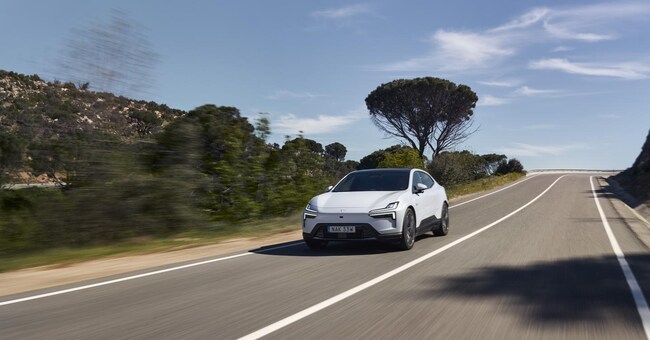
.Although electric like its sister cars, the suv-coupé writes a new page in the Polestar story, starting with the Sea 2 modular architecture developed by Geely and adapted to single and twin-engine powertrains that, for example, in various evolutions support very different models such as the Smart #1 or the Lotus Electra. The Polestar 4 comes in Single and Dual Motor variants. In detail, the single-motor Polestar 4 is rear-wheel drive and has a powertrain with 272 horsepower and 343 Nm of torque that propels it to 200 km/h and 100 km/h in 7"1, powered by a 100 kWh lithium-ion battery integrated in the 400 V mains that promises a range of up to 620 kilometres. The Dual Motor with all-wheel drive employs a motor from the other version on each axle and thus offers 544 horsepower and 686 Nm of torque. It too reaches a self-limited 200 mph, but does 0-100 in 3.8 seconds. The battery is the same as the Single Motor, but the range stops at 590 kilometres. The battery is recharged with alternating current up to 22 kW and direct current up to 200 kW, in which case 10 to 80 per cent of electrons are topped up in half an hour. For the Dual Motor there is also the Performance Pack that includes active suspension, 22-inch wheels, Brembo braking system and electronically controlled power vectoring on the rear axle. A dozen perimeter cameras manage the Polestar 4's rich network of safety and driver assistance systems, which with the Pilot Pack is ready for Level 3 when regulations permit, with the wide-angle camera at the end of the roof influencing the Polestar 4's body design and interior volume.
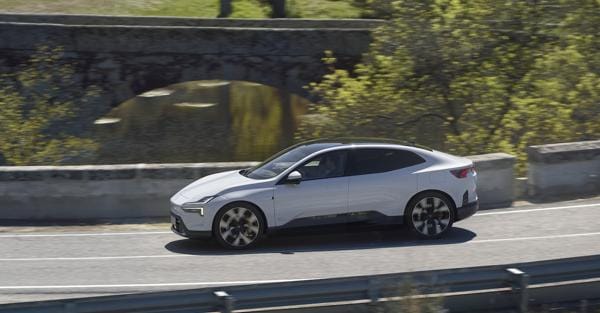
Polestar 4, sleek suv-coupé without rear window
.The position of the camera that retires the interior rear-view mirror replaced by a high definition monitor showing real time feeds is justified by the fact that the Polestar 4 is the first model in the hypercar sector without a rear window. Somewhat paradoxically, at first glance this absence is what is most surprising when observing the suv-coupé. For the rest, the car remains faithful to the clean styling canons that are fundamental to the brand and presents itself with a sleek line accentuated by the trend of the pavilion that seems to push down the high side panels, as well as bringing a new interpretation of the Polestar family style to debut. All blended to optimise aerodynamics.
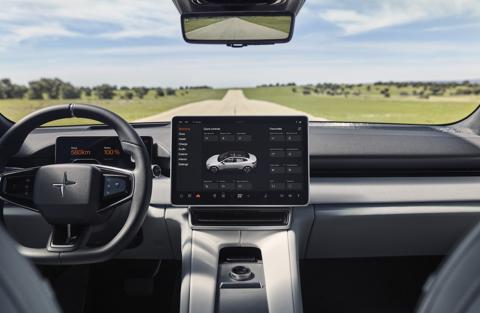
Polestar 4, inside it's big, super technological and even bright
.With a length of 4.84 metres, a width of 2 metres, a height of 1.54 metres and a wheelbase of 3 metres, the Polestar 4 comes close to the maxi-suv sector. The dimensions, the flat floor above the large battery pack together with the minimalist furnishings, made of high-quality materials together with many obtained from recycled materials but treated very well on the surface as well as assembled with care, favour the spaciousness of the environment. Also influencing this last claim to the Polestar is the absence of a rear window, which has made it possible to design a roof that does not loom over the head of those sitting behind. The farewell to the rear window is also reflected in the capacity of the well stowed load area, whose capacity ranges from 526 to 1,536 litres.
But let's return to the cockpit where the absence of a rear window does not arouse claustrophobic effects because the Polestar 4 has a large glass roof that illuminates the environment well but which, unless you resort to the optional system that partially or fully cancels transparency, is not a panacea on sunny days. The essentiality of the interior is only interrupted in the dashboard from which the 10.2" digital cockpit and 15.4" central infotainment display emerge. It is based on Android Auto Automotive Os with an interface developed by Polestar, which integrates Google and interacts with Snapdragon Digital Chassis for cloud connectivity and Nvidia Drive for processing data collected by external cameras and sensors. The GUI can be subdivided at will and customised with many shortcuts, but much remains hidden. Also embedded in the infotainment system is the management of the air conditioning vents, as well as the opening of the glovebox. In the test with a pre-series model it was not possible to assess the responsiveness of the system, because the touchscreen received commands only after many attempts. The digitisation is closed by the large 14.7-inch head-up display, standard only with some optional packs, as well as the 8"9 rear-view mirror display.