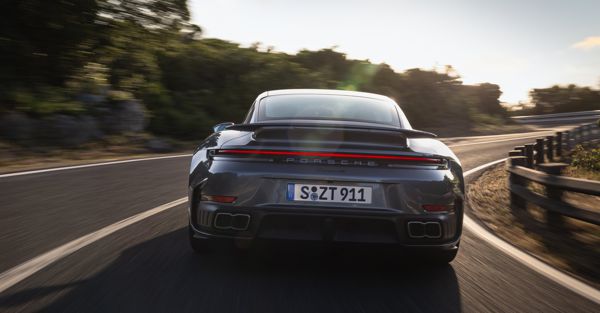
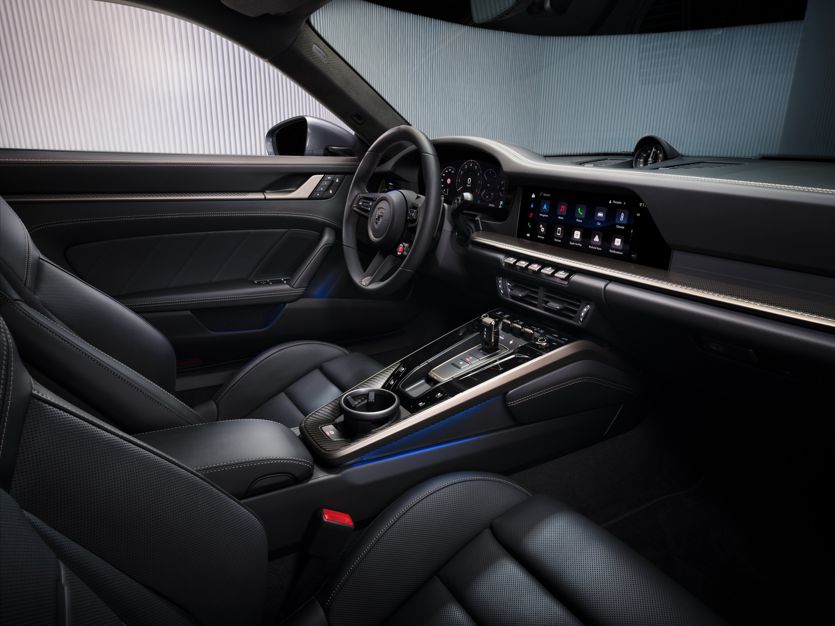
Porsche 911 Turbo S, the most powerful ever is a hybrid
Immediately available also in a Cabriolet version, it clearly stands out from its predecessor in terms of the 711 horsepower output of its twin-turbo flat six electrified by the sophisticated solution developed by the German manufacturer

4' min read
Key points
4' min read
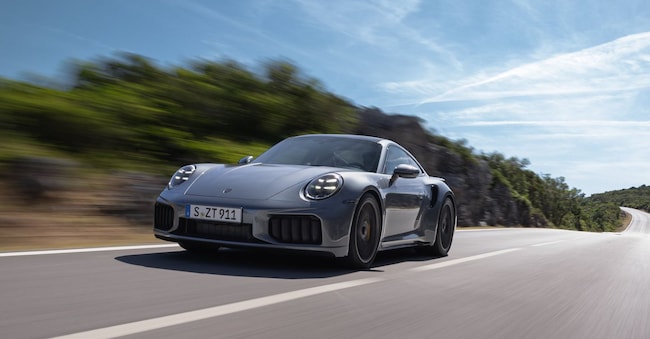
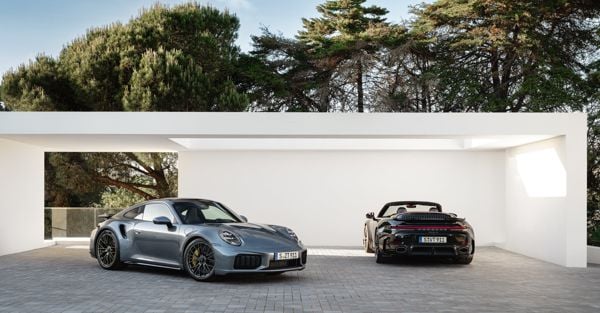
Now 50 years and seven generations old, the 911 Turbo never ceases to amaze with the fourth series of the S version that has always been at the top of the most iconic Porsche family. Indeed, the Porsche by definition. The new Turbo S debuting at the Munich Motor Show extends the line of the 992.2 generation by taking advantage of the sophisticated T-Hybrid technology developed by Porsche. An unparalleled solution that debuted with the current 911 Carrera GTS and evolved ad hoc for the Turbo S, with which, in keeping with the lineage's tradition, it aims even higher, the new Turbo S offers higher performance and even more effective dynamism than its predecessor, while still offering a character suitable for both everyday use and when you put it to the test. Just as consistently, it debuts in Coupé and Cabriolet versions that can be ordered immediately at prices of 280,000 and 295,000 euros respectively. In short, also at the top end of the 911 range.
Porsche 911 Turbo S, more technology and more power
The 711-horsepower powertrain, an output more than 60 hp higher than that of the previous Turbo S, crowns this new 911 as the most powerful ever produced. Along with this figure, the supercharged 3.6-litre flat-six also delivers 800 Nm of torque, available over an extremely wide rev range of 2,300 to 6,000 rpm. The power curve is also characterised by an unusually wide peak, as the maximum peak is available between 6,500 and 7,000 rpm. The powertrain is supplemented by sophisticated T-Hybrid technology with a 400 V high-voltage system and a high-voltage battery with a capacity of 1.9 kWh that debuted with the Carrera Gts, but has been refined for the Turbo S. In practice, here there are two turbochargers each with an electric motor placed between the turbine and the impeller sized specifically for this model. The two eTurbos not only contribute to a considerable increase in performance, but also improve responsiveness and spontaneity of delivery. In addition, an electric motor is integrated in the eight-speed dual-clutch transmission and transmits the driving force to the all-wheel drive. The new unit pushes the Turbo S up to 322 km/h, allowing it to reach 100 km/h in 2.5 seconds and 200 km/h in 8.4 seconds (half a second less than the old model) with a combined cycle consumption of 11.8 litres per 100 kilometres.
Porsche 911 Turbo S, many innovations improve dynamism
Despite weighing 85 kg more than its predecessor, the new Turbo S was much faster in the Green Hell of the Nürburgring, covering the 22.8 kilometres of the track in less than 7 minutes 4 seconds, or almost 14 seconds less. A result determined by the numerous technological innovations developed for the most powerful 911 ever. The line-up includes the electro-hydraulically controlled ehPddc set-up that reduces roll tendency, increases agility when entering and exiting corners as well as stability while improving drivability and comfort. In addition, the set-up is complemented by wider rear rims than in the past, which together with the front ones fit a new generation of tyres, and the carboceramic braking system derived from that of the Porsches that race on the track has larger discs. In fact, the largest ever fitted on a two-door Porsche. Another big contribution to the dynamism and overall efficiency of the new 911 Turbo S comes from the intelligent active aerodynamics. It is defined by the vertically arranged active air vents at the front, the active front diffuser and the variable profile of the front spoiler and the extendable and tilting rear wing, inherited from the previous model. The system directs the cooling air optimally towards the brakes and transmission cooling units, depending on the driving situation intelligently reduces lift or drag, The aerodynamic drag coefficient of the Coupé version is 10 per cent lower than that of the previous model when all active aerodynamic elements are in their most efficient position. Finally, when set to Wet mode, active aerodynamics improves braking behaviour in wet conditions because the front ventilation flaps close to protect the front discs as much as possible from water spray.