
'Energie Possibili', the future of Italy and industry with the green transition
The meeting organised by Unione Industriali Torino, linked to Torino Capital of Business Culture 2024 and Biennale Tecnologia 2024. The role of nuclear power and the environmental supply chain

4' min read
4' min read
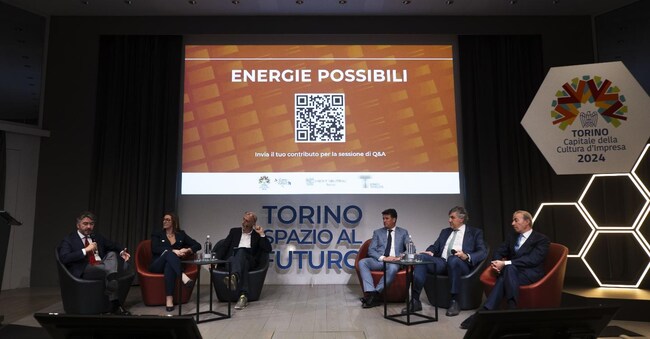
(Il Sole 24 Ore Radiocor) - Designing Italy's future from the perspective of energy autonomy and the decarbonisation of industry. This is the central theme of "Possible Energies", the event organised by the Unione Industriali Torino as part of the Biennale Tecnologia 2024. A meeting occasion linked to the recognition received by the Piedmontese capital, which has been nominated by Confindustria Capital of Business Culture 2024 . "Energy is a key element to boost our businesses and economies. We are in a phase of transformation, but also of openness and new perspectives. Italy must be quick to seize the opportunities for growth,' said the president of Unione Industriali Torino, Giorgio Marsiaj kicking off the proceedings. Climate neutrality, according to the president, is fundamental for companies, but 'the ecological transition must not leave anyone behind. Decarbonisation must be achieved through multiple routes,' he emphasised. And looking at the global scenario, Marsiaj pointed out that, to be competitive, it is necessary "to find resources to finance research. Fundamental is the collaboration between the public and private sectors, between large and small companies, with universities, associations, research institutes and start-ups,' he concluded.
Security, Sustainability and Competitiveness
.From hydroelectric power to new-generation nuclear power, from chemistry to biofuels: many topics were analysed during the meeting, thanks to the contribution of numerous guests from the business world. Speaking of renewables in Italy, "the goal is to go from 44%, which was the percentage of renewable electricity produced in 2023 to 84% in 2030," pointed out Agostino Re Rebaudengo, president of Elettricità futura. "It is an important challenge, but one that we could win and that implies investments in the battery system, in the grids to make the system even smarter, and certainly artificial intelligence will help us," the chairman said. "To produce energy we need to have security, environmental sustainability, competitiveness in production," said Giuseppe Bergesio, CEO of Iren Energia, emphasising the three fundamental points on which companies must work. And from the manager's words it emerges how Iren Energia is moving in precisely this direction, with a 'new industrial plan' that 'focuses on renewable energies, with a strong entry of photovoltaics and wind power'. The same opinion is shared by Simone Nisi, director of institutional affairs at Edison, who points out how the company started "from the decarbonisation of the electricity sector, which is one of the major objectives", to then work "on the decarbonisation of the natural gas sector and then the decarbonisation of customers in various capacities, final consumers, public administrations, the tertiary sector and finally the decarbonisation of industry and the transport sector".
Fourth Generation Nuclear
.And if we are talking about ecological transition, we cannot forget fourth-generation nuclear power, which, as Stefano Buono, founder and CEO of newcleo, emphasises, 'is excellent in terms of security of supply (very little material is needed and a reactor goes on for tens of years); for environmental sustainability, because the impact is minimal in terms of the surface area used and it is decarbonised energy', but is less convenient in terms of cost. For this reason, in the process 'it is important to use not only the electron, but also the heat' since 'all industrials need both high-temperature steam and the electron', and this can be provided by nuclear power, while 'it is more difficult for renewables, because the temperature must then be obtained with electricity', said the CEO. "Modularity helps with costs, but what helps more is how much you invest: we are moving from government nuclear to private nuclear and private individuals need a quick return on investment," he continued. "The plant has to be built in three years, fast," so, Buono explained, instead of a large plant it is cheaper to build small plants that come on stream quickly. "If all this works well nuclear power will also be attractive from an economic point of view, he concluded, pointing out that "young people are very much in favour of nuclear power at the moment, the statistics say so, the big problem will be when you have to put the plant somewhere, but this problem is there with wind, solar and with anything."
Waste is the 'oil of our millennium'
.From nuclear power to chemistry and biofuels, exploiting an unprecedented resource: waste. "Waste is the oil of our millennium," said Fabrizio Di Amato, founder of Maire Tecnimont. "We have developed a patented technology and recover undifferentiated waste, which today in Italy, without touching existing supply chains, is 16 million tonnes. If we transform it, we could produce 1.6 million tonnes" of energy, the chairman specifies, an important result considering that "the demand in industry is 400 thousand tonnes". And starting precisely from waste, biofuels can also be obtained, not only biodiesel, but also Hvo, which starts from the same base as biodiesel, but is an element from which oxygen is removed to obtain a hydrocarbon. "Apart from the CO2 emissions of the production process, what we emit is worth zero," explained Raffaella Lucarno, head of bio refining & supply Biomethane at Enilive, emphasising how Hvo "reduces Co2 by 60% to 90%".
Net zero target also supported by banks
The goal of achieving zero emissions does not only concern companies. On this path, industry can have an ally: banks. "The net zero goal of a bank is not primarily related to the branches, or the sites where employees work," specified Giovanna Zacchi, Head of Esg Strategy Bper Banca, but is related to who receives the money to invest in reducing their emissions. "The bank supports the decarbonisation of its customers," said Zacchi, asking them for demonstrations of the methodology to reduce their own climate impact.

