
Power management as a leader's talent
In his latest essay, Luca Baiguini invites us to come to terms with a fundamental constitutive element of human relations and organised structures

4' min read
4' min read
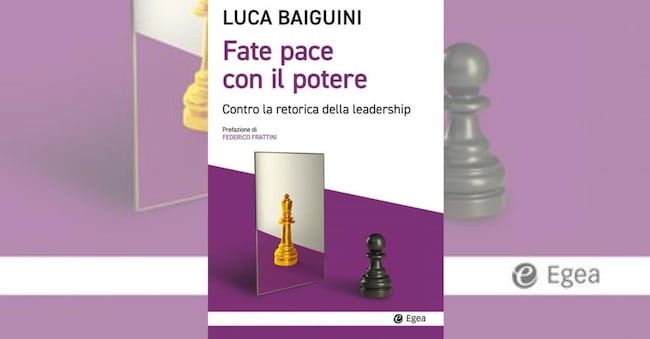
What might be a manager's reaction to the statement 'more leadership and less power'? The statement is not so recurrent but it has inspired deep reflection, resulting in a 258-page book, in Luca Baiguini, a political scientist by training and lecturer in People Management and Organisation at the School of Management of the Milan Polytechnic and the Cefriel digital innovation centre. In "Make peace with power - Against the rhetoric of leadership", published by Egea and in bookshops from mid-May, the author invites us to come to terms with a fundamental constituent element of human relations and organised structures: power, to be precise. The objective? To learn to read (and experience) companies as they really are and not as we would like them to be, leaving aside the often-poor redundancy of content that rages on media and social platforms and (above all) polemical and preconceived attitudes.
The literature on this topic over the last 25 years is very broad, embracing a wide spectrum of distinctions between being a leader and being a leader (all in favour of the latter) and finding expression in texts, articles and posts that chase each other to describe more or less detailed recipes on how to ideally lead a team to success. But as we read in the note accompanying the book's launch, the reality of life within organisations and personal relationships is quite different: power exists, all right, it fuels decisions and influences behaviour, and not infrequently in a positive way. 'The denial of power,' Baiguini explains to Sole24ore.com, 'is unproductive for the functioning of an organisation, because it is power that makes things happen. Leadership is not intrinsically and constitutively better as an action that goes to determine behaviour to lead an organisation. It is, if anything, a form of power, based on symbolic resources'.
Power vs. leadership?
.The book tackles the subject of 'power vs. leadership' from various angles - the relationship and boundary between the two concepts, whether they are really opposites and mutually exclusive, their coexistence and overlapping - and its main aim is to 'clear' power as a necessary element of managerial baggage and literature, as a worthy ingredient in the recipe for nourishing the governance of organisations, whatever they may be. There is therefore a clear desire to give a strong message about the precise contours of these two components of corporate life, starting from the assumption that there is no worst or best and providing an analytical and useful framework for those who want to know more about the dynamics of a work team and a company as a whole. Baiguini's intention, in short, is not to draw up a merit ranking of these two forms of exercising command, but rather to try to clarify, reiterating a very precise concept: power is something that it is good to know in depth in order to understand the ways in which it is expressed and to use it, consequently, when needed and with full knowledge of the facts to make processes more effective.
'There is a lot of confusion around the meaning of power,' adds the Politecnico lecturer, 'and there is a cultural habit of devaluing its importance. In fact, there is a tendency to follow a narrative that leads us to think of the ideal world and not the real one, to describe the leader of tomorrow with various peculiarities and characteristics, but these almost never include the ability to acquire and then manage power. Instead, power management is part of the relational skills of a team leader and the priority of one who is responsible for leading a group of people is to influence them to make them all row on the same side, in a way that is aligned with the company's objectives. If this happens of course it is an advantage, but in all other cases, which are the majority, you have to force their hand through coercive power'.
The consensus currency of leadership
.The idea of 'open leadership', which calls upon all the components of the organisation to take a slice of responsibility in the definition and execution of processes, is not, according to Baiguini, a utopian model, because (in his words) there is nothing utopian about it. But the crux of the matter is to create the pre-conditions for this model to take root and find application. There are cases of large companies, and the examples the author refers to are Enel and Fiat (led respectively by Francesco Starace and Sergio Marchionne), which confirm how the pragmatic exercise of power is functional to the construction and success of participative leadership. "The currency of leadership," Baiguini explains the concept further, "is consensus, in all its articulations. And when consensus costs too much, leadership cannot be effective. Exercising power and being a leader has a cost: those who have the ability to influence the conduct of others at the lowest possible cost excel in this discipline'.

