Today

The solar eclipse at sunset is also visible from Italia

The sky treated us to one of nature’s most fascinating spectacles

by Leopoldo Benacchio

Aggiornato il 12 agosto 2026 ore 19:54

Aggiungi Il Sole 24 Ore
ai preferiti su Google

4' min read

Translated by AI
Versione italiana

4' min read

Translated by AI
Versione italiana

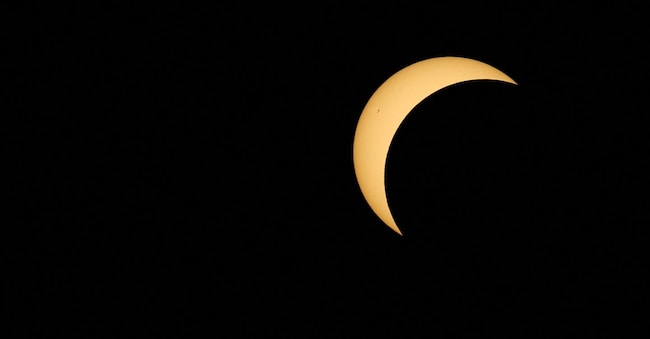
On 12 August 2026, the sky treated us to one of nature’s most fascinating spectacles: a solar eclipse that was also visible from Italia at sunset. An event that combines astronomical precision with visual wonder, still capable today of drawing millions of people to gaze towards the horizon.

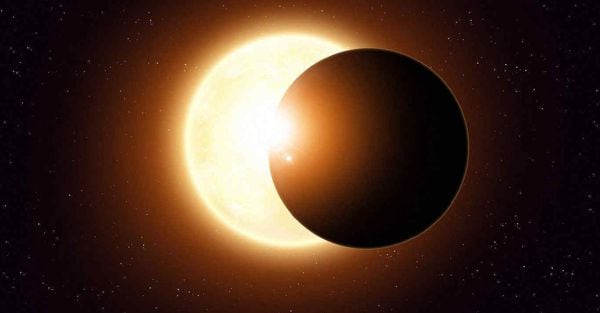
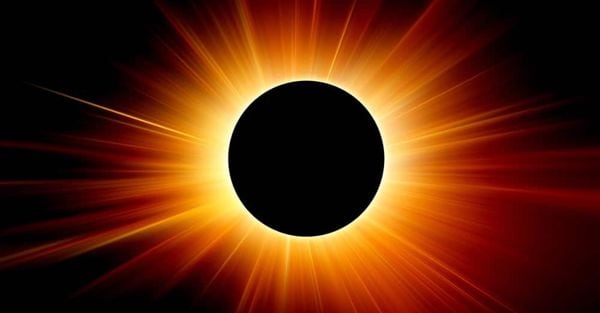
A solar eclipse occurs when the Moon passes between the Earth and the Sun, obscuring the Sun’s disc. It is the result of an alignment between the three celestial bodies, which is only possible under specific conditions because the Moon’s orbit is tilted relative to that of the Earth. It is precisely this inclination that prevents a solar eclipse from occurring every month, making it a less frequent phenomenon, visible only from a specific area of the planet. The Sun’s diameter is about 400 times that of the Moon, whilst the Sun’s distance from the Earth is about 390–400 times that of the Moon; this is why the discs of the Sun and the Moon appear virtually identical in the sky – at about half a degree – and a total eclipse is possible.

Loading...

Beyond the scientific explanation, an eclipse remains one of the most evocative phenomena observable with the naked eye (with the necessary protective equipment). The quality of daylight changes; it dims in an unusual way, shadows become sharper and the atmosphere takes on almost unreal hues. It is hardly surprising that eclipses have always captured the human imagination, inspiring both fear and wonder.

L’eclissi di Sole dall’Italia e dall’Europa

Photogallery25 foto

For centuries, in fact, they were viewed with fear, particularly in societies lacking the scientific tools to understand them: the sudden darkening of the Sun was interpreted as a divine sign or an omen of misfortune, or as the work of mythical creatures that ‘devoured’ the Sun. There was no shortage of rituals and noises designed to drive away the darkness. With the progress of astronomy, this aura of mystery has faded, but not the fascination. Some eclipses have gone down in history: the one in 585 BC, which, according to tradition, interrupted a battle between the Medes and the Lydians; the one in 1919 observed by Arthur Eddington, which helped to confirm Einstein’s general relativity; and, more recently, the great total eclipses that crossed the United States in 2017 and 2024, watched by millions of people.

The phenomenon unfolds gradually: the Moon begins to cover the Sun, marking the start of the partial phase, which can last for over an hour. It then reaches its peak, when the obscured portion is at its greatest, before slowly returning to normal. In Italia, the eclipse on 12 August will remain partial throughout, but in some areas the coverage will be very extensive.
Looking at the Sun without proper protection is dangerous, even during an eclipse. The reduction in brightness can be misleading, but serious damage to your eyesight is still possible.

The only safe method for direct observation is the use of certified solar filters that comply with the ISO 12312-2 standard. Make-shift solutions, such as tinted glass or uncertified filters, do not provide sufficient protection.

Particular attention must be paid to children and young people: their eyes are more vulnerable, and the excitement of the event may tempt them to look at the Sun without taking the necessary precautions. Observation must therefore take place under the constant supervision of adults, who must ensure that the solar viewing glasses are worn at all times and correctly.

The eclipse will be visible across the whole peninsula, but to varying degrees. The event will take place in the evening, with the Sun close to the horizon: it will therefore be essential to choose locations with an unobstructed view, such as the coast, the mountains or the countryside.

The north-west will be among the areas best placed to view the eclipse. Turin, in particular, will be able to observe up to 93.3 per cent of the Sun’s disc being obscured – one of the highest percentages in Italia. Here, the eclipse will begin at around 7.28 pm, reach its peak at 8.21 pm and end shortly after sunset, offering a particularly striking sight with the Sun turning red on the horizon.

Loading...

In the rest of Italia, coverage will vary considerably: in Catania it will be 10.4 per cent, in Naples 36 per cent, in Rome 57 per cent, in Florence 83 per cent, in Milan 92 per cent, and in Venice 86 per cent.

The eclipse will be visible, as a partial eclipse, from 55 countries. Only in certain areas, such as Iceland and Spain, will it be total. This is precisely why a whole industry of eclipse tourism has existed for some time: organised trips, charter flights and even cruises designed to follow the path of the lunar shadow.

Despite the accuracy of astronomical calculations, there remains one unpredictable variable: the weather. Cloud cover can hinder observation. This, too, is part of the experience, reminding us that, when it comes to natural phenomena, there is always an element of uncertainty.

12 August will therefore be an opportunity to pause, look up at the sky and, whilst taking the necessary precautions, witness one of nature’s oldest and most fascinating spectacles.

Copyright reserved ©
Loading...

Brand connect

Loading...

Newsletter

Notizie e approfondimenti sugli avvenimenti politici, economici e finanziari.

Iscriviti