
Private Funds for the Riace Bronzes. The Strategic Plan of the Museum of Reggio
Director Sudano: Objective is to become cultural 'hub' and growth engine. After two years of organisational reorganisation, ticket revenue doubled

Key points
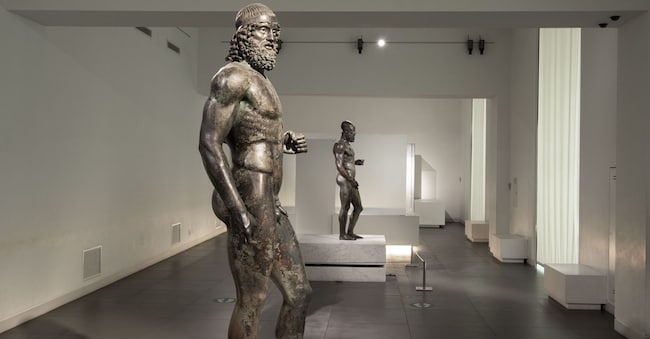
To become a Mediterranean cultural hub - an international reference point for the history and civilisation of Magna Graecia - and a growth engine for the region. The goals of the Archaeological Museum of Reggio Calabria (Marc) are ambitious, but achievable, according to its director Fabrizio Sudano, who in two years has effectively redesigned the face of this jewel of Italia's artistic and cultural heritage, still too little known to the Italian and international public and too little exploited by private patrons, despite the fact that it houses two of the main masterpieces of Italian art, the Riace Bronzes.
The Strategic Plan 2026-2028
It is precisely to the private sector that the Strategic Plan 2026-2028 announced a few weeks ago - the first to be produced by the Museum and one of the very few to be drawn up by a museum institution in Italia - looks, reflecting the change of pace and entrepreneurial vision imparted by Sudano over the past two years.
Developed by a high-profile team, thanks to the collaboration of the internal staff, but also of external figures such as Ludovico Solima, professor at the University of Campania Luigi Vanvitelli, the Plan responds to the need to provide the Museum with 'structured planning and a systemic project over the medium term,' Sudano explains, 'capable of guiding strategic choices in a coherent and integrated manner. The Plan is rooted in the work carried out over the past two years, during which the new management has reorganised both the offices and the activities, including through investments in digitalisation, with the aim of enhancing and raising awareness not only of the heritage housed within the museum, but also of the museum itself.
Growth for 2024-2025
"We have invested, for example, in temporary exhibitions, focusing on one major event a year, not necessarily related to the Magna Grecia artefacts that the museum already exhibits in its halls,' Sudano continues. 'This was the case with the Gianni Versace exhibition (which ended on 3 May, ndr), which was a huge success. Obviously the costs of an exhibition of this kind are higher, more than double, than those of the exhibitions traditionally organised by the museum, and the economic return is not immediate, but it is an enormous investment in communication, which allows us to reach a new public that had never before visited our halls'
Speaking of the public, the number of visitors has increased, reaching a record 260,000 admissions, higher even than the pre-Covid number of visitors (227,000 in 2019). "We have to consider the geographic position of our museum, which, despite being one of the most important in Southern Italy, remains outside the main tourist flows, so a 16% increase in admissions between 2024 and 2025 is an extraordinary result: those 260 thousand in my opinion should be multiplied by three." In addition, the number of paying visitors has increased, rising last year to 55% (whereas before it was a minority share). This, together with the increase in the ticket price from 8 to 10 euro, has led to an exponential increase in takings, which in 2025 exceeded 1.2 million euro, double the 601 thousand euro recorded in 2019.

