
Energy: Prodi on Radio 24: Schlein’s proposal to Meloni is common sense
During the programme ‘Immagini, uno sguardo sull’attualità’, presented by Valentina Furlanetto with Riccardo Barlaam, the former prime minister outlined the risks for the European Union should the AfD secure a majority in Germany

Key points
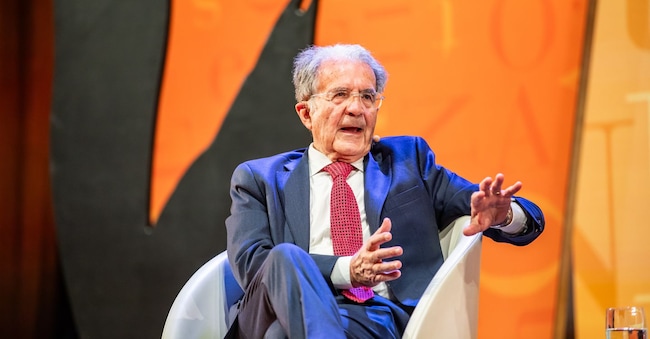
The proposal made by PD Secretary Elly Schlein to Prime Minister Giorgia Meloni to join forces on energy and climate is a matter of common sense. The European Union would be at risk if the AfD were to secure a majority in Germany. The stance taken by Virginia Libero, secretary of the Young Democrats (“we will not be the soldiers in your wars; for us, talking about the homeland means rejecting war; we will organise the deserters”) is at odds with the party line. The European Union is still struggling to implement the decisions it has taken. These are some of the issues touched upon by the former Prime Minister and former President of the European Commission, Romano Prodi, who spoke on the Radio24 programme “Immagini, uno sguardo sull’attualità”, hosted by Valentina Furlanetto with Riccardo Barlaam.
Schlein’s proposal to Meloni
‘Schlein’s proposal is one of absolute common sense,’ according to Prodi. The proposal on climate change had been criticised by some of Schlein’s allies. Prodi pointed out, however, that ‘the content of the proposal is, in my view, quite fair because we are facing a staggering national emergency that affects everyone; take, for example, how this emergency has unfolded: ultimately, it also led to the proposal to abolish road tax; it affects everything, so the idea that it can be tackled in a somewhat collaborative way – given that, in my view, it stems from an external threat – strikes me as common sense.”
Virginia Libero’s statements and the party line
Prodi commented that the position expressed by the secretary of the Young Democrats “I don’t know how it can be reconciled with the party’s policy”. ‘When I heard her,’ added the former prime minister, ‘I said let’s hope she matures, because if there’s one person who has always fought for peace, it’s me; but here we are faced with a very clear choice, a policy dictated by a series of circumstances that have led to an unimaginable war. I do not see how a position of this kind can be reconciled with the party’s policy; I believe this is a statement that falls outside the framework of the PD’s agenda, and therefore a proposal that does not come from the PD and has never even been discussed within the PD, as far as I am aware; so let’s take it as a slip of the tongue, as Topo Gigio would say.”
The AfD: a wild card for the future of the European Union
“If the AfD were to come to power,” Prodi told ‘Radio 24’, “those values would go to hell, as the saying goes, because the AfD has different values. But bear in mind that these elections are a major warning sign; however, they concern the whole of eastern Germany, which is going through a period of particular tension, almost a sense of inferiority compared to the former West Germany, so let’s not generalise, even if the danger is spreading across the whole country. You’ve asked me a question that I must answer very simply: if the AfD were to secure a majority in the European Union, it would quite simply be over. I can’t comment any further because this is the reality – it is anti-European, it is overwhelmingly opposed to multinational institutions, it is nationalist, it is racist, there would be nothing left of Europe. Since Germany is not only Europe’s most important economic power, but – ever since the war in Ukraine began – has put in place a programme whereby it will become the greatest power – as the Chancellor himself has said – both militarily and politically; if this were to happen, my answer is very simple: it’s the end of Europe, full stop.’
The difficulties of implementing decisions that have been taken
“The problem with Europe – and this was the whole point of von der Leyen’s fine speech – is that fine speeches are made and then that’s as far as it goes, because the decision-making processes are incapable of implementing the decisions taken,” Prodi went on to remark on the Radio 24 programme. “The Canadian Prime Minister’s speech was perfect; it inspired everyone. It was well followed up during the meeting in von der Leyen’s address. However, I mean, the problem here is putting it into practice. In other words, it must be concrete; it must be based on facts. For example, the proposal to establish some sort of institutional link between Canada and the European Union – the specific arrangement that was put forward simply does not exist. So, in my view, we need to work on this, fully aware of its importance, because otherwise Canada will become a colony of the United States, drifting away from Europe; but the path ahead is a long one, and above all, I don’t think Europeans are particularly enthusiastic or in agreement.” Is the problem the unanimity veto? ‘The unanimity veto, but also in cases where there is no veto,’ he explains, ‘everything has shifted to the Council. In short, the Commission has become a body that makes proposals and then stops there; and secondly, the Commission ends up taking refuge in multiplying regulations and investigations – in other words, many things over which it has competence and which, in a way, substitute for the aspects that have already slipped through its fingers. That is the problem.”

