
Election rumours and speculation

Propaganda from the former regime is promoting Aisha Gaddafi ahead of the vote in Libya

The former leader’s daughter has received 141,502 votes in an online poll organised by local media and Al Arabiya. Following the killing of her brother Saif al-Islam, groups linked to the family are calling for her to take over the leadership. However, there is no official candidacy.

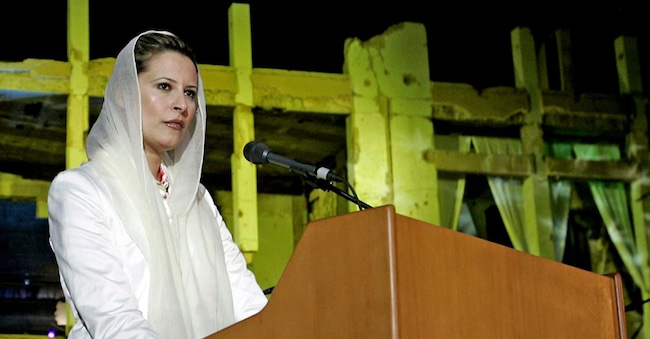
Aisha Gheddafi, figlia dell’ex leader libico Muammar Gheddafi Ansa

5' min read

Translated by AI
Versione italiana

5' min read

Translated by AI
Versione italiana

The name of the Gaddafi family is back at the centre of Libyan politics. Aisha, daughter of former leader Muammar Gaddafi, has come top in an online poll on the ‘best candidate’ to lead the country, whilst calls are mounting amongst supporters of the former regime for her to take the helm of the movement following the death of her brother Saif al-Islam. This is according to Al Arabiya TV.

The final results of the September vote show that Aisha received 141,502 votes out of 549,954 cast, giving her a lead of 30,227 votes over her nearest rival. This represents around a quarter of the total. However, the platform has clarified that the poll is not official and does not constitute either an election or a referendum: an essential distinction to ensure that an online result is not treated as a measure of national consensus. In short, a good dose of propaganda

Loading...

Succession within the movement

According to the article by Al Arabiya, calls for Aisha to take the lead are coming from various factions within the political sphere linked to the former regime. The organisation ‘Women of Fezzan’ has announced its support, whilst a similar statement has been issued by the group ‘Free Women of Fezzan’. The ‘National Popular Movement’, linked to Saif al-Islam, has declared its allegiance to Aisha, asking her to lead the movement and continue the path set out by her brother.

Ashraf Abdel Fattah, a member of the Supreme Tribal Council, told Al Arabiya and Al Hadath that large sections of the movement consider Aisha to be the ‘most suitable’ figure to take the helm, given the respect she is said to command amongst tribes, cities and supporters of the former regime. This assessment was expressed by a source favourable to her leadership, not an independent survey of public opinion. Abdel Fattah himself emphasised that whether she accepts or declines this role will depend on Aisha’s personal decision.

The killing of Saif al-Islam last February, as reported in the article, has left a void in this political sphere. For years, the son of Gaddafi had been the main figurehead for the project to bring back representatives and supporters of the old regime onto the political stage, particularly following his candidacy in the 2021 presidential elections, which did not take place. The initiatives in support of his sister therefore primarily concern the succession to the leadership of a movement, not a bid for the leadership of Libya.

Aisha’s message

Aisha commented on the result in a statement on behalf of the Gaddafi family. She argued that the election ‘cannot be reduced to numbers’: behind every vote, she said, lay support and responsibility. Above all, the message seeks to overcome the political divisions that have solidified since the fall of the regime. ‘We must move beyond the rhetoric: “I am from the September camp and you are from the February camp”’, she said, contrasting rival allegiances with the idea of a single ‘camp of the homeland’. The reference is to political identities built around the former regime and the 2011 uprising. In his speech, the call for reconciliation therefore goes hand in hand with acknowledging the support received. It does not, however, constitute a government programme.

The Arabic-language report published by Jawhara FM adds two further points. Aisha has asked the organisers not to include her name in future votes, ‘to leave a little hope for those striving to win’. She also responded to objections against female leadership with a question: “In all these difficult years, where has prosperity been?” These statements demonstrate her presence in the public debate, but do not amount to an acceptance of calls for her to take on a political role.

The figures and social media

The consultation involved more than thirty prominent figures from Libyan political, military, economic and public life. The Tunisian daily Al Horria highlighted the scale of the reported turnout and the winner’s margin of victory. These figures describe the result within the platform, without allowing it to be automatically extrapolated to the Libyan electorate.

The sources consulted do not provide sufficient information on the methodology used to classify the vote as a representative poll. There is no evidence of a sample of the population, the geographical distribution of participants or procedures to verify that each vote was cast only once. Furthermore, the platform’s own disclaimer distinguishes inclusion in the list from a declaration of candidacy and from the verification of legal requirements for holding public office.

The rise in support had also been highlighted on Arabic-language social media. On 22 September, the Libya Press account on X reported a result that was still provisional: 87,891 votes for Aisha, compared with 61,523 for Mohamed Sawan, 47,727 for Saddam Haftar and 37,034 for Ismail al-Shtiwi, out of over 293,000 votes cast. These figures relate to an interim stage and should not be confused with the final results.

Loading...

The post presented a favourable view of Aisha, contrasting her symbolic significance with the positions of power associated with other contenders. Among the visible replies were also sceptical comments regarding the return of the Gaddafi family to public life. The discussion documents conflicting reactions, but does not provide a sample against which to gauge the attitudes of Libyan society.

From visibility to power

The return of Aisha to the media spotlight follows on from a previous political appearance. In November 2021, she had backed the presidential candidacy of Saif al-Islam with a message picked up by the Arab press and the social media channels of Al Arabiya. Her current demands mark a shift: no longer merely support for her brother, but the possibility that she might personally take on the role of representing that region. The outcome remains to be seen.

The issue also arises within an institutional framework that remains divided. On 4 October, according to the Arabic website Ean Libya, the United Nations mission reported on a meeting in Tunis, chaired by Special Representative Hanna Tetteh, concerning the consequences of the division within the judiciary for the electoral process. The participants indicated that overcoming this rift, whilst respecting judicial independence, was necessary to guarantee the integrity of the elections and the acceptance of the results.

Online voting and appeals from supporters therefore raise two distinct issues. The first is who will lead the political faction linked to the former regime following Saif al-Islam. The second is what conditions will enable that same faction, alongside other Libyan forces, to compete in a recognised electoral process. For Aisha Gaddafi, the decisive step remains the possible decision to transform her symbolic presence into a direct political role: a decision which, according to available sources, has not yet been announced. In short, we are left with rumours and speculation in a Libya that remains in turmoil.

Copyright reserved ©
Loading...

Brand connect

Loading...

Newsletter

Notizie e approfondimenti sugli avvenimenti politici, economici e finanziari.

Iscriviti