Spain

Sanchez calls for early elections: ‘The choice is between going backwards with the far right or moving forwards’

The Spanish Prime Minister has announced that a snap election will be held on Sunday 29 November

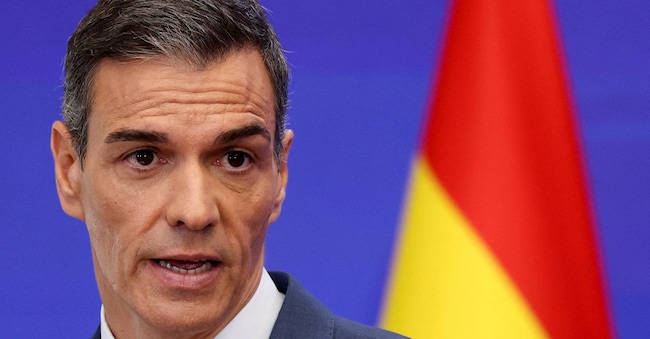
Pedro Sanchez  EPA

4' min read

Translated by AI
Versione italiana

4' min read

Translated by AI
Versione italiana

Spanish Prime Minister Pedro Sánchez has called a snap election: Spain will go to the polls on 29 November 2026. Following the rejection in Congress of the two housing decrees, the Spanish Prime Minister spent the weekend consulting with ministers and Socialist Party leaders, whilst in the squares of Bilbao, Salamanca and Oviedo, the jingling of keys — which has become the symbol of the protest against evictions and the housing crisis — accompanies calls for new measures and, increasingly, for a general strike as well.

“I have decided to convene the Council of Ministers today to dissolve Parliament and call a snap general election on 29 November,” said Spanish Prime Minister Pedro Sánchez in an official statement from the Moncloa Palace.

Loading...

Spagna, il Sindacato degli inquilini in piazza per il diritto alla casa

Photogallery24 foto

Sanchez: ‘Courageous measures have been approved on housing’

The Spanish government “has approved bold measures to safeguard the constitutional right to housing”, said the Spanish Prime Minister, Pedro Sánchez. “We have striven to build a better world for our fellow citizens,” added Sánchez, “by fighting the speculators who want to destroy the future of our sons and daughters in order to boost their own profits.”

Sanchez: ‘We’ve had so many successes over the years, despite facing the toughest possible opposition’

In his speech announcing the snap election, Spanish Prime Minister Sánchez outlined his government’s economic and social achievements, such as progress in renewable energy, social rights and the reduction of inequalities. He recalled having to face unprecedented crises, such as wars and geopolitical upheavals, and having ‘fought against tyrants, techno-oligarchs and genocidal regimes’.

He also criticised the need to contend with the ‘worst possible opposition’ – that of the Vox and PP parties, which have even questioned his legitimacy. The latter, the People’s Party, reacted with a terse “at last” to Sánchez’s announcement that he was bringing forward the election to 29 November. In a social media post, they accompanied the announcement with a promotional video featuring Beethoven’s ‘Ode to Joy’, in which they state that they will ensure justice.

Spagna, ancora proteste contro le speculazioni nel mercato delle case

Sanchez: ‘The choice is between going backwards with the far right or moving forwards’

“The time has come for you, the people of Spain, to decide what future you want for yourselves and for your country: whether you want to join the wave of the far right, which is causing regression wherever it governs,” or whether “you want Spain to continue to be a bastion of openness and social justice”, “whether you want the country to regress or to continue to move forward,” added the Spanish Prime Minister.

The PSOE’s pressure and social tensions

According to El País, the decision is said to have been reached following a weekend of reflection during which Sánchez is reported to have assessed both the internal balance of power within the PSOE and the growing social pressure. Within the party, in fact, the majority is said to be pushing for an immediate vote, viewing the mobilisation over the housing issue as a political opportunity to turn the parliamentary defeat into an election campaign. The Socialists’ reasoning is that, following the ‘no’ vote by Junts – Carles Puigdemont’s right-wing Catalanist party, which joined the People’s Party and Vox in voting ‘no’ in the Chamber against the decrees – it is becoming increasingly difficult to envisage a full parliamentary year without a new budget law and with a parliamentary majority capable of supporting the government’s actions.

The issue of housing, which is mobilising millions of Spaniards, offers the PSOE the chance to accuse the right-wing parties and Catalan separatists of having prevented the government from taking action on the housing crisis. “Now there is an opportunity,” is therefore the conviction gaining ground within the party. A strategy that would allow the Prime Minister to present himself not merely as the head of a government defeated in Parliament, but as the leader asking the Spanish people for a stronger mandate to govern. The scenario, which the Prime Minister’s ‘inner circle’ at Moncloa is said to have been working on over the last 48 hours, is a more complex and politically daring solution: to call an election and, at the same time, reintroduce at least some of the housing measures via a new decree. This is the scenario reported by *El Independiente* and also analysed by *El País*. The dissolution of the Cortes would not, in fact, prevent the government from carrying out its duties and adopting new decree-laws until the elections.

The difference would lie in the ratification procedure. With Parliament dissolved, the ratification vote would move from the plenary session of Congress to the Permanent Deputation, the body which exercises some of the functions of the Houses during the dissolution period. Here, the required majority would be 35 votes out of 69. The PSOE and Sumar, the parties in the governing coalition, control 31 of these and would therefore need a further four votes. These could come from EH Bildu, ERC, Podemos and PNV, parties which had already supported the first decree on protection against evictions. In this scenario, Junts’ vote against the measure would become irrelevant.

The anti-eviction shield

A strategy that would allow Sánchez to reintroduce at least the so-called ‘anti-eviction shield’ even whilst the Cortes are dissolved, offering a concrete response to the pressure from the streets. The Prime Minister could thus present himself to the electorate both as the head of government calling the country to the polls and as the leader who, right up until the very last day, is attempting to tackle the housing crisis. It is a narrow path, but it could represent a possible way out of the crisis for Sánchez.

Loading...

Not least because the decision to go to the polls straight away would have a further advantage: it would prevent the PP and Voz, in opposition, from dictating the narrative of the campaign by focusing it on the migration crisis in Ceuta or on the investigations into alleged corruption involving Socialist leaders, or even on the forthcoming trial before a jury of Begona Gomez, the Prime Minister’s wife. The stakes are high. And the PP is just waiting for the election to be called. Its leader, Alberto Núñez Feijóo, argues that Spain has “the right to decide immediately” because “the country can’t take it any longer”. The progressive camp, on the other hand, appears more divided. The five ministers and leaders of Sumar have met and announced that on 17 October they will present the Frente Amplio’s candidacy for the forthcoming elections. Podemos, which has not yet decided whether to join a united list, is instead calling for the election to be avoided.

Copyright reserved ©
Loading...

Brand connect

Loading...

Newsletter

Notizie e approfondimenti sugli avvenimenti politici, economici e finanziari.

Iscriviti