

Radiologists: how artificial intelligence frees up time for building relationships with patients
It’s not just about tests that need to be reported on, but an ever-increasing focus on the patient. Thanks to AI, the specialist remains at the heart of the diagnosis and treatment process.

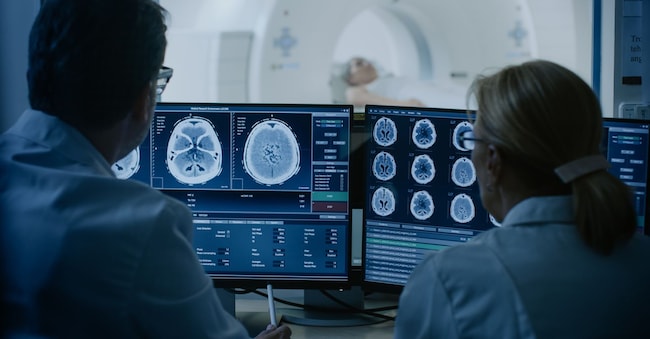
Mr Smith arrives at A&E with severe abdominal pain. There is no time to waste. Above all, it is essential to determine – through discussion and rapid diagnostic tests – whether emergency surgery is required. An abdominal ultrasound is carried out and, thanks to Artificial Intelligence, the radiological data is integrated with clinical information and laboratory test results. In this way, Mr Smith receives, in a very short space of time and with the appropriate human support from the specialist, a possible diagnosis and the recommended course of treatment. We are not on the set of a ‘medical drama’. We are in the reality of radiology research, as reported in *Nature Communications*, where researchers at the University of Colorado – Anschutz School of Medicine are using AI algorithms to make radiologists’ work increasingly efficient, whilst also allowing them more time for their patients.
What has been described so far is particularly relevant to the specialists attending the National Congress of the Italian Society of Medical and Interventional Radiology (SIRM), which opens today at the Allianz MiCo in Milan. This is because technology and data digitisation – going far beyond the analogue images of traditional X-ray films – are shaping a new professional role, with specialists becoming ever closer to their patients thanks to the time saved through the optimal use of Artificial Intelligence algorithms.
Key players in the care pathway
Radiologists are already key figures in a wide range of medical fields, from prevention and diagnosis to the formulation of treatment strategies. In short, they play a vital role in the interdisciplinary approach to complex medical issues. “In recent years, radiology has taken on an increasingly important role within the healthcare system,” emphasises Nicoletta Gandolfo , president of SIRM. Today, we are regular members of multidisciplinary teams and play a key role in defining diagnostic and therapeutic pathways. This entails growing responsibilities and requires a review of traditional organisational models, which must also take into account the time needed for consultation between specialists. During these two years of my presidency, we have worked hard to strengthen relations with other scientific societies (starting with AIOM) and with institutions, whilst also promoting interventional radiology and collaboration with radiography technicians. SIRM is becoming increasingly robust and well-structured, with over 13,000 members, 49 per cent of whom are women and 46 per cent under the age of 45. These figures demonstrate just how much our community has grown and renewed itself. We have invested in young people, expanded our international collaborations and strengthened radiology’s presence at key scientific and institutional forums.”
Beyond the interpretation of test results
Mr Smith’s story is, in some ways, emblematic of what is currently taking place. “We are entering a new phase in medicine, characterised by the complete digitalisation of processes,” notes Luca Brunese, president-elect of SIRM. Our discipline has undergone extraordinary transformations, moving from analogue imaging to digital and now to artificial intelligence. These technologies can reduce the time needed to analyse an ever-increasing number of images and support the reporting process. This is important because the time saved must be used to speak with the patient, explain the findings and answer their questions, thereby re-establishing a direct, personal relationship. This trend is already evident in breast imaging, ultrasound and interventional radiology, but will gradually extend to all sub-specialities. Let us also consider cancer patients, for whom diagnostic imaging is fundamental in diagnosing and monitoring the disease, or the management of emergencies, where the speed of radiological assessments can make all the difference. All of this also benefits the sustainability of the universal health service, and it is not true, moreover, that there are too many radiologists: in future, we will need more and more of them, not least because the demand for diagnostic services will continue to rise in the coming years. Technological innovation does not replace the doctor, but provides them with new tools to carry out their work to the best of their ability.”
Focus on training
These steps inevitably involve a level of complexity in their preparation that goes beyond the analysis of images and scans. For this reason, as Roberto Grassi, President of the SIRM National Congress, points out, “we have put together a high-calibre programme, with ample scope for discussion amongst specialists, research and technological innovations. A distinctive feature of this edition is also the organisational model: it is a fully self-sufficient congress, organised and managed at every stage by in-house staff, from programme planning to logistics, right through to hospitality and communications. This decision highlights our resources and demonstrates the scientific society’s ability to organise an event of this scale independently. Among the new features is the ‘Photon Hunt’, an interactive trail in the exhibition area dedicated to medical technologies and devices. Our aim is to offer a dynamic, engaging Congress that reflects both the present and the future of the discipline.”

