Public television

Rai: the Italiana and V/BE channels are coming. CEO Rossi: “Telemeloni? It’s just marketing”

Autumn programming schedules unveiled in Ancona. Rossi: “It was a mistake not to appoint Simona Agnes as chair”

from our correspondent in Ancona Andrea Biondi

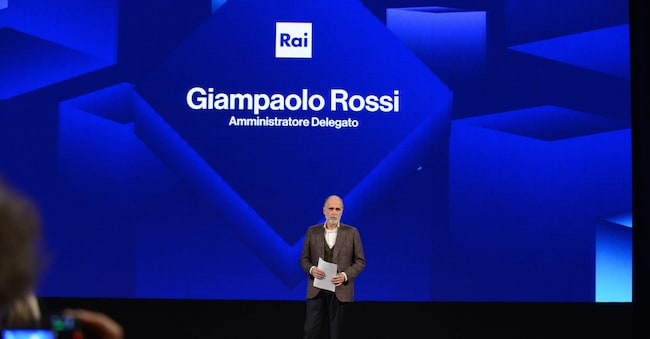
L'amministratore delegato della Rai, Gianpaolo Rossi, alla conferenza stampa di presentazione dei palinsesti, Ancona, 3 luglio 2026 ANSA

7' min read

Translated by AI
Versione italiana

7' min read

Translated by AI
Versione italiana

Two new channels, a new strategy to attract audiences moving away from traditional television, and an uncompromising defence of Rai’s management. And all this whilst the political row over the governance of the public service rages on.

The presentation of the 2026–2027 programming schedule, which took place at the Teatro delle Muse in Ancona, thus ended up becoming more than just the traditional showcase for the coming television season. It became an opportunity for the chief executive, Giampaolo Rossi, to reaffirm the company’s editorial line, reject the ‘Telemeloni’ label, defend the choice (which even he now, between the lines but without saying so openly, seems to regard as a thing of the past) to appoint Simona Agnes as chair, and to assure that the institutional upheaval that has engulfed the Parliamentary Supervisory Commission will have no impact on Rai’s day-to-day operations.

Loading...

The two new channels

Whilst the focus was supposed to be on the editorial offering, the main development lies in the launch of two channels, which, however, should now also be regarded as multi-platform projects: from 1 October, Italiana will make its debut – a new channel that will occupy channel 57 on digital terrestrial television and will be entirely dedicated to showcasing the region, its local productions, cultures and identities. From 1 January 2027, however, Rai Gulp will be replaced by V/BE, a new brand aimed at children aged between 8 and 14, situated on channel 42, with the aim of winning back this audience segment, which is increasingly drawn to digital platforms.

These are two very different projects, but Rossi presents them as part of the same industrial strategy: to strengthen the public service’s mission without simply trying to keep up with commercial television.

“Italiana,” says the CEO, “was created with the aim of portraying the real Italia in its territorial, cultural and productive dimensions, developing a narrative that is both rooted in our identity and modern, capable of showcasing a unique heritage and making it accessible across different media. “We are Europe’s leading broadcaster in regional storytelling, and this new channel will showcase our country’s extraordinary richness through a distinctive and highly recognisable offering.”

For Rossi, V/BE also represents more than just a simple revamp of the children’s programming. “Rai is aiming to overhaul its Kids programming – a radical change – with a new brand, V/BE, created with the aim of directly engaging the pre-teen target audience, children aged between 10 and 14, whilst at the same time, in an aspirational way, reaching out to younger children from the age of 8, and building a programme designed to be shared – that is, capable of speaking to the whole family in a way that reinforces the relational value of the content.” The chief executive emphasises one point: “These are not mere revisions. They are paradigm shifts.”

Why Ancona

The choice of this town in the Marche region inevitably gives rise to political interpretations. Some point out that the Marche is one of the regions where Fratelli d’Italia has built up a significant portion of its support, and see the venue for the presentation as carrying symbolic significance. Rossi, however, offers a completely different explanation.

The idea, he explains, is to showcase Italia even beyond Rai’s traditional production centres, putting the spotlight on regions that reflect the real country. It all starts here, in the capital of the Marche region, which, thanks to the shape of its elbow-like promontory, has the unique feature of allowing one to watch both the sunrise and the sunset over the sea from the same side.

Telemeloni? Rossi’s response

The launch of the new channels inevitably raises a question that has now accompanied every public appearance by Viale Mazzini’s top management for months: is Italiana the symbol of a Rai that is increasingly defining its identity? Is it the channel of so-called ‘cultural sovereignty’? Rossi firmly rejects the label. ‘Telemeloni is a brand we’ve carried with us, and I continue to regard it as an extraordinary marketing campaign, which, as such, when it works, is replicated endlessly. The effort made at Rai in recent years has been to create, as far as possible, a programme line-up capable of reflecting the diversity of narratives and the identity of our country and our nation.’ He adds a remark destined to enter the political debate. ‘Telemeloni is the programme that brought Roberto Benigni back to Rai. It therefore strikes me as a statement with little basis in fact.’

The CEO also rejects the opposition’s accusations that the editorial offering has been weakened. “To speak of a decline in programming seems to me to be a stretch. The best response to the controversy is the presentation you have seen today.” He also cites some figures in support of this: “The number of programmes and hours of investigative journalism has risen steadily, from around 400 hours in 2023 to nearly 700 in 2025. Rai has invested in news coverage by offering permanent contracts to 127 journalists who were previously on temporary contracts.”

The Vigilanza case and Agnes’s defence

Political wrangling inevitably finds its way into the Teatro delle Muse as well. The presentation of the programming schedules comes, in fact, less than twenty-four hours after the sensational dissolution of the Parliamentary Supervisory Committee, which was first depleted by the resignations of opposition members and then by those of the majority.

For Rossi, however, there will be no impact on the company’s management; indeed, he points to the results that have been achieved: the business plan and property plans, as well as the profit over the past year. ‘There is no element of instability in Rai’s governance. We have an acting chairman (Antonio Marano, ed.), a chief executive and a director-general. The board of directors is fully in control and the company is implementing the most significant business plan in its history.”

But the chief executive has not shied away from taking a stand on the failure to ratify the president-designate. ‘I would venture to say that I believe it was a mistake not to appoint Simona Agnes as president of Rai. I have known this organisation for twenty-five years and I believe that Simona would have been (he then corrects himself, saying ‘would have been’, ed.) an outstanding interim chairperson. She would have been far superior to previous interim chairpersons. I say this not for political reasons but for business reasons.”

The future of “Chi l’ha visto?”

Among the questions raised following the presentation of the programming schedules is one concerning the future of *Chi l’ha visto?*, following Federica Sciarelli’s announced departure. Rossi remains non-committal. “We’re still considering our options. We don’t have a name yet; it’s still too early to say. *Chi l’ha visto?* is a long-standing, fundamental part of Rai’s schedule, and Federica has left a very strong, positive and incisive mark, even within her editorial team. It’s a task we must approach with great care.” Standing beside him, Stefano Coletta – who had been mentioned in recent weeks as a possible successor to the journalist – gracefully steps aside. But he confirms that the rumours of him taking over were more than just speculation. “I wanted to present *Chi l’ha visto?*, because, of all the programmes I’ve written, it’s the one that suits me best. But I believe everyone must do their bit. I can’t say it isn’t a great disappointment, but Rai will have to find the best formula to carry on Federica’s legacy. The most authentic path cannot simply be a continuation of Sciarelli’s style, because she is inimitable.”

Amadeus and Monteleone

There was also a question about Amadeus’s possible return, to which Rossi gave a clear answer: “Any return by Amadeus is linked to an editorial decision, and this can be discussed calmly. I reject the idea that Rai is a closed organisation: Rai is full of top-class talent, including those who have replaced Amadeus, but Rai has also been able to welcome back in the past those who left, provided there was a convincing project on offer.”

Finally, a question about the controversy surrounding Antonino Monteleone’s latest post on Gaza. “All employees and contributors,” replied the CEO, “are required to comply with the code of ethics. There have been several cases: yesterday there was Monteleone’s, and before that Ranucci’s. These are cases where journalists use their social media accounts to express personal opinions. All we can do is ask for a sense of responsibility and restraint. I have never accepted a censorial role because freedom of expression within the limits of the law is of immense value, but individual responsibility comes into play.”

The advertising match

Alongside the editorial strategy is the commercial strategy, outlined by Rai Pubblicità’s chief executive, Luca Poggi. The advertising agency is celebrating its centenary by highlighting an ecosystem capable of reaching 98 per cent of Italians every month, supported by 24 million registered users on RaiPlay and around 20 million profiled contacts.

“We’ve turned 100; we’re Europe’s longest-running radio and television agency: that means we’ve delivered some results for our clients,” notes Poggi, who also highlights “the huge investment in the World Cup”, which managed to achieve “an average 40 per cent share among 15–24-year-olds” and forms part of that sports offering whose breadth has been emphasised by both the CEO of Rai Pubblicità and Rossi himself: “Since 2023, Rai has invested over 600 million euros in the acquisition of sports rights, both for regular events and major tournaments.”

For the CEO of the broadcasting company, the issue is no longer the contrast between traditional television and streaming platforms. “There are still those who regard Rai as a linear broadcaster. The reality is quite different. Every day, our ecosystem generates millions of certified interactions that translate into attention, trust and authentic relationships between brands and people.” This marked the end of a day which, at least in the intentions of the Viale Mazzini leadership, was supposed to be solely about television. Instead, inevitably, it ended up also addressing the all-too-close relationship between politics and a Rai that has always served as a barometer (and, in some ways, a harbinger) of what happens in the parliamentary arena.

Copyright reserved ©
Loading...

Brand connect

Loading...

Newsletter

Notizie e approfondimenti sugli avvenimenti politici, economici e finanziari.

Iscriviti