Public television

All-out war on the Rai Supervisory Board: all board members resign. Accusations fly between the majority and the opposition

Previously, members of the PD, 5Stelle, AVS and IV had left, as well as Chairwoman Floridia

by Andrea Biondi

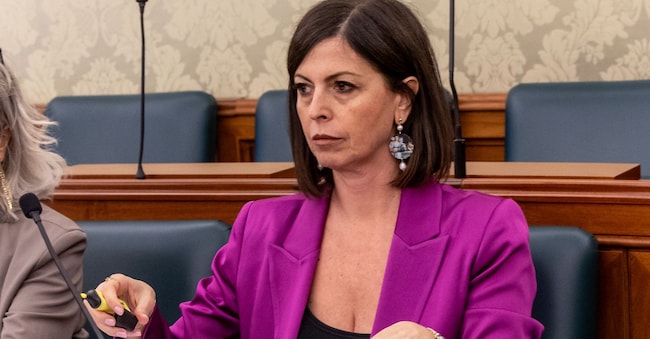
Barbara Floridia, presidente commissione vigilanza Rai,  in occasione dell’audizione del Ministro Giorgetti davanti alla commissione Ambiente, Lavori pubblici  sulla riforma della Rai. Senato, Roma Mercoledì 10 Giugno 2026  (photo by Mauro Scrobogna / LaPresse)  Barbara Floridia, president of the RAI Oversight Commission, at Minister Giorgetti's hearing before the Environment and Public Works Commission on the RAI reform. Senate, Rome, Wednesday June 10 26 2026  (photo by Mauro Scrobogna / LaPresse) LAPRESSE

4' min read

Translated by AI
Versione italiana

4' min read

Translated by AI
Versione italiana

It is all-out war on the Rai Supervisory Board. Following the resignation of the opposition members, the centre-right members have also chosen to step down. “We, too, like the opposition, are resigning from the Rai Supervisory Board, which has been taken over, hijacked and exploited in an irresponsible manner by the left. The left has cynically exploited the law on Rai, which requires a two-thirds majority to elect the Chair – a provision we have been trying to change over recent months.”

This is stated by the centre-right members of the Rai Supervisory Commission in a statement in which they add that ‘it is, in fact, anomalous that the President of Rai cannot be elected by a majority after a certain number of votes, a scenario which is, in contrast, provided for even in the case of the office of President of the Republic. And the opposition parties have, in fact, shamefully exploited this law, thereby preventing Rai from having a president despite the fact that one had already been nominated some time ago by Rai’s own Board of Directors’.

Loading...

Shortly before, the opposition parties had opted for the most high-profile move – the one that turns a deadlock into an all-out institutional crisis. All minority members of the Parliamentary Supervisory Committee for Rai have tendered their resignations. This mass resignation, unprecedented in political terms, involves MPs from the PD, M5S, AVS and Italia Viva, and strikes at the heart of the body responsible for overseeing the public service broadcaster.

Vigilanza Rai, Mattarella: Inaccettabile che la Commissione non possa esercitare i suoi compiti

Paralysed for over a year

This is yet another appeal – but this time in the most sensational form – to break the deadlock into which the Supervisory Board has been mired for over a year. The most pressing issue is the ratification of Simona Agnes as chair of Rai. The centre-right supports her, whilst the opposition opposes her. Consequently, whenever the election of the chair appeared on the agenda, members of the majority would walk out, bringing proceedings to a standstill.

The chairwoman Barbara Floridia, of the M5S, announced her resignation in very strong terms: “Today I handed my resignation as chair of the Parliamentary Supervisory Committee on Rai to the Presidents of the Senate and the Chamber of Deputies.” She added: “It is a painful but necessary and inevitable decision. I have had to acknowledge that staying on and speaking out has served no purpose. All that remains for me to do is to send a strong message in the face of the arrogance and unscrupulous use that this majority makes of the institutions and parliamentary committees.”

Rai, Floridia (M5s): "Giorgetti? Nodo riforma è l'accordo Lega-Forza Italia"

Along with Floridia, Vice-President Maria Elena Boschi and the other minority members of the bicameral committee are also stepping down. The message is addressed to the Speakers of the Houses, but above all to the majority: either the system is changed, or the Supervisory Committee will remain a mere sham – a committee that exists in name only, but is incapable of actually carrying out its duties.

The paradox is that Rai continues to operate without a fully appointed chairman. Acting as chairman is Antonio Marano, a senior board member and representative of the Lega. This is a practical, rather than a political, solution. It was precisely on this point that, on 14 April, the President of the Republic, Sergio Mattarella, issued a warning: ‘It is unacceptable that, after a year and a half, the national public service still lacks a proper structure for its administrative bodies and the Supervisory Commission is unable to carry out its duties.’

Rai, Ranucci: "Vigilanza bloccata è una pagina bruttissima, non funziona democrazia"

Since then, nothing has moved forward. Neither the black smoke nor moral suasion has produced an agreement. Now the opposition is raising the stakes in the crisis: no longer just complaints, press releases and fruitless summonses, but a walkout.

‘As members of the opposition within the Parliamentary Supervisory Committee for Rai, we have all tendered our resignations with immediate effect. This is a necessary political act, resulting from the paralysis that for months has prevented the Committee from fulfilling its oversight role, due to internal divisions within the majority and a management style that has effectively rendered its functions meaningless. This decision was reached following repeated, unheeded appeals to the Speakers of the Chambers, Ignazio La Russa and Lorenzo Fontana, and despite the call by the President of the Republic, Sergio Mattarella, for the full functioning of Parliament’s oversight bodies”, reads a joint statement signed by the now former opposition group leaders on the Rai Oversight Committee: Stefano Graziano (PD), Dario Carotenuto (M5S), Angelo Bonelli and Giuseppe De Cristofaro (AVS) and Maria Elena Boschi (IV).

‘Previews of the new programming schedules confirm the gradual decline of public service broadcasting: viewing figures and credibility are falling, pluralism and quality are diminishing, costly external contracts are on the rise, and the Media Freedom Act is being flouted. We believe that the Commission is no longer in a position to carry out its institutional supervisory role. Remaining within it would mean abdicating our role of democratic oversight and endorsing an increasingly partisan use of the public service.”

A radical choice, then. One which, even if it does not resolve the issue, at least breaks the deadlock – and in any case already casts it in a harsher light. Because whilst politics is preoccupied with power struggles, public service remains in limbo. And the Supervisory Board, set up to oversee matters, ends up being the most visible symbol of this paralysis.

Copyright reserved ©
Loading...

Brand connect

Loading...

Newsletter

Notizie e approfondimenti sugli avvenimenti politici, economici e finanziari.

Iscriviti