Climate

Heatwave: deaths at work under the sun in the Padua area. Milan brings forward the start of construction site work to 6 am

Finally, the three urban centres that remain in the yellow zone on Saturday are Cagliari, Catania and Messina.

aggiornato alle 18:20

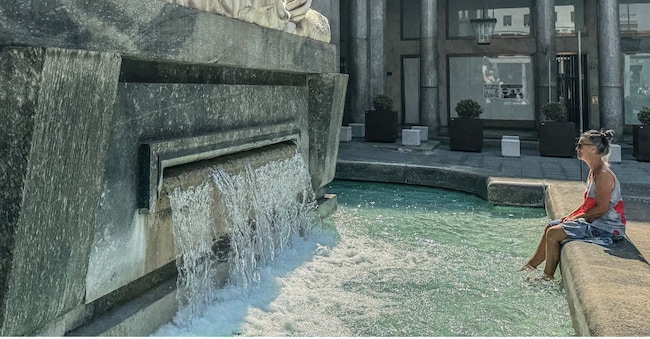
Caldo torrido a Torino, Italia - la gente cerca refrigerio nelle fontane giovedi 25  giugno 2026 ( foto Daniele Solavaggione/LaPresse)  LAPRESSE

4' min read

Translated by AI
Versione italiana

4' min read

Translated by AI
Versione italiana

The increase in the number of ‘red alerts’ has been confirmed, rising from 17 today to 18 on Friday 26 June, whilst the figure will remain unchanged on Saturday 27. This is according to the Ministry of Health’s heatwave bulletin, which takes into account 27 urban centres.

The red alerts, which indicate the highest level of heat risk for the entire population, are in force today in Ancona, Bari, Bologna, Bolzano, Brescia, Florence, Frosinone, Latina, Milan, Perugia, Pescara, Rieti, Rome, Turin, Venice, Verona and Viterbo. As expected, Genoa will be added to the list tomorrow and the day after. 

Loading...

The fact that the heat is intensifying is confirmed by the appearance in Saturday’s bulletin, , of six new orange alerts indicating a risk only to children, the elderly, people with disabilities and, in general, the most vulnerable: these are Campobasso, Civitavecchia, Naples, Palermo, Reggio Calabria and Trieste.

These urban centres are currently on ‘yellow’ alert (a pre-alert status for a possible heatwave) today and on Friday. Finally, the three urban centres that will remain on ‘yellow’ alert on Saturday are Cagliari, Catania and Messina.

Man dies at work in the sun; investigation into manslaughter underway

An investigation into manslaughter is underway following the death of Stefano Tonin, the 57-year-old labourer who collapsed and died last Wednesday whilst working on a building site in San Martino Lupari, in the Padua area. The investigation opened by the Padua Public Prosecutor’s Office, currently against persons unknown, aims first and foremost to clarify what role the extreme heat of recent days played in the man’s death, as he is reported to have worked all morning in the sun with temperatures reaching as high as 36 degrees.

It also remains to be seen why he was on duty during the time slot prohibited by regional legislation. According to the findings of the initial investigations, Tonin is believed to have fallen ill at around 2.30 pm, just before finishing his shift and returning home to his family. However, the order signed in recent days by the President of the Veneto Region, Alberto Stefani, to “protect the health and safety of workers most exposed” to the heat and sun, prohibits outdoor work between 12.30 pm and 4.00 pm on days when the Worklimate system indicates a high level of risk. And on Wednesday, precisely because of the high temperatures, the worker should have stopped work.

Tonin, who in the hours and days leading up to the tragedy had been working on a water supply system for a number of detached houses under construction, suddenly collapsed to the ground, without even having time to tell his colleagues that he was feeling unwell. Those who were near him at the time immediately came to his aid and called the emergency services, so that the 57-year-old could be taken to hospital as quickly as possible. But despite the prompt arrival of the ambulance and the air ambulance, there was nothing that could be done. Tonin never regained consciousness, and about an hour and a half later, the doctor had no choice but to declare him dead.

An autopsy – already ordered by Padua’s public prosecutor, Sergio Dini – will be crucial in clarifying the cause of death and the nature of the illness that struck the man at the end of his working day. The case is also being investigated by Spisal (the Occupational Accident Prevention Service) of the Euganean Local Health Authority (ULSS 6), which will need to verify Tonin’s working hours, his duties and the instructions given to him by the company in Castelfranco Veneto (Treviso) where he was employed.

Due to the heatwave in Milan, the opening of building sites has been brought forward to 6 am

Until 23 September, outdoor construction sites for public works or public utility projects in Milan will be able to start work at 6 am. Owing to the heat and the regional by-law prohibiting work – including on building sites – between 12.30 pm and 4 pm on days when high temperatures pose a risk, the City of Milan has in fact authorised an exemption from the noise limit values for this type of activity. However, contractors and site workers are asked to follow certain precautions: noisy machinery and equipment must only be switched on for as long as is strictly necessary and must be positioned, where possible, in areas of the site furthest from homes and ‘sensitive locations’ and to ensure suitable noise barriers are in place; machinery and equipment must be positioned in such a way as to prevent sound waves from travelling towards homes and those most exposed. Furthermore, particularly noisy operations must be carried out in phases at different times, thereby limiting noise not strictly related to the construction site’s work.

Drought: the River Po is struggling; the Great Alpine Lakes are crucial

The great Alpine lakes remain the last safeguard for water availability in the Po basin, but the water situation continues to deteriorate due to the exceptional heat and the persistent lack of significant rainfall. This is the picture that emerged from the extraordinary meeting of the Permanent Observatory on Water Use of the Po River District Authority, which today in Milan took stock of how the crisis is unfolding across the entire Po Valley District.

The most difficult conditions are being experienced in some areas of Piedmont, where the availability of water for irrigation is falling sharply and, in some catchment areas, water abstraction has been completely suspended. Containment and alert measures have also been put in place in Emilia-Romagna and Veneto. In Emilia-Romagna in particular, there have also been reports of sharp reductions in river flows and, in several cases, Apennine streams that have now run dry.

The situation is particularly worrying in the Po Delta, where the saltwater wedge from the Adriatic continues to advance. In the Pila-Venice and Goro branches, the intrusion of seawater has reached 16–18 and 18–20 kilometres from the mouth respectively, forcing the suspension of irrigation activities for agriculture.

Against this backdrop, Lombardy retains a limited capacity to manage its water resources, thanks in part to the expected contribution from irrigation runoff, albeit within a scenario that remains critical overall.

Copyright reserved ©
Loading...

Brand connect

Loading...

Newsletter

Notizie e approfondimenti sugli avvenimenti politici, economici e finanziari.

Iscriviti