
Red dot counter-exodus kicks off
A nearly 25 billion turnover summer is drawing to a close. At least 38 million Italians took a day's holiday

3' min read
3' min read
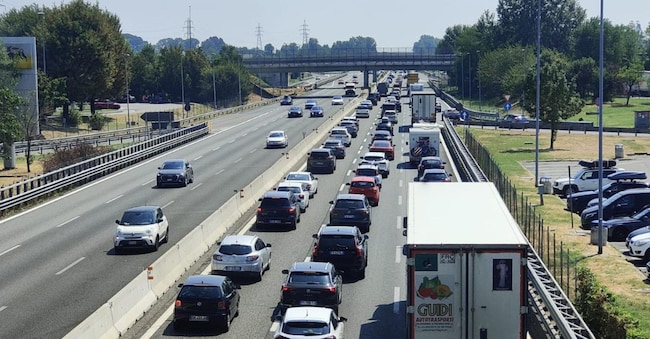
The big red-dot counter-exodus of summer 2025 is about to begin, bringing to a close a season in which 38 million Italians have indulged in at least one day's holiday at the seaside, in the mountains, the countryside and cities of art. On the Anas network this weekend, traffic will be mainly towards the large metropolises in the Centre-North and, according to estimates by the Anas Road Mobility Observatory, 12 million 255 thousand vehicle movements are expected. Viabilità Italia has announced a red dot on the afternoon of today, Friday 22 August, on the morning of tomorrow, Saturday 23 August, and the entire day of Sunday 24: there will be a sharp increase in movements towards large urban centres throughout Italy from holiday resorts. Anas has increased the commitment of personnel throughout the country and reduced the presence of construction sites. Until 8 September, 1,392 construction sites will be closed or suspended, around 83 per cent of those active (1,672).
The counter-exodus routes
.The routes affected by this weekend's counter-exodus will be northbound towards large cities from the Adriatic, Tyrrhenian and Ionian coasts, and along border crossings towards France, Slovenia and Croatia. Traffic may be intensified on the country's main arterial roads: the A2 'Mediterranean motorway' through Campania, Basilicata and Calabria; the state roads 106 'Jonica' and 18 'Tirrena Inferiore' in Calabria; the A19 'Palermo-Catania' and A29 'Palermo-Mazara del Vallo' motorways in Sicily; the state road 131 'Carlo Felice' in Sardinia State road 148 'Pontina' in Lazio, a particularly busy artery that together with state road 7 'Appia' ensures connections between Rome and the tourist resorts of lower Lazio; the E45 route (SS675 and SS3 bis), which covers Umbria, Tuscany, Emilia-Romagna and connects the north-east with central Italy; the SS1 Aurelia (Lazio, Tuscany and Liguria), SS16 Adriatica (Puglia, Molise, Abruzzo, Emilia-Romagna and Veneto). In the north, the motorway junctions RA13 and RA14 in Friuli-Venezia Giulia towards the border crossings, state road 36 'del Lago di Como e dello Spluga' in Lombardy, state road 45 'di Val Trebbia' in Liguria, state road 26 'della Valle D'Aosta' and state road 309 'Romea' between Emilia-Romagna and Veneto and state road 51 'di Alemagna' in Veneto. The ban on heavy vehicles is in force tomorrow Saturday, 23 August from 8 a.m. to 4 p.m. and Sunday, 24 August from 7 a.m. to 10 p.m. "Italians are starting to return home from their holidays to resume their daily routines and work activities," explained Claudio Andrea Gemme, managing director of Anas. "I invite everyone to drive carefully: it is essential to ensure road safety. The melancholy of the end of the holidays and the desire to get back to one's destination quickly can lead to risky behaviour: according to our latest survey on driving styles, for 51% of Italians it is not dangerous to exceed speed limits. 11.4 per cent believe that 'you can do something else while driving', while only 55.4 per cent are convinced that road accidents are due to incorrect behaviour.
Summer 2025 accounts
.According to Coldiretti/Ixè, the overall turnover in summer 2025 amounts to 24.6 billion with an average per capita expenditure of 648 euro. In detail, 33% of tourists - underlines Coldiretti - stayed below 500 euros of expenditure and 47% between 500 and 1000 euros, 17% between 1000 and 2000 euros while only 3% exceeded this limit..
More than a third of the travellers (34%) limited themselves to a short stay, between four days and one week, while another 25% indulged in a longer break, between one and two weeks. In contrast, 13% limited themselves to a maximum of three days. The overall average duration stood at 9.7 days, two days less than a decade ago, according to Ixe' data. Even in the summer of 2025, food was confirmed as the absolute protagonist of tourist spending in Italy: one third of the holiday budget was allocated to food, even surpassing accommodation costs. Thus food and wine tourism not only represents the main channel for promoting local specialities, but also constitutes an engine of growth for territories. Much of the prospects for economic and employment development," Coldiretti emphasises, "in fact passes from the ability to highlight the immense food and wine and cultural heritage of the country. According to the survey, almost four out of ten Italians (39%) have taken part in activities such as tastings, guided visits to wineries, oil mills, cheese factories or breweries, and cooking courses. In this perspective, an essential role is played by agritourisms, a constantly growing phenomenon with more than 26 thousand active structures on the national territory, which have recorded excellent results this year as well.

