
Referendum, the map of the Catholic vote (divided between Yes and No)
In the variegated world of both secular associations and the various religious institutions present in Italia, some have taken sharper and others more nuanced positions

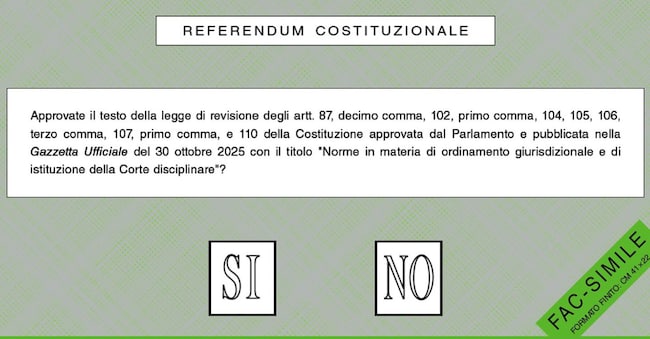
Catholics for Yes and Catholics for No. The strong appeal to participate in the forthcoming referendum on justice on 22 and 23 March launched by the president of the Italian Bishops' Conference Matteo Zuppi at the solemn opening of the proceedings of the last bishops' council, left the field open to the variegated world of both Catholic lay associations and the various religious institutions present in Italia, with some taking sharper positions and others more nuanced.
Opposite face
Monday's 'positioning' of the Jesuits through their magazine of reference, 'Aggiornamenti sociali'. "The separation of powers envisaged in the Constitution is too fundamental a value to risk endangering it," wrote the director, Father Giuseppe Riggio. "This is why the choice to safeguard it in the face of uncertain prospects on the subsequent normative steps orients us towards a negative vote on an issue that can be dealt with in other ways and in other forums". On a similar line, even if not expressly for the No vote, is Catholic Action. In a letter on the matter, the national presidency, recalling that there is a plurality of souls in the Association, emphasised, in the wake of the Italian Bishops' Conference, the encouragement for participation. Then, more fundamentally, the topic of constitutional architecture with balances that are maintained with the separation of powers was taken up. 'We wish, once again,' we also read in the letter sent to all members, 'to represent our unease and deep regret in verifying how a matter that concerns the founding pact, which describes the common rules, returns to being an occasion for division and confrontation rather than an opportunity for dialogue'. With these premises, meetings and seminars were also promoted by Fuci, the Italian Catholic University Federation, and Meic, the Ecclesial Movement for Cultural Commitment.
For Yes
On the other hand, those who sided decisively for the Yes vote was the Network of Catholic Associations 'Say it on the Roofs': the grouping of more than one hundred associations including well-known acronyms such as the Movement for Life, Family Day, the Rosario Livatino Committee and many others, with a conservative orientation and close to government positions. Here the choice for the 'yes' vote was motivated in the name of the non negotiable principles as Benedict XVI had defined them, that is, the so-called ethical issues: issues ranging from the end of life to egalitarian parenthood, passing through assisted fertilisation to gay unions, in which the judiciary is deemed to have overstepped the legislative power of Parliament. Abusing, in the words of one of the promoters of the Committees for Yes, Maurizio Sacconi, of 'creative justice'.
Personal positions
In the background remain personal positions that have caused much discussion, such as that of the vice-president of the Italian Bishops' Conference, Monsignor Francesco Savino. The prelate has made it clear on several occasions that he did not want to launch explicit appeals for a Yes or a No vote, but many have read that he wanted to recall the figure of the (Catholic) constituent father Giuseppe Dossetti in the context of the referendum.

