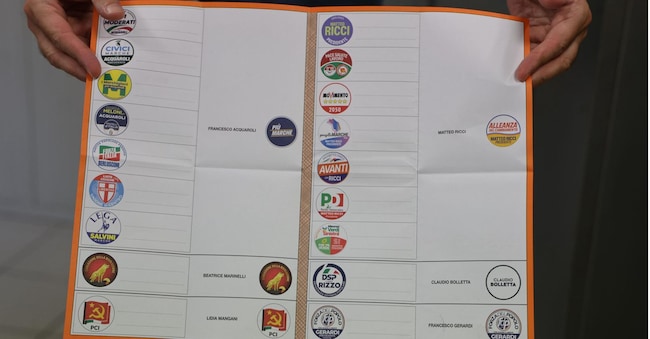
Seven regions on the ballot
There are seven regions where the vote will be held this autumn: Calabria, Campania, Marche, Puglia, Toscana, Valle d'Aosta and Veneto. As mentioned, we start with Valle d'Aosta on 28 September and Marche (28 and 29 September). Then it is the turn of Calabria (5 and 6 October) and Tuscany (12 and 13 October). In Campania, Veneto and Apulia, the dates chosen are 23 and 24 November. The outcome of the vote in the Marches and Valle d'Aosta may act as a driving force in the other territories.
Candidates in the Marche
The challenge in Marche will be played out between the outgoing governor Francesco Acquaroli (Fdi and loyalist of premier Giorgia Meloni) and the centre-left challenger Matteo Ricci, Dem Euro MP and former mayor of Pesaro. The PD is aiming to win back together with the allies of the wide field (from Iv to M5s, but without Action) the former red region that first went to the right five years ago. The election campaign had a clear national imprint, with Meloni herself, together with her deputies Antonio Tajani (Fi) and Matteo Salvini (Lega) going to Marche to directly support Acquaroni. PD secretary Elly Schlein and party president Stefano Bonaccini also went up to lend Ricci a hand.
-U44737334556hWS-600x313@IlSole24Ore-Web.jpg)
Regionali nelle Marche, Acquaroli ha votato a Potenza Picena

Regionali nelle Marche, Ricci ha votato nel seggio a Pesaro
The Veneto node
.For the centre-right, the outcome of the vote in Marche is closely linked to the choice of candidate in Veneto. Acquaroli's defeat would increase the pressure on Meloni to nominate a candidate from her party in Veneto: Fdi, despite being by far the leading party in the breakfast party since 2022, has only two regional governors (precisely in Marche and Abruzzo). If, on the other hand, she were to confirm Acquaroli, she could leave the field open to a candidate from the Lega, postponing the game to conquer a northern region until 2028 (when the vote will be held in Lombardy).
Wide field in the centre-left
Schlein has already achieved so much, succeeding in forging an understanding with the M5S in all the regions on the ballot, with an alliance involving all centre-left parties except Action. The eye is above all on the politics of 2027: the only hope to prevent the centre-right from winning is to close the widest possible alliance, especially to win as many uninominal constituencies in the South (unless the electoral law changes). A victory in Le Marche, but also a defeat after a confrontation to the last vote, would strengthen this strategy
In Valle d'Aosta
.There is great uncertainty in Valle d'Aosta. In the small Alpine region there is no direct election of the governor, who is elected by the renewed regional council (35 members) at its first meeting, in this case scheduled for the end of October. Should the centre-right win, barring any surprises (linked to the number of preferences obtained), the favourite to occupy the president's chair is Alberto Zucchi, regional coordinator of Fratelli d'Italia, director and the glue of the 'united centre-right' in Valle d'Aosta, an operation that has not been easy given the proportional system. A united push also came from Rome, which in case of victory would be a further arrow in Meloni's bow. The other scenario is the victory of a majority that is either only autonomist (Union valdotaine and Autonomists of the centre) or autonomist-progressive (with the support also of the PD). The Union valdotaine aims to confirm itself as leader of the coalition and take the presidency of the region.