
Renault and Ford allied on electric cars and commercial vehicles with production in France
The French group and the Oval Blue sign an industrial agreement. Ford will develop models based on Renault's technology and plants

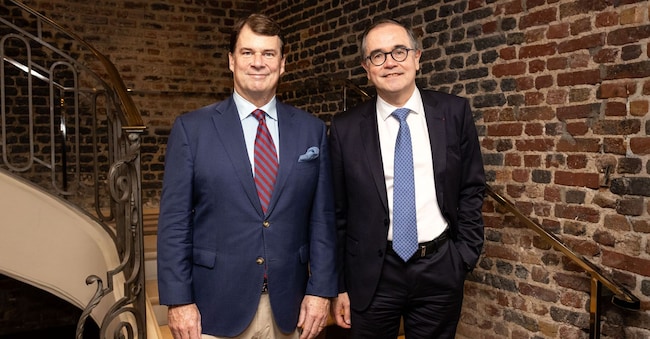
Renault comes to Ford's rescue in a sales slump and with an ever-shrinking range. The French group and the house of the Blue Oval have announced a partnership to develop two separate electric vehicles with Ford brand built on the Ampere platform family (that of the R5, Twingo and Rg for example). The cars will be produced by Renault Group in northern France, demonstrating the cutting-edge industrial expertise and experience of Ampere's ElectriCity Centre. For Ford, it is a strategic alliance because the Oval is facing a difficult period. Last year, 4,000 redundancies were announced in Germany. Over the past five years, the range, sales and market share have shrunk considerably. Now the share stands at 3% with just over 260,000 cars registered in the EU, while in 2019, pre covid, Ford was close to one million cars sold in Europe with a market share of 6.2%, only to fall in the following years inexorably and in direct relation to an ever shrinking offer.
Designed by Ford and developed with Renault Group, these two vehicles will, according to a note, offer Ford's authentic DNA, including in the user interface and technical and dynamic features, and indeed the assumptions should not be those of a sterile operation ofBadge Engineering, This is the first phase of a new and ambitious product offensive by Ford in Europe. The first vehicle is scheduled to arrive at dealers in early 2028.
The partnership with Renault follows the one, later cancelled, signed with Volkswagen for the sharing of the Meb platform for lithium-ion cars that led to the birth of cars such as the Ford Explorer and the coupe derivative, two cars that have not yet conquered the market. In fact, Ford, like other manufacturers, decided to go all-in on electrics, which turned out to be a disaster, not least because the attempt to change the brand's positioning in Europe only resulted in a haemorrhage in sales (saved only by commercials such as the Tourneo and Transit). In July 2027, the Blue Oval ended production of the Fiesta, a European best seller for five decades with 16 million cars sold. There are no longer any large-volume cars in Ford's range and only a few weeks ago it stopped assembling the Focus. On the contrary, Renault, with Dacia, is pursuing a dual-track strategy: lots of electrics and lots of thermals, including electrified ones. And it is no coincidence that it recently launched the sixth generation of the Clio, which historically was born to compete with the Fiesta. And by the way, in a market that demands small cars and hybrids, being discovered in this area for Ford has proved to be a disaster, since dealers have not queued up to buy the American electric Mustang Mach-E, nor the 'Fordswagen' Explorer and Capri.
At this point a question arises: will the alliance with Ford stop at the boundary of the synergic sharing of AmpR platforms or will it continue on the hybrid front where Renault is strong thanks also to Horse, the joint venture with the Chinese of Geely, those who are in charge at Volvo. Jim Baumbick, the new president of Ford Europe, in response to a direct question from Il Sole 24 Ore on the hypothesis of an expansion of the partnership with Renault, seemed more than a little possibilistic beyond the usual caution and sibylline answers. "Ford,' said Baumbick, 'believes in and is committed to multi-energy vehicles. An answer that therefore opens up the possibility that there could be developments in Ford's relationship with Renault, which in turn needs allies and to share architectures (especially after the Volkswgen group's refusal to ally itself on small electrics). It is difficult to imagine the return of the Fiesta, but perhaps someone is already imagining a version of the hybrid Clio with the Ford logo, or extended range and super hybrid cars in the category of a Kuga developed with the help of Renault/Horse. After all, Ford, like other large 'traditional' manufacturers, faces the competitive threat from China.
Moreover, at the same time as announcing the pact with Renault, Ford declared the guidelines for the next stage in its drive to profitably relaunch its European operations: building a profitable business. The strategy is based on two pillars: defending the leadership in commercial vehicles and Ford Pro services, and launching a new electrified range of cars.


