Half-yearly

Renault, Bmw and Volvo on the podium. Here's why they win (for now) in 2024

The current year is putting the plans of the major automobile manufacturers to the test. The analysis by Vittoria Ferraris (S&P Global Ratings)

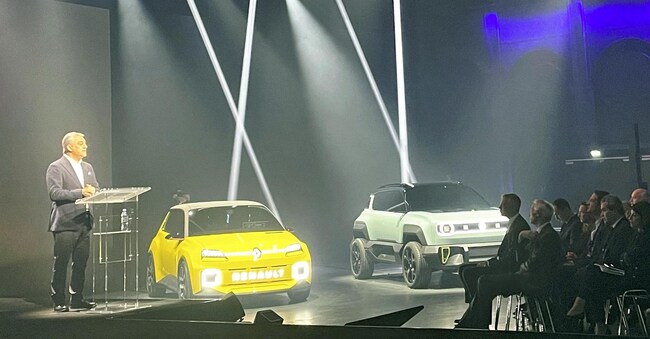
Luca de Meo, ceo di  Renault Group. (AFP)

5' min read

5' min read

The European car industry, and not only, has archived the first half of 2024. A year that is testing the resilience of the major western players, excluding the Chinese giant BYD, which has so far played a different game. And which is likely to continue in the same vein, given the recent agreement for a new production site in Turkey. Safe from new heavy tariffs. Who, then, are the continental winners at the halfway mark? Which manufacturers are facing the biggest obstacles? And what is the broader scenario?

Three names stand out above the rest, each different from the others and each with their respective caveats. Renault continues the brilliant turnaround started four years ago. The French manufacturer has clinched its record in operating margin, making innovation, flexibility and speed of execution, with development time reduced by 40%, its best weapons. But the market for the Renault brand is still too concentrated in Europe and could more easily fall victim to regulation. Then Bmw, premium world. The first six months' results showed declining revenues and profitability in an increasingly challenging environment, but Munich's electric cars are doing better than their European competitors. Now, however, there is the risk of tariffs, if they are confirmed, for imports from China, like the Mini.

Loading...

The first three: strengths but not only

.

"Renault," comments Vittoria Ferraris, Sector Lead Automotive Emea at S&P Global Ratings, "has benefited from a European market that, apart from Germany, where it has a relatively small market share, is expressing lively demand. The operating margin of the car segment continues its uninterrupted growth, driven by traditional engines and the hybrid, while the pure electric component still remains modest in the mix, considering that the new Scenic is still in the launch phase while the highly anticipated Renault 5 will not arrive until the end of the year. For Renault, the results are good, but there is growing uncertainty about its ability to meet EU regulatory targets in 2025 in a more uncertain electric market. For now, the stock is the only one of the lot (surpassed only by the non-European BYD and GM) to grow in 2024.

"Looking at the Bmw group and the Bmw brand in particular, the half-year results are positive due to the contribution of the European and American markets, which partly offset declining sales in China, a market where growth is concentrated in a price range beyond the German brand's reach. Sales of the Mini brand are affected by the wait for new electric models available from the second half of 2024 and burdened by new import tariffs in Europe. Striking at Bmw is the confirmation of the 2024 operating margin corridor (8-10%) at the expense of further growth of electrics in the mix'.

Ferraris also places on the podium Volvo Cars, Swedish tradition and Chinese ownership (Geely Group, the same one that produces Smart cars in China in jv with Mercedes-Benz). "Remarkable results, in particular for the strongly growing volumes, driven by the new electric suv EX30, even if in perspective the group will have to review its sales targets until the end of 2025 due to the impact of new EU tariffs. From the end of 2025, the group's flagship electric vehicle will in fact also be produced in Europe, in Belgium." .

LA PERFORMANCE IN BORSA

Loading...

They are doing less well Stellantis and Volkswagen. They are two giants, with different models. But what doesn't work? Stellantis fights costs by taking refuge in Morocco, Poland and Serbia. The Wolfsburg giant has put all its eggs in the electric basket and now, as the market has not followed, it is turning to hybrids. As for costs, it is reducing capacity by 25 per cent in Germany, an unprecedented fact in front of which the market is hesitant, because historically reducing labour costs is a major obstacle for VW.

Stellantis and Volkswagen, giants in trouble

.

"Stellantis is surprised by disappointing results in the American market," Ferraris continues, "due to delays in aligning production with real market demand and a product mix policy that has proved to be out of step with consumer preferences, which have revalued low-medium range SUVs, thus favouring GM, Toyota and Hyundai-Kia. For Stellantis, the challenge is to rebalance the product offering for the American market and make up the ground lost in Europe due to delays in the launch of expected products, such as the new Citroen C3, and logistical problems'.

"Volkswagen is paying for the time lost in cultivating ambitions to develop proprietary software and platforms that have severely slowed down the launch of new products and the direct transition to pure electrics, especially in the attack phase of electrification. The challenge for Volkswagen remains the programme to restructure the production set-up in Europe in order to increase the efficiency and productivity of the Volkswagen and Audi brands, the first result of which has been the restructuring of the Audi plant in Belgium. But also the reshaping of the software strategy for the development of the new electronic architecture in partnership with the American Rivian, and the adoption of platforms dedicated to electric engines by the Chinese partner Xpeng in China, starting in 2026. Vw has one of the highest costs in the industry in terms of investment, including research and development charges. That is the equivalent of 13.5%-14.5% of car sales. And like Stellantis, the Vw Group has also significantly reduced its cash flow forecast (net of investments) for the year 2024.

China. thorn in the side for many

.

Another large European group like Mercedes-Benz has produced a major brake on electrics, manages to hold the bar but does not quite shine. And China suffers. "Mercedes' electric SUV range struggles to establish itself in a very competitive market and volume growth on the top end suffers. By contrast, the performance of commercial vehicles is very positive. For Mercedes, however, the hesitation on the pure electric market is rewarding for the group's margins, thus allowing it to maintain the profitability indications previously shared with the market for the year 2024."

In general, even in the rest of the world those who bet on electrics are losing (Ford heavily), those who bet on hybrids are running, despite other problems: there is the issue of the certification scandal that has hit Toyota, the world's first manufacturer in trouble, which sees growth slowing down and is losing ground in China.

Loading...

'Ford,' explains Ferraris, 'suffers from quality problems that are a ballast in the US. Moreover, cost cutting is proceeding slowly, leaving the only positive note the performance of commercial vehicles. GM is largely benefiting from the difficulties of Ford and Stellantis in the US but continues to suffer in China. Hybrids are winning across the board in Europe in the United States, making the fortune of the Japanese, with the exception of Nissan whose product mix penalises the group in America and China.

What's happening to Tesla and what will happen to electrics

And the champions of the electric car outside Europe? Tesla loses on the delivery side andsees more than one unknown factor: think of the bet on AI, which underpins the stock, and the postponement on the presentation of robotaxis, the investigations and enquiries on the Autopilot driving software, the phantom cheap Tesla - the Model 2 - which should guarantee volume, the numerous recalls. Can BYD take advantage of this? "In reality they lose all manufacturers exclusively on electric drives, but for Tesla the results are particularly disappointing for the reasons mentioned. Tesla's weakness is an opportunity for traditional European manufacturers and for BYD on entry level electric models, a long-standing ambition of Tesla's that does not take off. Moreover, Tesla's erratic pricing policy of the past two years has been an own goal, having created disaffection among customers'.

Lastly: will the pure electric trend remain weak? "At this stage of the market, electrics need generous incentives because in the eyes of the consumer there is still no clear perception of an economic advantage over the lifetime of the vehicles. In addition, leasing, the most suitable formula for covering residual value risk, suffers from still high interest rates'.

Copyright reserved ©
Loading...

Brand connect

Loading...

Newsletter

Notizie e approfondimenti sugli avvenimenti politici, economici e finanziari.

Iscriviti