
Renault Forefront Concept, the unmanned electric military vehicle
A remotely piloted electric ground-based drone, designed for military operations and civilian missions, with a range of 400 km

Key points
Renault is applying its automotive expertise to the development of unmanned ground vehicles. The French group and the Belgian company John Cockerill have unveiled the Forefront Concept, a remote-controlled electric platform – comparable to a ground-based drone – designed for military operations and civilian interventions in areas that are difficult to reach or dangerous. The project was developed with the involvement of the French armed forces, who will be testing it in the coming weeks.
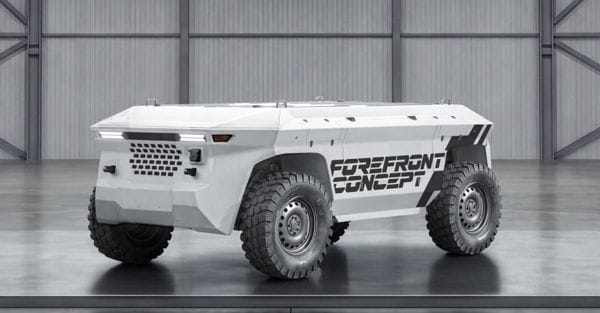
Forefront Concept: four-wheel steering and two electric motors
The technical specification includes four-wheel drive, with all wheels steering, and two electric motors. This configuration has been chosen to improve traction and manoeuvrability on rough terrain, even in confined spaces. Remote control allows the vehicle to operate without a crew on board, whilst the electric propulsion system keeps noise levels to a minimum whilst on the move. The expected range is approximately 400 kilometres, which can be extended through the use of a range extender. The load capacity is up to one tonne, enabling the vehicle to carry the equipment and materials required for various operations.
From military logistics to civil protection
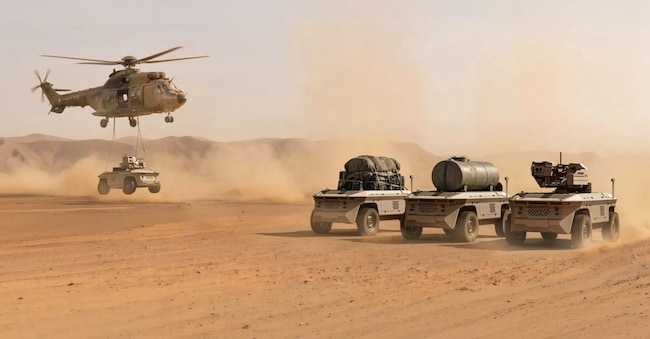
Forefront Concept was designed as a modular vehicle, to be configured according to the mission. In the military sphere, its intended uses include the transport of materials and supplies, intelligence gathering, surveillance and reconnaissance. It is also intended for counter-drone operations, fire support and evacuation. The ability to control the vehicle remotely reduces the exposure of military personnel in the most hazardous situations, by entrusting the platform with the transport of cargo and equipment. Civilian applications include civil protection, the transport of materials and operations in hazardous industrial environments or those with difficult access. In such conditions, the ability to operate remotely can prevent personnel from having to enter high-risk areas directly. The modular design also allows the vehicle to be adapted to different operational requirements, whilst retaining a common mechanical and electrical base.
What are Renault and John Cockerill doing?
Renault has developed the mobile platform, focusing on a modular architecture and the use of tried-and-tested automotive components. This solution helps to keep costs and development times down, by utilising processes and supply chains capable of supporting larger-scale production than that of specialised vehicles. The group also brings to the table its expertise in electric motors and batteries, as well as its experience in designing vehicles for a variety of uses.

