
Renewables: Brussels green light for 23 billion in aid for Italia
The mechanism will allow for 37.15 gigawatts of additional capacity. Pichetto Fratin: 'Step forward for innovation and energy security'
Key points
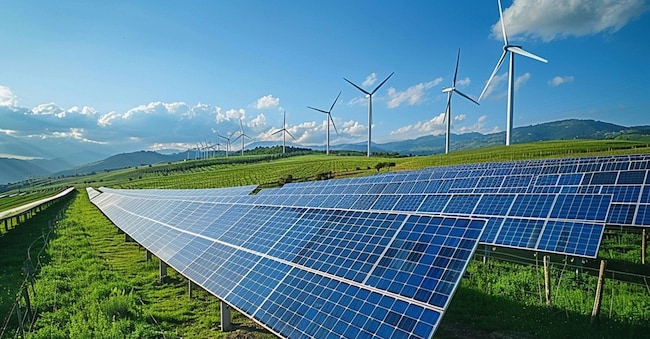
The European Commission's long-awaited OK has arrived for the FerX decree scheme with which the government aims to support the development of established technologies such as photovoltaics, wind power, hydroelectric power, and plants for the treatment of residual gas from purification processes. The mechanism envisages a maximum quota of 37.15 GW of new renewable capacity, of which 10 GW is reserved for plants of up to one megawatt capacity, which will not participate in auctions, and the remaining 27.15 GW for larger plants. The scheme is expected to be worth a total of up to EUR 23 billion: a figure that, according to the note released yesterday by Brussels, is based on market price estimates and could be considerably lower in the event of higher than expected market prices.
Pichetto Fratin: step forward for innovation and energy security
"The European Commission's green light,' commented Environment and Energy Security Minister Gilberto Pichetto Fratin yesterday, 'makes it possible to continue the path of building plants powered by mature renewable sources. It is a strategic tool, the Forza Italia exponent went on to say, 'to strengthen the country's energy autonomy, reduce dependence on foreign countries, and guarantee the continuity of the transitional mechanism that came into force in 2025'.
Now the passage to the Court of Auditors
The text will now be sent to the Court of Auditors for registration before publication on the ministry's website. It is, therefore, an important step on the path to accelerating the national energy transition. As the European Commission itself makes clear, the 37.15 GW of additional capacity linked to the decree represent about 48% of the current Fer capacity in Italia. If brought to fruition, the scheme will contribute significantly to achieving the decarbonisation target set by Italia, allowing the country to reach 39.4% of gross final energy consumption from renewables by 2030.
Contracts for Difference
As will be recalled, the aid will take the form of variable payments under two-year, two-way contracts for difference which provide for a bonus per kilowatt-hour of electricity produced and fed into the grid, based on a so-called strike price. The mechanism is well known: if the market prices of electricity are lower than the strike price, the state will pay the difference. If, on the other hand, they are higher, the companies will reimburse this.
The auction for plants above one megawatt
It will now be up to the ministry to organise a separate tendering procedure for solar and wind technologies with a capacity of more than one megawatt, whose candidates will have to comply with additional pre-selection criteria set out in the Net Zero Industry Regulation, designed in line with Regulation (EU) 2024/1735 (the Net Zero Industry Act) and Implementing Regulation (EU) 2025/1176, which regulates non-price criteria to be applied in public auctions for the deployment of green energy. Instead, plants with a capacity of less than one megawatt will be able to benefit directly from the scheme without participating in a tender procedure: in this case, the operating price will be set administratively by Arera.


