

Research by an Italian neuroscientist: ‘This is how the brain anticipates the onset of disease’
By showing participants virtual avatars associated with an infection, the researchers observed an immune response. The studies will be presented at BergamoScienza
by Francesca Cerati
 Aggiungi Il Sole 24 Ore
ai preferiti su Google
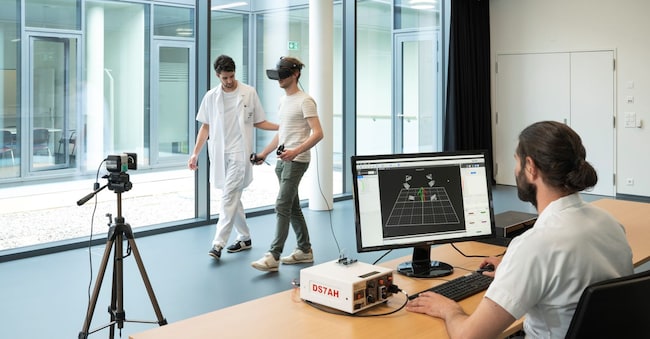
The brain prepares the immune system even before a pathogen enters the body. This is one of the frontiers of research for Andrea Serino, a neuroscientist at the University of Lausanne, who has been studying for years how the brain constructs representations of the body and the space surrounding it. This journey has taken him from the study of ‘peripersonal space’ to the dialogue between the brain and the immune system, opening up new perspectives for understanding the placebo and nocebo effects as well.
Serino will discuss this research on 3 October at BergamoScienza, in a talk entitled ‘Where do you end and the world begin?’. The starting point is the way in which the brain distinguishes between what belongs to us and what lies outside us, and anticipates potential danger. ‘Our brain has a special representation of the space around the body – the near space – because it is a space where we can interact with the outside world, but also in a dangerous way,’ he explains. The neurons he studies respond to touch, but also to an approaching visual or auditory stimulus: they anticipate possible contact. This led to the hypothesis that the same predictive mechanism might be used by the immune system. Experiments conducted by Serino’s team have provided an initial answer: by showing participants virtual avatars associated with an infection, the researchers observed an immune response. “We have shown that if we see avatars – that is, those representing a virtual infection – our immune system responds.” The research now aims to understand how specific this response is. In the initial experiments, the focus was primarily on innate lymphoid cells – the sentinels of the immune system – which signal a potential threat without being specific to a particular pathogen. The team is analysing new data to determine whether interaction with the brain could trigger a more precise response, such as disease-specific antibodies depending on the infection depicted.
This development is also helping to change the way we view the placebo. ‘In my view, the placebo is part of the mechanism; in other words, it is the brain’s influence on the biological mechanism, and is therefore biological,’ observes Serino. The placebo, once seen as a confounding factor in clinical trials, has thus become an opportunity to study the interaction between mental state and physiology. The same applies to the nocebo: expectations, fear and interpretations can all contribute to altering the body’s response. The point, however, is not that simply ‘thinking positively’ is enough to heal. Serino insists on the need to distinguish experimental evidence from slogans. ‘Science is probabilistic,’ he says. ‘Data have an infinitely greater probability of things being as they are than a narrative or a slogan.’ The challenge, therefore, is to learn to interpret the data without turning science into a new dogma.
At the heart of the placebo and nocebo effects lies the way the brain interprets reality. ‘The brain is not a machine that passively processes information.’ Every perception is an interpretation built upon hypotheses, or ‘a priori’ assumptions, formed through experience. The same physiological signal can take on different meanings: an increase in heart rate can be interpreted as fear or as excitement, depending on the context and mental state. This is the principle of the ‘Bayesian’ brain, which formulates hypotheses and continually compares them with what is happening. This mechanism also relates to the capacity for change. The brain learns statistical patterns and modifies its predictions when reality no longer confirms the previous association. To interrupt a harmful response, therefore, an exception alone is not enough: ‘I have to create another statistical pattern’.
The relationship between the brain and the immune system also works both ways. “An immune system that reacts poorly has a huge impact on neurodegenerative diseases,” emphasises Serino, citing evidence of hyperinflammatory processes present in various neurological conditions. It is therefore increasingly difficult to view the two systems as separate compartments: “Our body functions in a much more coordinated manner.” And it is precisely from the representation of the body that the biggest question arises. For Serino, the peripersonal space is ‘the first distinction between the self and the outside world’: the boundary of what we are does not simply coincide with the physical body, but with what the brain represents as ‘us’ and ‘not us’. ‘What I have always tried to understand—and will never fully understand—is how the brain generates self-awareness through very basic mechanisms designed for survival.’ A question without a definitive answer, but one that continues to guide his research.

