

Research, design and industrial development: UNDP’s formula for long-term infrastructure
As part of the Rimini Meeting, a round-table discussion entitled ‘UNDP and the Italian System: From Research to Business’ took place, attended by representatives from universities, the scientific research sector and the business world. The aim was to establish a model that facilitates sound technology transfer and creates a cycle leading to economies of scale, in a context where traditional charity is giving way to public-private finance. Concrete examples included support for Kampala’s electricity grid and innovative models for plant mulching. The
by 24Ore NextMed
 Aggiungi Il Sole 24 Ore
ai preferiti su Google
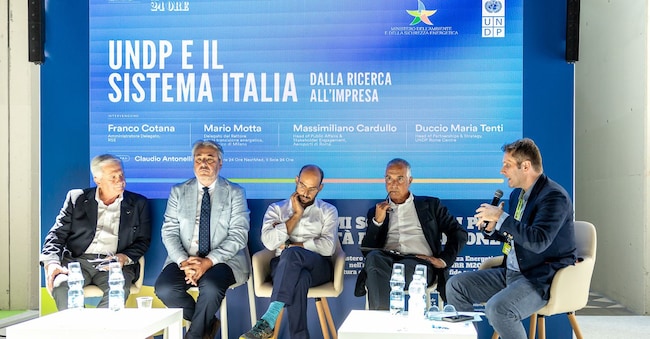
Research, project validation, implementation and industrial development. All within the framework of international cooperation, philanthropy and business. This is the virtuous circle underpinning the round-table discussion ‘UNDP and the Italian System: from Research to Business’, which took place in Rimini as part of the Meeting. The aim of the panel, attended by Duccio Maria Tenti (Head of Partnerships & Strategy, UNDP Rome), Franco Cotana (Chief Executive Officer of RSE), Mario Motta (Rector’s Delegate for Energy Transition at the Politecnico di Milano) and Massimiliano Cardullo (Head of Public Affairs & Stakeholder Engagement at ADR), was to explore how the scientific, technological, industrial and project-related expertise of the Italia system can contribute to strategic and operational priorities through the UNDP in the sectors of energy, climate, the environment and innovation. During his opening address, Tenti focused on Pista (Platform for Investment Support and Technical Assistance), the climate finance facility supported by MASE and created to bridge the gap between international climate priorities and bankable projects. ‘Another building block’, explained Tenti, complementary to PISTA and more closely aligned with the world of applied research evoked by the event’s title, “is Mission Innovation, the intergovernmental initiative to accelerate innovation in clean energy technologies, which the UNDP is responsible for implementing at an international level, through concrete projects such as the smart grid in Uganda and biogas in Kenya”.
Thanks to the support and vision of MASE, Mission Innovation is expanding internationally and being consolidated through a partnership between the academic world, the private sector and the United Nations. It also works further upstream, on technology generation and transfer — a natural fit for the Politecnico di Milano’s contribution on the topic of technology transfer to partner countries. ‘The field of energy transition, which I personally oversee,’ said Motta, ‘can help strengthen the virtuous cycle of effective technology transfer to partner countries. Let us envisage a sustainable framework that translates the expertise and technologies of the ‘Italian System’ into concrete projects and supports solutions from validation through to implementation and wider-scale roll-out’. This refers to an interesting project for which a call for proposals will shortly be launched, aimed at stabilising the electricity grid in Kampala, Uganda. “A project that will bring numerous long-term benefits,” concluded Motta. As the debate continued, moderated by Claudio Antonelli, deputy director of 24Ore nextMed, a focus was placed on philanthropy as a driver of innovation and catalytic capital. Thanks to flexible, impact-oriented resources, foundations can support high-risk early-stage initiatives, fund experimentation and evaluation, strengthen local ecosystems and mobilise further public and private capital. Cardullo cited the example of ADR (Aeroporti di Roma), which, through the Pacta Foundation, is working to reduce CO₂ emissions. ‘Our activities do not represent a model that benefits our company alone, but the airport system as a whole,’ explained Cardullo, adding that ‘in this context, as part of the Mattei Plan, we have offered to make our expertise available – including in start-up development – to build new relationships with countries in the Global South’. In short, the dialogue between the UNDP, universities, the research sector, philanthropy and industry enables us to examine the value of ‘4P’ partnerships – public, private, people and philanthropy – and to focus on the entire value chain: from setting priorities to research, from funding initial trials to the implementation of concrete projects. “In the case that concerns us directly, we can say we have a track record that enables us to apply our model to internationalisation projects as well. Within the framework of the Mattei Plan and beyond,” added Cotana, CEO of RSE, the company specialising in research across the energy and sustainability value chain, from primary energy sources to all conversion and utilisation systems, from energy carriers to technologies for energy efficiency and storage. Cotana also explained how a project aimed at mulching vegetables and plants using innovative glass-fibre sheets could become a large-scale model that, on the one hand, benefits crops and, on the other, helps tackle climate change by reducing glare and regulating temperatures. The round table thus concluded not only with concrete examples, but also by shining a spotlight on a broader vision within the ongoing changes in the world of cooperation. The focus has shifted from traditional charity to a public-private finance system aimed at infrastructure investment and, consequently, long-term projects.

