The book

Rethinking leadership in a complex world, instructions for use

Alessandro Cravera's new essay invites us to understand the concept of leadership in today's context and to go beyond the traditional command and control approach

6' min read

6' min read

What does an organisation need when confronted with multiple market variables? Several components. One item cannot be missing from the list, that relating to leadership. Which should be wise, widespread and shared, attributable not only to the classic 'boss' but to anybody capable of transforming the context in which they operate by putting it on a trajectory of positive and sustainable evolution. What is required of the figures in charge in the company, in other words, is the ability to change the way we understand the reality that surrounds us - all the more so if it is uncertain, paradoxical and ambiguous - in order to learn how to have a positive impact on it.

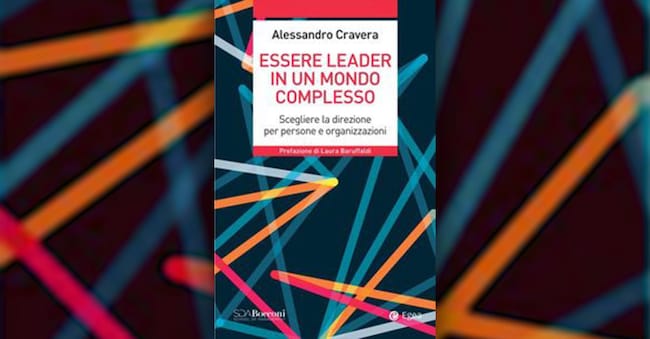
This is the reflection that animates the new essay, published by Egea, by Alessandro Cravera, founder and Senior Partner of Newton (as well as Faculty member of the Executive MBA of ALTIS Università Cattolica and of the EMBA of 24 Ore Business School). "Being a leader in a complex world", this is the title of the book, is a reading that invites a deeper understanding of the concept of leadership, framing it historically and culturally and explaining how its perception has not yet adapted to the new context in which we live and work.

Loading...

Today, a leader is still considered to be anyone who has a leadership role and/or manages to create a group of followers who respond to his or her directions, a figure who holds formal power or who indicates a direction to follow and creates followers in his or her wake. But the leader can be positive or negative, follow an ethical direction or not, and this ambiguity, according to Cravera, is all too dangerous, not least because in today's interconnected and interdependent world, any strategy adopted by a leader can have much wider systemic effects than in the past.

It can be difficult to think of a manager as a 'social architect' who directs ethical and sustainable behaviour, untethered from the idea of command... Who are, or rather how are, the leaders who lead companies today?

I would like to clear the field of a possible misunderstanding. When I describe the leader as a social architect who moves in a perspective of the common good, I do not imagine a manager-philosopher who is disinterested in business, far from it. The central point that needs to be emphasised is that the classic manager/leader who exercises his role with a traditional command-and-control approach and thinks only of achieving the assigned goals, whatever the cost, is today totally dysfunctional for the success of the company. In today's context, it is necessary to move beyond management by objectives and to start thinking in terms of goal relations, i.e. to make trade-off. If every manager only thinks about reaching the assigned target, the risk is that the company system suffers negative consequences. And I use the expression 'social architect' precisely because the complexity and speed of change are such that it is impossible for the company to be managed centrally by a few decision-makers/leaders, leaving all the other employees in the role of dull-brained followers.

So what should the leader's priorities be?

In a modern company, one must know how to read objectives in inverse relation and decide on one's action strategies according to the specific context the company is facing. Is it more important to increase margins by putting pressure on suppliers, or to increase time to market and customer satisfaction? These two objectives are potentially in inverse relation and the leader must know how to balance the strategies to be implemented according to the continuously changing context. Orienting oneself to the common good is therefore not only an aspect that has to do with ethics, but with the real success of the company over time and its competitive capacity. The leader is a social architect because he or she exercises his or her role by creating the organisational and cultural conditions that foster the development of initiative and responsibility in people, and consequently bring out forms of collective intelligence. This approach to leadership enables not only more motivated employees but also a much faster and more flexible organisational response to competitive challenges. It is therefore about business, not just ethics and values.

Whoever is at the helm (of a group or organisation) should bring about a positive evolution of the system and the context of which they are a part: but what if the system 'does not respond' and is not receptive?

If the system does not respond, it means that, consciously or unconsciously, those who have led the group or organisation up to that point have created an environment that rewards task execution more than initiative and responsibility, individualism more than collaboration, following rules more than achieving results and creating values. This happens when there is an absence or ineffectiveness of leadership. People in an organisation tend to adopt the behaviour that they find most rewarding or least risky for them. If they only look at individual results, they will tend to be individualistic and it certainly won't be enough to do a teambuilding course to change things; if they are afraid of making mistakes, on the other hand, they will tend to limit themselves to applying rules and procedures, regardless of how many empowerment courses they may take.

What can leaders do in such cases?

The first thing I would suggest to them is to understand why employees behave in a certain way. Questioning what signals come to the employees themselves and how they are interpreted. This will allow them to make some changes that will alter the context, for example organisational policies, management narrative and style, ways of working and reward systems. Each change will impact on the signals that reach people, leading to new behaviours over time. When I describe the leader as a social architect, I am referring precisely to this type of change: creating the conditions for people to want to change the way they work.

How can the qualities of rationality and knowledge, pillars of leadership in the past, survive in the way of being a leader today?

Rationality and knowledge remain central to the exercise of leadership. The criticism I make in the book is as follows: we sometimes think of the leader as the one who has all the right answers, but this is a historical legacy that works very well for an orderly environment characterised by linear causal relationships. However, when leadership must be exercised in uncertain and highly complex contexts, thinking that past knowledge, best practices, rationality and the ability to always have the right answers is a big mistake. Leaders to deal with complexity must be strongly connected to the context, understand it in a very short time in depth and in its temporal dynamics, and decide what to do in that specific situation. It is not enough to adopt techniques or best practices from the past.

Is this where wise leadership comes into play?

Certainly. Wisdom manifests itself as a propensity to move towards the common good, and thus ecosystemic, balancing the interests at stake and the effects over time. Our education system was built to help us have the right answers. In order to make more effective leaders emerge in increasingly complex contexts, today and in the future, we will have to train ourselves to ask the right questions, the ones that allow us to understand what is happening, avoiding acting on autopilot and potential blind spots, training ourselves to better manage the web of trade-off goals that complexity has created.

Has the digital society made the leader's role more aseptic or has it (humanly and culturally) enriched it?

The digital society has had positive and negative impacts on leadership. I start with the former. Compared to the past, leaders and decision-makers have a much greater amount of data and information available and this enables them to be quicker in understanding situations and deciding on courses of action. Knowledge has therefore become almost a commodity for leaders, but what makes the difference is the use that is made of this knowledge. Knowing how to interpret data, connect it with other information and points of view, contextualise and read possible evolutionary dynamics are fundamental qualities for successful leadership. The negative aspect of the digital society on the concept of leadership is that it has taken the leader-follower relationship to extremes. Social media has created the figure of the influencer, who measures his strength by the number of followers with the aim of climbing the like charts and increasing the number of followers. He is not interested in bringing about a positive evolution of the system in which he operates, because the goal of the influencer is only to become one. He does not want to change history, but he wants to be history. The influencer phenomenon represents a degeneration of the concept of leadership.

Do we therefore need to review the mechanisms of the digital society?

The message that the digital society is getting across is that whoever succeeds in creating followers, regardless of how they do it and how they use this influence, stands as a leader. At the centre is not a result to be achieved and a change to be initiated, but personal success, differentiation from the masses, the creation of followers and emulators. Leadership was born to empower a purpose. Today, however, the purpose seems to be rather to empower the leader, to create and maintain him.

Copyright reserved ©
Loading...

Brand connect

Loading...

Newsletter

Notizie e approfondimenti sugli avvenimenti politici, economici e finanziari.

Iscriviti