Space

Back to the Moon, the Artemis II mission has started: all its secrets

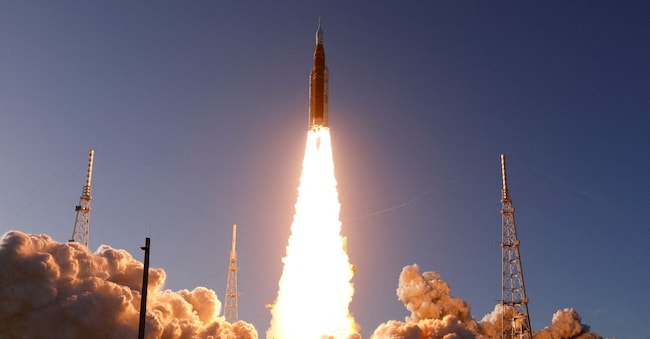
At 2:39 a.m. Italian time from Cape Canaveral the launch of the Nasa launcher that will take four astronauts to fly over the satellite

by Leopoldo Benacchio

La missione Artemis II della Nasa decolla dal Kennedy Space Center di Cape Canaveral, in Florida  REUTERS

4' min read

Translated by AI
Versione italiana

4' min read

Translated by AI
Versione italiana

Noise, fire from the engines, smoke such as we rarely see, and the mission Artemis II took off, at 2:39 a.m. Italian time on 2 April. It has been causing a lot of trouble recently, due to the usual valves leaking fuel, an obviously very dangerous situation in a nearly 100-metre carrier that, for over 60, consists of a gigantic tank of highly explosive fuel.

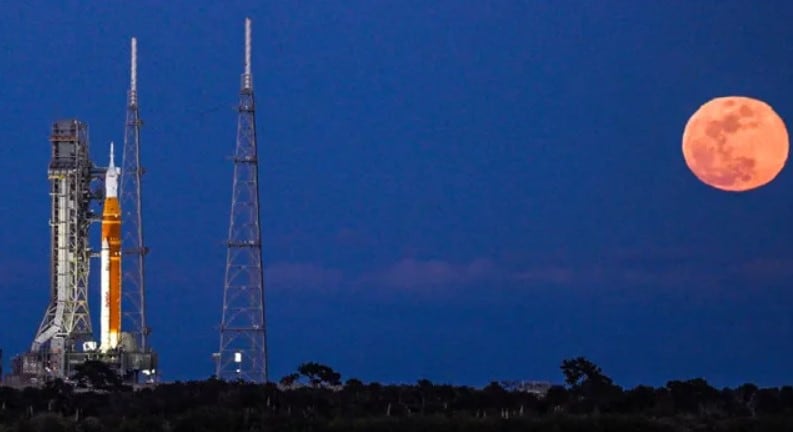
Everything went well, however: a splendid day and the four new lunar heroes, Reid Wiseman, Victor Glover, Christina Koch of Nasa and Canadian Jeremy Hansen, set off on the ten-day journey that will take them beyond the Moon, where no human has ever gone before, and then back home again. They will carry out experiments, release small satellites that have precise targets and see the Moon from very close up, but only from the window. However, this is no small thing: it is probably what they will remember for the rest of their lives. They will send us a new image of our blue planet from that distance, mimicking the historic photo we know as "Earthrise", taken on 24 December 1968, in which the Earth is seen rising above the lunar horizon.
Loading...

All went well, perhaps not too many people at Cape Canaveral, with umbrellas and deck chairs, enjoying the monstrous roar of the engine, at arm's length, and the restart of what Nasa wants, at all costs, to propose as the new 'American dream'. The first was initiated by President J.F. Kennedy who, as we know, did not get to see the completion of the programme with Apollo 13 and the landing of the first man on the Moon.

Today, there is not the same spirit, but probably, if all goes well on this and the next missions, the desire to return to the Moon will also be revived in the public, in the same way it exploded in the Apollo programme.

Nasa's own administrator, Iared Isaacman, told internal staff on 24 March that 'the United States will never again give up the Moon'. A few words, very clear, with which the redefinition of the American lunar programme began, the umpteenth, making it clear that the race, this time, is with China, and is not just to set foot on lunar soil again. That theme is there, of course, and this time it will be about a woman's foot, but this time it is a different story: it is about being on the Moon, inhabiting it, with robots and astronauts, opening laboratories, perhaps mines, in other words setting off a real 'lunar economy', which at the moment can only be partly imagined.
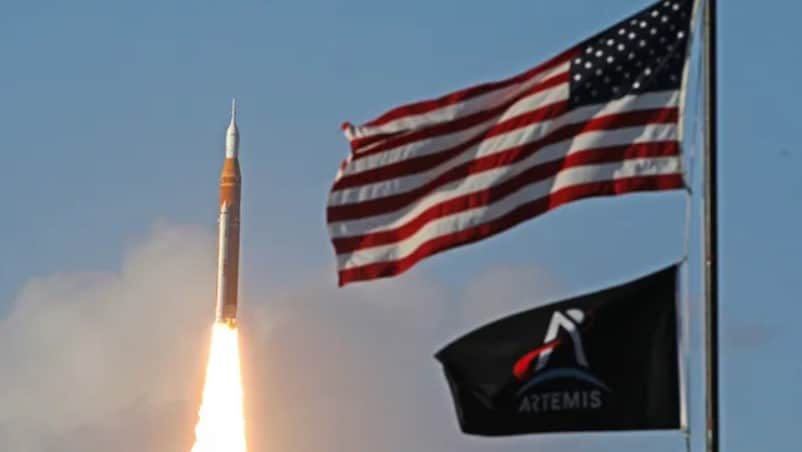
Artemis II, le immagini del lancio della nuova missione per la luna

Photogallery33 foto

Since December, when he took office as administrator, Isaacman has introduced a good dose of realism and pragmatism into the chronically delayed, increasingly expensive and complex lunar plan. It is not certain that they will be able to keep to the timetable: 2028 is practically tomorrow and there are many important things to be done, but for the time being we wish the Artemis programme all the best.

Of course, in the new plan the loser is Europe, which already plays a key part in the Artemis mission with the sophisticated Service Module of the Orion capsule, with the four astronauts on board. The nine European countries, which have contributed to the Service Module, from Germany to France, from Italy to Holland, provide with this all that is needed for the survival of the astronauts and the operation of the capsule.

Strong doubts, on the other hand, about the Gateway, the cislunar station that was to be used for the transit of astronauts to and from the Moon. It will probably not be done, and the money saved will be put directly on the first American lunar city. From the Earth to the Moon directly, in short.

There remains the mortgage on the carrier rocket that would have to make dozens of flights with astronauts and materials, since Sls, which has just taken off, is a rocket that is according to many ill-conceived, too expensive and unreliable, if used dozens of times, as mass production seems very problematic.

The entire mission will of course be supervised from the ground and Italy's Telespazio contributes to this with its global antenna network, while Thales Alenia Space, Leonardo's other major investee, has contributed to the Service Module's survival systems: oxygen and nitrogen and water. Finally, Leonardo contributes photovoltaic panels and power management and control units for all modules.

Returning to the Artemis II mission, the ten-day schedule is tight for the four astronauts. They will first have to ignite their own engines, as the rest of the rocket has long since detached, to put the spacecraft into a very high elliptical orbit

The sleep schedule of the Artemis II crew is set according to the take-off time, but at least 8.5 hours per day are set aside for rest. On the second day, upon waking up, the astronauts must perform the delicate manoeuvre to enter the orbit that will take them to the Moon. A 30-minute manoeuvre with the engine running will begin the actual journey towards our natural satellite.

Between experiments, rest, training to keep their muscles at their best and even photos that ours will have to take, we arrive at the sixth day, the day when they will fly to the Moon, at a distance of between 6440 and 9650 kilometres. This will be the highlight of the mission and also the moment of greatest fascination for the astronauts.

From day seven, the descent, so to speak, since in space there is no up or down, towards Earth begins, and the last real problem to be faced will be Orion's entry into the atmosphere at a speed of tens of thousands of kilometres per second. The crew will don their spacesuits, open their seats and buckle up for a literally fiery re-entry. The service module will be detached and the capsule will point the heat shield towards Earth, to protect Orion from the friction that will cause temperatures to reach 1650 degrees. The ditching will take place at a speed of only 27 kilometres per hour, thanks to the parachutes, in the Pacific Ocean, off the coast of San Francisco. In short, it is getting serious about the Moon.

Copyright reserved ©
Loading...

Brand connect

Loading...

Newsletter

Notizie e approfondimenti sugli avvenimenti politici, economici e finanziari.

Iscriviti