
World Day

Roberta’s story, three years on from her bone marrow transplant

Over 5,000 transplants a year. To mark World Bone Marrow Donation Day, we tell the story of how Roberta coped with this ordeal

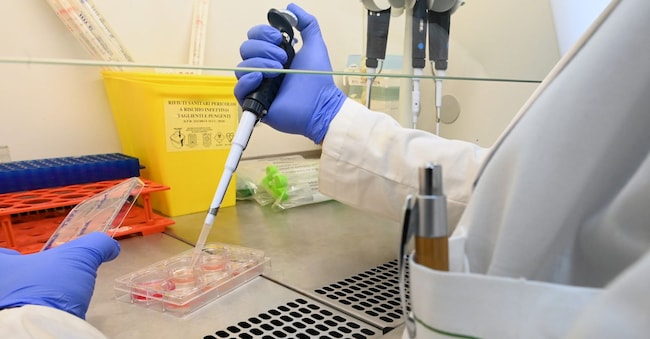
ISTITUTO TUMORI GIOVANNI PAOLO II INAUGURAZIONE  DELLA NUOVA AREA PER IL TRAPIANTO DI MIDOLLO  REPARTO OSPEDALIERO  IMAGOECONOMICA

5' min read

Translated by AI
Versione italiana

5' min read

Translated by AI
Versione italiana

‘The other day, my daughter told me that her name had been added to the database as a bone marrow donor. I don’t know who my donor is, but to me they’re an angel. And I must admit I was moved to learn that, after everything that’s happened, my daughter might one day become someone else’s angel.”

It was 3 January 2023 when Roberta R. received her bone marrow transplant. Almost four years have passed since that pivotal day in her life. All she knows about the donor is that he is Israeli, is no older than 35 (the age limit for donation) and weighed 68 kilos at the time of the transplant. He, too, knows nothing about her. There is a hidden thread linking the lives of these two people. And it saved her life.

Loading...

Roberta’s story is similar to that of the other 5,500 people in Italia who undergo a bone marrow transplant every year, including autologous transplants – using the patient’s own cells – and those from a donor. ADMO is the Bone Marrow Donors’ Association, which since 1990 has been working to raise awareness of how bone marrow donation and transplantation can help combat leukaemia, lymphoma, myeloma and other blood cancers. A story like so many others, yet each one is unique in its own way.

For Roberta, it all began on 28 July four years ago, just a few days before she was due to set off on holiday. It was just a routine check-up, out of an abundance of caution, to look into that strange cyst that had appeared on her breast. Then came some test results that were decidedly off, an urgent check-up at Lilt, a mammogram and the diagnosis: acute lymphoblastic leukaemia type B, with features of non-Hodgkin’s lymphoma. Within a few hours, Roberta found herself thrust into a journey with no alternative, a far cry from the family holiday she’d planned: hospitals, needle aspirations, constant tests, and admission to an oncology ward.

Five weeks in hospital with gruelling chemotherapy, mucositis, a very high fever and persistent bronchopneumonia. This was followed by three further hospitalisations and more cycles of chemo. And in the meantime, life outside carried on: ‘Whilst I was in hospital, my beloved dog Oliver died. And then I had to tell my 90-year-old mum what was happening to me. It wasn’t easy. A year and a half later, she passed away. I carried on. I had to carry on. My husband had been told to prepare for the worst, but I never once thought I would die: my children couldn’t be left without a mum.”

Roberta underwent a total of ten lumbar punctures: there were supposed to be 12, but the results seemed encouraging. Yet each one was a gruelling experience: a small amount of cerebrospinal fluid was withdrawn from her lower back. Painful and uncomfortable. On one occasion, they had to try six times before they managed to collect the fluid properly so they could then inject the chemotherapy.

The prospect of a bone marrow transplant seemed the only way to beat leukaemia. From there came the search for a donor: his brother initially appeared to be a match, but shortly afterwards further tests yielded a different result. His children also proved to be incompatible. This led to the search for a donor in the databases.

One day, the doctors gave her a date: 3 January. It was almost a cruel joke: Roberta’s birthday is on the 4th – the very day she got married, and she would have preferred that date for such an important event. But the 3rd couldn’t be changed: a transplant has rules that you simply cannot alter.

Being admitted to an oncology ward is no easy matter. Everyone has their own story, their own suffering. But inevitably, you find yourself comparing experiences – comparing pain, treatments and side effects. Then there are the children. And then there are those who don’t make it.

The operation went well: Roberta remembers that day for the almost garlic-like smell emanating from the cool bags, which had arrived frozen by air. But she also remembers the pain and the hallucinations. “I saw rats running up the walls.” Inevitably, there was morphine. There were a few days of fever, just a few, to be honest. I fainted in the bathroom, and the nurse came to my aid. “All the staff who looked after me were absolutely lovely.” To my surprise, on 18 January, the doctor came into my room with the test results in his hand and said: ‘What if we sent you home tomorrow?’ ‘Really?’ I replied. I knew that, on average, you stay in hospital for a month after the operation, so I couldn’t even imagine being able to leave any sooner. My neighbour in the next bed was also wide-eyed: she’d been there for a month and a half…’

Loading...

Recovery is not easy, and the first hundred days require great care due to the risk of rejection following a transplant of this kind. The alarm bells ring in the event of dysentery: it is a precursor to the worst possible outcome one could fear. Roberta is holding on, scrupulously following all the instructions: wearing a face mask even at home to avoid any infection, keeping her distance even from family members, absolutely no raw food, and being careful in enclosed spaces. And then there’s the change in blood group: Roberta has gone from O positive to B positive.

‘I never suffered from nausea or vomiting as a result of the chemo,’ she says. ‘At one point I started losing my hair; I asked for it to be shaved off. I switched to a wig, and wore a turban at home. But that didn’t matter to me all that much: I weighed less than 50 kilos, and I had no muscle in my legs. Meanwhile, all around me, life went on. My children didn’t talk about my illness to anyone: ‘It’s a private matter,’ my son explained to me once. My daughter, on the other hand, cried a couple of times.”

‘I lead a normal life now; I could, but I no longer eat raw food. I wash fruit and vegetables thoroughly with bicarbonate of soda, and I avoid rare meat. Fortunately, I was able to eat the pizza straight away, given the temperature at which it’s cooked. I’m well today – in fact, perhaps even better than before. And I’m getting ready to celebrate the fourth anniversary of my transplant. Four years – and the six months leading up to it – during which I never gave up. And as I told my friends at ADMO, if I’m here today, I owe it to that act: the bone marrow donation.”

Copyright reserved ©
  • Marco lo Conte

    Marco lo ConteResponsabile per lo sviluppo delle attività video multimediali de Il Sole 24 Ore

    Luogo: Milano

    Lingue parlate: Inglese, francese, spagnolo

    Argomenti: social media, digital journalism, risparmio, previdenza, finanza comportamentale, educazione finanziaria

    Premi: Premio Federchimica "Per un futuro intelligente", 2001; Premio PrevAer 2019 per l’impegno a favore della cultura Previdenziale & Finanziaria

Loading...

Brand connect

Loading...

Newsletter

Notizie e approfondimenti sugli avvenimenti politici, economici e finanziari.

Iscriviti