

Robotic surgery: 54,000 operations by 2024, more than half in urology
State-of-the-art platforms integrate AI by transforming the data collected during the operation into suggestions to improve the surgeon's performance
Key points
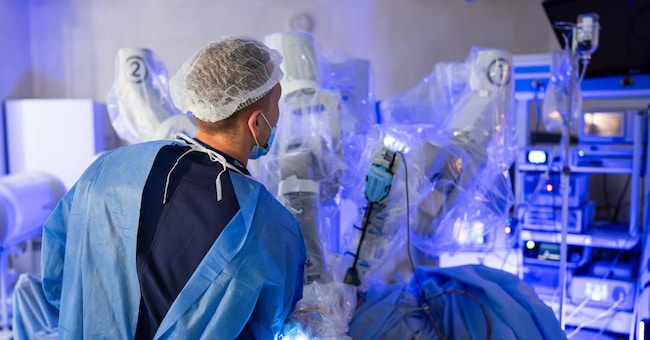
Robotic platforms for urological surgery are constantly evolving. From the multi-port, with 4 inlets into the patient with as many surgical arms, there has been a move to the single port with 3 surgical arms and a viewer, and now both tissue incision and vessel synthesis are being studied in the latter platform as well as the superimposition, during surgery, of magnetic resonance images with those of the monitor to optimise operating activities. These new frontiers were discussed in Bari during the conference held at Santa Maria Hospital, a GVM Care & Research facility accredited with the SSN.
More than half of all robotic surgeries involve urology
Thirty thousand of the 54,700 robotic surgeries carried out in Italy, in 2024, are in the urological field, with peaks of excellence in Apulia, a reference region in the centre south where the introduction of the first urological robotic platforms dates back to 2005, together with San Raffaele, and before the European Institute of Oncology, in 2006. Thus, over time, we have gone from the basic platform to those with four arms/entrances in the patient and with a single port, a single entrance, with three surgical arms that do not collide and one with a camera - almost like a cobra's head - that scans, in a three-dimensional magnified version, the area to be operated on.
In the future, platforms integrated with AI
And in the future, further developments - it emerged from the testimonies of the experts who spoke, from the IEO to the universities and polyclinics of Bari and Foggia - will focus on training and platforms integrated with AI. Twenty years of continuous evolution that have introduced, over time, up to 150 innovations, such as those, thanks to AI, that make it possible to process and transform the data collected during surgery into useful suggestions to improve the surgeon's performance in the operating room, or tactile feedback and enhanced vision with a more gentle and tissue-friendly surgery. The first urologist to introduce robotics in surgery in central and southern Italy was Giuseppe Mario Ludovico, UO coordinator of Urology at Santa Maria Hospital. He did this in 2005 in a private clinic in Bari to which he was a consultant, and has continued, with updated versions, first at the head of the UO of the Miulli di Acquaviva and today of the SMH of the GVM group. "Thanks to the more than 150 innovations introduced, the platform allows for less invasive surgery," explains Ludovico, who has performed almost 6,000 operations in 20 years. "The virtual simulator and a second integrated console then allow two surgeons to collaborate during the procedure, accelerating the learning curve for young surgeons.Robotics is decisive: smaller and smaller incisions allow 'an immediate and shorter recovery,' Ludovico adds, 'allowing the return home, for example in the case of radical prostatectomy, even after 2-3 days as opposed to 8-10 before 2025, and therefore with less risk of hospital infection.
Oncological results are thus improved, transfusions are very few thanks to the very limited bleeding, and post-operative pain is reduced with drug savings. "And incontinence is also very rare," Ludovico concludes, "while sexual impotence is zero in localised forms and much reduced if the disease is at an advanced stage.

