

Skiing, without a helmet you are up to 7 times more likely to end up in hospital
The survey was conducted through the analysis of thousands of accidents recorded in the Courmayeur and Monterosa Ski resorts

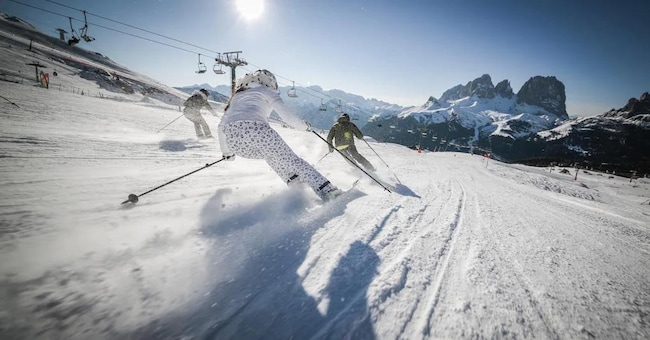
Crowded pistes, high speeds and snow conditions, and failure to wear a helmet: these are the factors that can increase the risk of getting injured while skiing. The analysis was conducted by researchers from the Iss, the Italian National Institute of Health, who coordinate the Simon (Sorveglianza degli Incidenti in montagna - Mountain Accidents Surveillance) epidemiological surveillance system, developed at the Iss's Environment and Health Department. With the Milan-Cortina 2026 Winter Olympics currently in progress and the high number of fans in Italian ski resorts, the Istituto Superiore di Sanità is keeping the focus on the importance of preventing accidents on the slopes. In fact, the results of Simon's surveillance show that risk factors for skiing accidents can multiply the probability of injuries requiring recourse to first aid up to seven times.
The main risk factors identified
The survey, conducted by analysing thousands of accidents recorded in the Courmayeur and Monterosa Ski ski resorts, simultaneously examined several risk factors, with the aim of identifying the conditions that most influence the severity of accidents and providing useful indications for prevention. The results highlight four elements that significantly affect the probability of access to hospital care. The difficulty of the slope is the most decisive factor: each passage from one level of difficulty to the next increases the risk by about 16%, with a significant overall increase going from the easiest to the most challenging slopes. Snow conditions also have a significant impact. Skiing on natural snow, compared to mixed snow with snowmaking, increases the risk by 62%, while unfavourable conditions such as ice, crusty or very wet snow lead to a further increase of 52%. The type of accident is a further discriminating factor. Collisions with other skiers or obstacles are more dangerous than accidental falls, increasing the risk of going to the emergency room by about 69%. Among individual factors, older age and not wearing a helmet are associated with a 7% and 42% increased risk respectively.
Counts the interaction effect between different factors
The most significant aspect that emerged from the study concerns the interaction between the different factors. Under favourable conditions (adult, helmet use, easy slope, snow in good condition and accident without collision) only 7-8% of injured persons require hospital care. The simultaneous presence of personal risk factors, such as advanced age, lack of helmet and collision, increases the likelihood of emergency room access by about 2.5 times. Similarly, unfavourable environmental factors, such as difficult slopes and natural snow in poor condition, lead to an increase in risk of up to 2.8 times. When individual and environmental factors combine, the probability of a serious injury can be more than seven times higher than under ideal conditions, rising from about one in thirteen to about one in three. "The data confirm that accidents on the slopes are not random events, but the result of the interaction between several risk factors," emphasises Alessio Pitidis of the Iss - "The most relevant aspect is that these factors do not simply add up, but multiply each other. This means that intervening on even just one element, such as wearing a helmet or choosing slopes appropriate to one's technical level, can significantly reduce the likelihood of serious trauma and improve the safety of slope users." The most important aspect is that these factors do not simply add up, but multiply with each other

