
Salami, Pasdaran hawk master in psychological warfare killed in Israel's attack on Iran
A senior official close to Iran's Supreme Leader, Ayatollah Ali Khamenei, Hossein Salami was known for his invective against Israel and the West

2' min read
2' min read
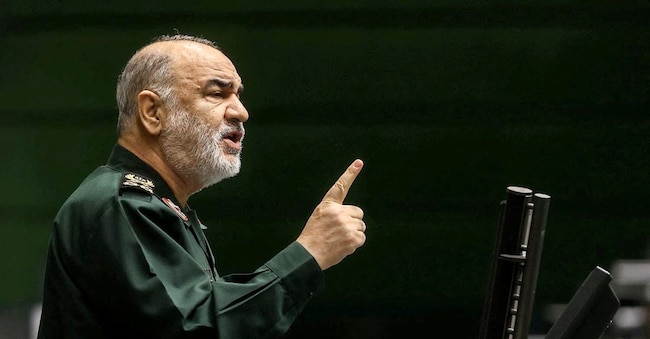
Not only fiery speeches against Israel, but also the responsibility for ordering, in April last year, the first attack with 300 drones and missiles against the 'sworn enemy of Iran'. This was Hossein Salami, the head of the Iranian Pasdaran, the Guardians of the Revolution, who was killed in the Israeli attack on Tehran.
On the night of 13-14 April 2024, just over a year ago, Iranian state television showed him ordering his forces to launch an operation against Israel, the first of its kind conducted by Tehran. A senior official close to Iran's Supreme Leader, Ayatollah Ali Khamenei, the Pasdaran 'hawk' Salami was known for his invective against Israel and the West, so much so that he was considered a 'master of psychological warfare' and the use of propaganda.
"If you make the slightest mistake, we will open the gates of hell for you," he had warned last month when speaking of a possible attack on Iran by Israel or the US. Israeli Prime Minister Benjamin Netanyahu should ''train himself to swim in the Mediterranean Sea'' because he might be forced to flee his country, he had previously said. He had also said that there is a "fertile ground" for the "annihilation and destruction of the Zionist regime".
Born on 14 May 1960 in Golpayegan, Esfahan province in central Iran, Salami had been a combatant in the Iran-Iraq war (1980-1988) in the Revolutionary Guard Corps. A former commander of the Pasdaran Air Force, he had been the subject of sanctions by the US Treasury Department, the European Union and the UN Security Council.
Second in command of the Revolutionary Guards for nine years, he was appointed head of the Pasdaran by Khamenei in 2019, after US President Donald Trump decided to withdraw the United States from the Jcpoa, the agreement on Iran's nuclear programme, and at a time when the government in Tehran initiated major changes in the organisation's leadership.

