Food and Health

Salmonella outbreak and Sicilian cherry tomatoes, the EU confirms the link

A report by Ecdc (the EU agency dedicated to the prevention and control of infectious diseases) and Efsa (the European Food Safety Authority) takes stock of ongoing outbreaks since 2023

by Silvia Marzialetti

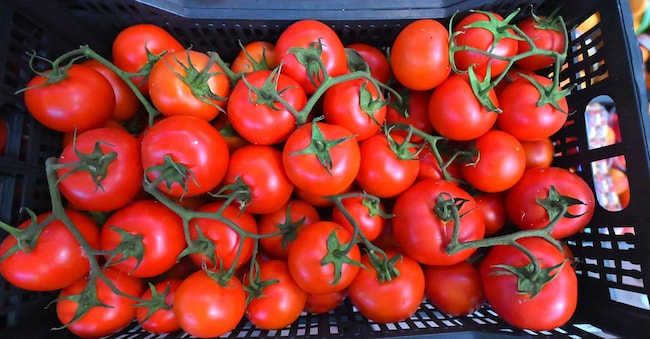
 Pomodorini grappolo  rossi. (Imagoeconomica)

3' min read

Translated by AI
Versione italiana

3' min read

Translated by AI
Versione italiana

A 'prolonged cross-border outbreak' of Salmonella Strathcona is ongoing in Europe. And investigations conducted over a three-year period (2023-2025) have consistently identified Sicilian cherry tomatoes as a likely source of infection. This is why consumers need to keep their guard up by following correct hygiene practices when handling raw vegetable foods: washing hands thoroughly, rinsing fresh produce carefully and avoiding cross-contamination by keeping raw and cooked foods separate.

This was written in a report just published by Ecdc - the EU agency dedicated to the prevention and control of infectious diseases - and Efsa - the European Food Safety Authority - to which, last September, the European Commission requested an update of the joint rapid outbreak assessment from 2023.

Loading...

But the Consorzio di Tutela del Pomodoro di Pachino Igp (the most representative one in the area), does not take this lying down: 'We would like to make it clear that no reports of this have been received from our associates,' says the president, Sebastiano Fortunato. 'If there had been such a serious problem, we would certainly have noticed it, since we eat our tomatoes every day.

In the meantime, the Ministry of Health has reinforced controls on the ground and provided a code of conduct for large retailers on the handling of first range products (fresh food that has not undergone any processing, transformation or treatment, and is sold as such after harvest).

But let's proceed in order

From 2023 to 30 September 2025, there were 437 confirmed cases of Salmonella Strathcona in 17 EU countries (but cases were also reported from the United Kingdom, Canada and the United States): 205 more cases than in the first rapid outbreak assessment published on 12 November 2024. Italy, Germany and Austria were the most affected countries with - respectively - 123, 113 and 76 cases.

As in the case of the epidemic that developed in Denmark in 2011,' the experts write, 'Sicilian cherry tomatoes remain the main culprit: this was the case in the 2023 epidemic in Austria and the 2024 epidemic in Italy. Again in 2025, new investigations into the epidemic in Austria identified cherry tomatoes from Sicily as the source of infection. The most frequently visited country among the travel-related cases, moreover, was our own.

To close the circle, then, the Italian Food Safety Authority conducted in-depth investigations and the detection of the Strathcona strain in an irrigation water sample collected from a tomato producer in Sicily confirmed the role of the environment in the contamination of the vegetable.

The crackdown from 2023

Starting in 2023, European Commission audits resulted in an immediate crackdown on health checks applied to agricultural production and a code of conduct for first range products. Exactly one year ago, with a circular dated 30 October 2024, the Ministry of Health ordered that in large-scale distribution these products be displayed on shelves clearly separated from fourth range products (those in pre-washed bags), clearly and visibly indicating the need for 'washing before consumption'.

The circular then emphasises (and confirms) how events related to ongoing climate change, such as the prolonged drought in some regions - such as Sicily - could lead to the use of 'not properly clean' irrigation water, just as the many flooding events could cause the mixing of sewage water with water used for irrigation purposes and constitute an element of complication for agricultural producers in the fulfilment of correct hygiene practices.

In addition to recommending 'a more conscious consumption of vegetable foodstuffs to be eaten raw', the ministry then strengthened controls during the production, marketing, serving and preparation of first range products, setting up specific sampling and analysis plans during the marketing phase by the ASLs and launching audits on the regions dedicated to fruit and vegetable production in the primary production sector.

The latest audit conducted in Sicily by the National Food Safety Authority with the support of the Istituto Superiore di Sanità to assess the effectiveness of controls on the production and marketing of cherry tomatoes identified 'significant improvements' in terms of personnel, regional coordination, data management and official control activities (the source is still the Ecdc), although inefficiencies remain in terms of irrigation water management plans, a long-standing problem in the region.

The improvements recorded are, however, good news for producers, although President Fortunato is bitter: 'We cannot fail to note how the attacks on Italian tomatoes are intensifying, almost as if there were a precise strategy to undermine a product that the whole world envies us. What is certain is that we are being crushed every day by the unfair competition from non-EU countries that flood Europe with tomatoes at prices that are unsustainable for the Italian labour system, with specifications that allow the use of plant protection products that have been banned in Italy for decades.

Copyright reserved ©
Loading...

Brand connect

Loading...

Newsletter

Notizie e approfondimenti sugli avvenimenti politici, economici e finanziari.

Iscriviti