Samsung is doubling down on foldable phones. Meet the new Galaxy Fold range
Thinner, smarter, and more like traditional smartphones. The Galaxy Watch Ultra2 and Galaxy Watch9 were also unveiled

Samsung believed in foldable smartphones even when the market was still sceptical about them. It was the first to really invest in this category, transforming a technological experiment into a family of products destined to evolve from generation to generation. Today, at Samsung Unpacked, the new Galaxy Z Fold8, Z Fold8 Ultra and Z Flip8 were unveiled alongside the Galaxy Watch Ultra2 and Galaxy Watch9. The South Korean firm is attempting to take another step forward: making the foldable a credible alternative to traditional smartphones. However, price remains the real litmus test for foldables. The €2,299 price tag on the Galaxy Z Fold8 Ultra is not what you’d expect to pay for a smartphone, but rather for a high-end laptop. The group is currently enjoying one of the most profitable periods in its history, but smartphones are not the driving force behind this growth. The Mobile Experience (MX) division maintains positive profitability thanks to its premium models and cost control. However, the smartphone business is under increasing pressure. The problem is not demand, but costs. Samsung manufactures smartphones, but the mobile division purchases memory and components at market prices, just like Apple or Xiaomi. And today, those components cost significantly more because the entire supply chain has been overwhelmed by demand for artificial intelligence hardware. This also explains the positioning of the new foldable models. Samsung does not need the Galaxy Z Fold8 or Z Flip8 to become mass-market products for the group to grow. Today, profits come mainly from chips. Smartphones, on the other hand, serve another purpose: to defend the premium brand, showcase the company’s most advanced technologies and sustain high margins in what is now a mature market.
So, what are the new foldables like?
The strategy is the same as always. To reduce weight and thickness, increase durability, conceal the display’s crease almost entirely, and use artificial intelligence not as an extra feature, but as the thread that ties hardware, software and multitasking together.
The technological leap starts with the hardware. The new Galaxy Z Fold8 Ultra is the thinnest foldable Samsung has ever made: just 4.1 millimetres when open. This has been achieved by completely rethinking the internal architecture, with a new Flex Titanium structure comprising a film and a titanium plate that stiffen the display, improve durability and help to almost completely conceal the central fold. Despite its slimmer profile, the battery capacity has increased to 5,000 mAh with 45-watt fast charging.
The display remains at the heart of the design. Samsung has boosted the brightness to 3,000 nits, combined with an anti-glare coating that improves readability even in direct sunlight. The Galaxy Z Fold8 Ultra features an 8-inch inner display, whilst the Fold8 retains a 7.6-inch screen in a lighter and more compact design. In both cases, the display becomes a true workspace designed for multitasking and productivity.
-U73336436118Nmw-600x313@IlSole24Ore-Web.jpg)
Design, too, is shifting its philosophy.
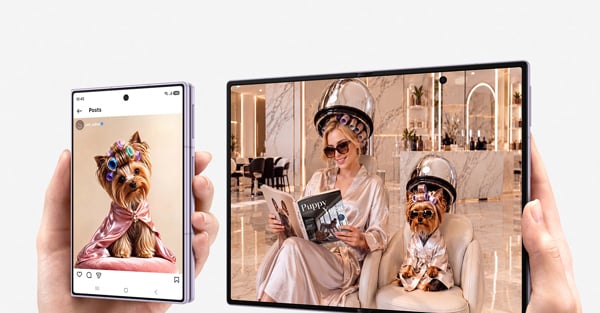
The Galaxy Z Fold8 features a slimmer and wider design than previous models. When closed, it offers an experience closer to that of a traditional smartphone, making it more natural to type messages, read or scroll through social media. When open, however, the screen aspect ratio is better suited to videos, documents and e-books. It’s a less obvious change than a new camera, but probably more important in everyday use: the foldable finally aims to behave like a normal phone when closed and like a tablet when open.