
Sanchez, the African tour and the (bipartisan) controversy over expulsions
The Spanish prime minister visited Mauritania, Gambia and Senegal to sign agreements on legal migration, sparking criticism from the opposition
by Silvia Martelli (Il Sole 24 Ore, Italy) and Ana Belén Ramos (El Confidencial, Spain)
 Aggiungi Il Sole 24 Ore
ai preferiti su Google
5' min read
5' min read
Migration policies have returned to the centre of a heated political debate in Spain in the face of Prime Minister Pedro Sánchez's tour of Africa, aimed at curbing irregular immigration.
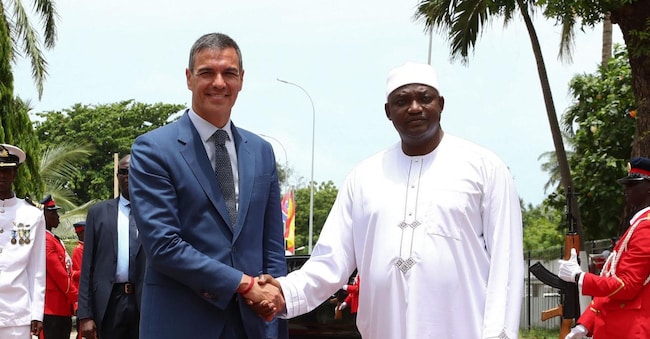
On 27 August, Sánchez started a trip that took him to Mauritania, Gambia and Senegal, accompanied by Elma Saiz, Minister of Inclusion, Social Security and Migration. The first stop was Mauritania, where the prime minister announced an agreement to allow the legal entry of 250,000 Mauritanian workers. He then reached Gambia, where he signed similar agreements. His last stop was Senegal, where he met President Bassirou Diomaye Faye. The two leaders signed agreements to promote temporary employment opportunities in Spain for Senegalese citizens and to launch vocational training programmes in Senegal.
Mauritania, Gambia and Senegal have become the main departure points for migrants attempting to reach the Canary Islands, the Spanish archipelago near the African coast often used as a stepping stone to mainland Europe. According to data from the Spanish Ministry of the Interior, more than 22,000 people have landed on the Canary Islands' shores since the beginning of 2024, more than twice as many as in the same period last year.
Earlier this year, the EU signed a EUR 210 million agreement with Mauritania to prevent smugglers from selling trips to Spain, but to date the agreement has not been particularly effective.
Among those leaving for the Canary Islands are many Malian refugees fleeing violence in the Sahel, as well as young people from Senegal, Mauritania and other West African countries in search of better job opportunities. The number of unaccompanied minors has also grown, resulting in an overburdening of the local authorities who, according to Spanish law, become responsible for their protection. Indeed, the government of the Canary Islands claims to be overwhelmed and speaks of a 'humanitarian crisis' with almost 6,000 minors, well over its capacity of 2,000.

