
Santa Cecilia, the summer season returns to the Basilica of Maxentius after 47 years
Presented the Academy's programme, which starts on 2 July with music by Tchaikovsky, Verdi, Gershwin, Mozart and Vivaldi, but also Desplat

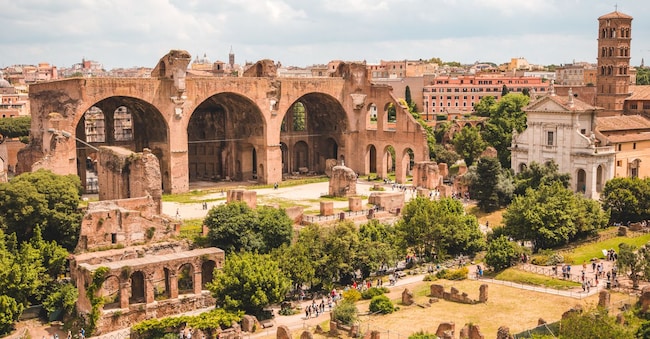
After 47 years, the summer season of the Accademia di Santa Cecilia returns to the Basilica of Maxentius for a month of musical events that, starting on 2 July, include music by giants such as Tchaikovsky, Verdi, Gershwin, Mozart and Vivaldi. But also forays into the contemporary better known to the general public, including Alexandre Desplat's compositions for films that are now equally 'classic', from Harry Potter to Small Women, via Wes Anderson's Suite.
The historic space of the Basilica of Maxentius thus returns to host the summer season of the Accademia Nazionale di Santa Cecilia, restoring a link that has its roots in the 1930s. The concerts of Santa Cecilia at the Basilica of Maxentius in fact represent a historical Roman summer tradition: between 21 June 1933 and 2 August 1979, more than 650 concerts were held there, making Maxentius the fulcrum of Roman musical summers.
The 'classic' Roman summer is back
The new temporary installation of the Basilica, signed by the international studio Alvisi Kirimoto, is a natural evolution of the recent redevelopment of the site, precisely grafting itself onto the multifunctional stage that has been created, designed to be a square for visitors and at the same time a device for events of various kinds.
On this architectural basis is the new stage design, conceived to dialogue with the historical monumental context through a contemporary but measured language. The new layout includes a semicircular tiered seating area capable of accommodating up to 90 orchestra members and a circular element located in the apse, designed to accommodate 80 choir members.
The intervention transforms the cultural device into a high-level symphonic stage and, through this contemporary layering, the Basilica of Maxentius is confirmed as a dynamic and inclusive space, in which architecture becomes an infrastructure at the service of the community and of great international music.

