
Humanoid robots enter Sapa's Benevento factory. Agreement signed with Wandercraft
The company, one of Italy's leading component manufacturers with a turnover of 650 million, will introduce robots at its plant in the province of Benevento

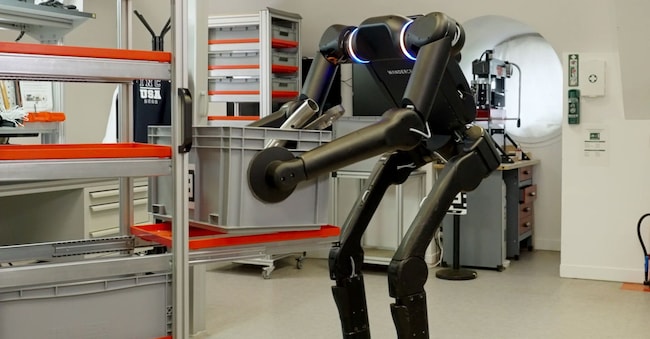
The Sapa Group, one of Italy's leading automotive components manufacturers, has closed a collaboration agreement with Wandercraft - a company founded in France and specialised in the production of exoskeletons - and has decided to integrate the company's humanoid robots into its production processes. It will start in the first quarter of 2026 with four robots and the pilot plant for Sapa will be in Arpaia, in the province of Benevento, where the company produces automotive components for interiors, exteriors and the engine compartment, mainly for Stellantis and Iveco. At the heart of the experimentation is Calvin-40, the modular autonomous humanoid robot developed by Wandercraft and intended to handle and move heavy loads.
The agreement between Sapa and Wandercraft is part of the strategic partnership between the company that produces isoskeletons and humanoid robots and the Renault Group, which has invested by acquiring a minority shareholding in the company. In this context, the collaboration between Wandercraft and Sapa effectively expands the applications of humanoid robots from the industrial network of vehicle manufacturers to Tier 1 suppliers to accelerate the implementation of these new technologies and learning in real environments. From a strategic point of view, this partnership represents a first for a global robotics company integrating its devices within the production cycles of the automotive sector, and at the same time marks a first for the Italian industry, with Sapa as the first industrial manufacturer in the country to choose to integrate humanoid robotics into the factory as part of its automation roadmap.
"Sapa has always been at the forefront of innovation, not only in the production of components, but also in leadership in industrial automation," emphasises a note from the Group's Board of Directors. Our recent acquisition of Megatech and this partnership with Wandercraft reinforce this mentality'. It is a matter of investing in the future, the Sapa Board note goes on to explain, 'not only in the way we produce components, but also in the way we manage production itself'. Sapa is one of the leading players in the automotive components sector, with a significant revenue growth trend behind it between 2022 and 2024 - Cagr higher than 18% - and a consolidated turnover of around 650 million in 2025 compared to 360 million in 2024, thanks to the consolidation of Megatech, a German company acquired during the year.
The first implementation phase of the project will focus on repetitive, high-precision movement of large and heavy parts, tasks for which Wandercraft's humanoids are differentiated in the market. In concrete terms, Wandercraft and Sapa will jointly develop a series of use cases that reflect real workflows in high-productivity environments such as automotive component manufacturing. "This ensures that each Calvin-40 application is purpose-built and high-performing as it expands across multiple locations, reinforcing Wandercraft's belief that humanoid intelligence begins with mastering specific, high-impact tasks," the two companies write in a note.


