
Schools: textbooks are more expensive, but the cost to families is falling. Here’s why
In our country, 37 per cent of adults aged between 25 and 64 fall below the minimum level of literacy, compared with an OECD average of 27 per cent

Key points
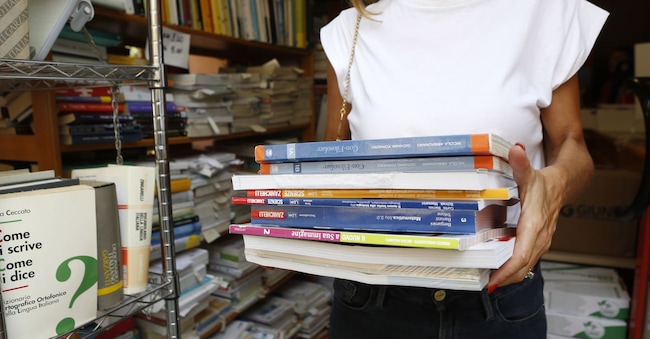
Textbook prices are rising. On average, the increase ranges from 2.3 per cent for lower secondary schools to 1.8 per cent for upper secondary schools, although these figures are still lower than inflation. However, based on the list prices submitted by the Italian Publishers’ Association to the Ministry of Education and Merit, the total average cost that each family must bear to purchase school books has fallen by 1.4 per cent compared with the previous year. And this, in both lower and upper secondary schools, is due to the wide range of titles available and the increasingly judicious choices made by teachers.
The three reforms
Publishers set the prices of school textbooks in January each year, submitting their price lists to the association, which shares them with the Ministry and the school authorities. Prices remain unchanged throughout the year and cannot be altered or increased during the academic year, according to the AIE. ‘Once again this year, publishers have kept price rises to a minimum,’ emphasises Giorgio Riva, chair of the association’s Education Group, ‘thereby helping to avoid placing an additional financial burden on families, despite the fact that the costs they face have risen, and not just because of inflation. Over the last twelve months the sector has seen the introduction of three reforms, the reform of the first cycle (primary and lower secondary education), due to come into effect in 2026; the reform of technical colleges, due to come into effect in 2026; and the recently announced reform of grammar schools, due to come into effect in 2027. These reforms mean that publishers must completely overhaul their multi-year editorial planning, and consequently face the devaluation of investments already made and the costs associated with speeding up projects.”
Where public intervention is needed
Against the backdrop of a declining population, which is making it increasingly difficult to support the industry, publishers are calling for public intervention along two lines. On the one hand, the introduction of a tax deduction for the cost of purchasing textbooks for all families, ‘as already exists for healthcare, sport and pet-related expenses’; and, on the other, greater streamlining and efficiency in the process of distributing aid to families living in absolute poverty. “These funds must reach beneficiaries in a timely manner. These measures are necessary to guarantee an effective right to education for everyone,” concludes the chair of the AIE’s Education Group.
Literacy: 37 per cent of adults fall below the minimum standard
In our country, 37 per cent of adults aged between 25 and 64 fall below the minimum level of literacy, compared with an OECD average of 27 per cent. This figure, taken from “Education at a Glance 2025” and cited by the Cariplo Foundation ahead of World Literacy Day on 8 September, is accompanied by another indicator relating to early childhood: according to the 2025 survey by the National Institute of Health’s 0–2-year-old monitoring system, 53.3 per cent of children aged between 2 and 5 months had not been read to aloud in the week prior to the interview. The Cariplo Foundation links these figures to the importance of linguistic experiences and reading from the earliest years of life. According to material published by the Foundation, the foundations of literacy skills are laid long before children start school, through exposure to language, stories and stimulating environments. The ISS data reveal marked regional differences: amongst children aged 2–5 months, the proportion not exposed to reading aloud ranges from 33.7 per cent in Friuli-Venezia Giulia to 68.2 per cent in Sicily. The situation improves with age: between 11 and 15 months, 68.3 per cent of children are exposed to books. Compared with 2022, in the 2–5-month age group, the proportion of children involved in reading has risen from 41.7 per cent to 46.7 per cent.
(Difficult) access to educational services
The issue also concerns access to educational services. Research by the Evaluation Lab of the Giordano Dell’Amore Social Venture Foundation, carried out as part of the ‘Anita. L’infanzia prima’ initiative, reports that 92 per cent of families consider educational services for children aged 0 to 3 to be essential, but four in ten have never used them. In the provinces bordering the Foundation’s catchment area, the main factor is the unavailability of the service, cited by 32.3 per cent of families who have never enrolled their children in a nursery; in Lombardy, Novara and Verbano-Cusio-Ossola, however, cost is the main factor, cited by 24.5 per cent. Another survey, conducted by the Santagata Foundation and the Associazione Abbonamento Musei amongst 255 museums that responded to the survey, highlights difficulties in accessing cultural venues as well. According to the results cited by Fondazione Cariplo, 60 per cent are rated as having poor accessibility for the 0–6 age group, 40 per cent do not have spaces designed for young children, and only 9 per cent are fully equipped.


