

Un Paese sempre più vecchio e sempre più ignorante
di Francesco Billari

by Leopoldo Benacchio

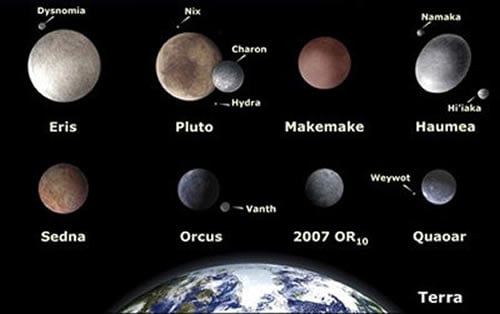
Jared Isaacman, administrator of Nasa, has in recent days claimed for Pluto the return to the role of planet, now a 'dwarf planet' after its cataloguing was changed years ago by the World Assembly of Astrophysicists. Here, however, the Japanese displeased him by finding another mini-planet, much smaller and much stranger, six billion kilometres away.
This story that in Prague, in August 2006, Pluto was, along with others, classified no longer as a planet but as a 'dwarf' planet is regarded by many Americans as a real insult, meaningless of course since Pluto just doesn't change because of this and peacefully continues its orbit around the sun. The mischievous claim that Isaacman, a billionaire, honourable self-made private astronaut and great space enthusiast, has perhaps brought up this alleged snub to the US again to cover up the continued delays of the Artemis lunar missions. The Artemis III mission was in fact just moved months after the success of Artemis II, and in any case nasa's role is not to discuss astrophysics but to fly rockets and, satellites and astronauts.
But let us come to the news, which is very interesting. Last Monday, Japanese astronomers from the National Observatory of the Rising Sun announced the discovery of a small planet, 480 kilometres in diameter, to get an idea, 3475 those of the Moon and 2376 of Pluto. A small world then, located 5.9 billion kilometres away, roughly the distance of the aforementioned Pluto. It does, however, have one unexpected peculiarity: it appears to be enveloped by a layer of atmosphere, 2002 XV93 the not very poetic provisional name.
"I was genuinely surprised," said Ko Arimatsu, the scientist who led the team of Japanese astronomers who published their findings in the leading scientific journal Nature, and the reason is that the planet, even more dwarf than Pluto, has an atmosphere, and really shouldn't have.
The atmosphere of a celestial body, like that of our Earth, is composed of molecules of various elements. In the case of the one we breathe, we have a mixture of Nitrogen, 78 per cent, Oxygen, 21 per cent, and then traces of others such as Argon, Carbon Dioxide, Helium, Methane and others.

