
Security: Army trained one thousand drone operators in 2025
In general, last year training was the focus of activity with over 200 exercises, in Italy and abroad

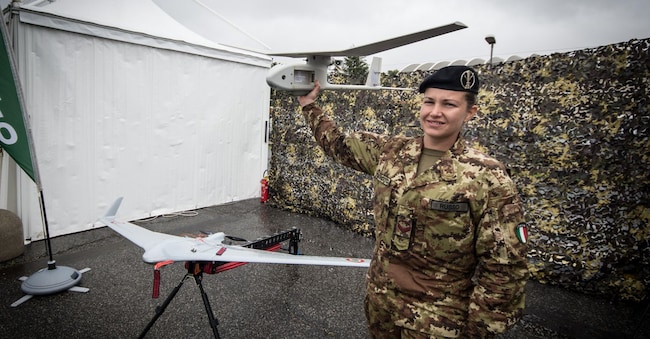
Defence is focusing on training. And, in particular, on that which is functional in facing and managing an increasingly topical threat: that represented by drones. The Army's goal, in particular, is to qualify a significant proportion of its personnel for the autonomous use of drones. A little over a year after the inauguration of the Training Centre for remotely piloted aircraft of the 'mini' and 'micro' category at the 41st IMINT Regiment 'CORDENONS', the Army has exceeded one thousand operators qualified for the use of mini/micro drones (weighing less than 20 kg). During the training activity - divided into 'remote', 'on-site' and 'Basic' and 'Advanced' modules - the soldiers obtained the qualification of Remote Piloted Aircraft operator after passing theoretical assessment tests and practical flight tests.
More than 200 exercises in 2025
More generally, in 2025 training was the focus of activity with over 200 exercises, in Italy and abroad, in increasingly realistic and complex contexts. The aim was to prepare personnel to operate in non-predetermined scenarios, overcoming traditional threat management logics and focusing on continuous and flexible preparation. Joint training with military friendly and allied countries has also fostered the exchange of expertise and strengthened amalgamation and interoperability.
New capabilities in the area of drone combat
At the same time, an Army memo explained, new capabilities were developed in the cybernetic and electromagnetic sectors and, indeed, in countering drones and fighting in complex environments, such as underground. The renewal of means and weapon systems continued, with the introduction of new-generation platforms and the enhancement of air defence and long-range engagement capabilities. Important impetus was also given to the digitisation of processes, with the introduction of computer applications and mobile tools that simplified administrative procedures, reducing the bureaucratic burden on the departments and returning time to training.


