
Security, Cavo Dragone: at least 10,000 more soldiers are needed. 'I will keep asking for more men until they kick me out'
Admiral: 'Our commitment to international stability will increase'

4' min read
Key points
4' min read
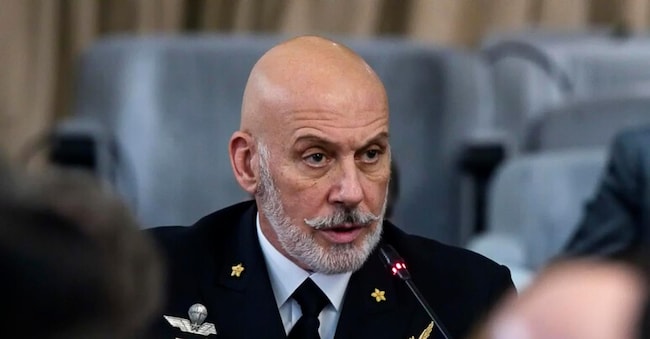
Faced with a scenario that, from a geopolitical point of view, outlines security threats on several fronts, it is necessary to increase the number of military personnel available. This was emphasised by the Chief of Staff, Admiral Giuseppe Cavo Dragone, speaking at an informal hearing before the defence and foreign affairs committees of the House and Senate. The Chief of Staff's speech was part of the examination of the Analytical Report on ongoing international missions and on the status of development cooperation interventions in support of peace and stabilisation processes, referring to 2023, also with a view to its extension for 2024.
Cavo Dragone emphasised the theme of the 'Hybrid Areas' as the 'enlarged Mediterranean' itself is taking shape. If we systematise the crisis in the Strait of Aden, the evolution of the geopolitical scenario from Sudan to the Sahel to West Africa, with the recent institutional crisis in Senegal, we see a band of instability taking shape that threatens Europe, capable of conditioning trade flows, migratory movements, and energy supplies. The complexity of the current geopolitical scenario and the extension of the threats to international security,' he recalled, 'are at the origin of the deployment of our Armed Forces abroad in an unprecedented operational dimension since the post-war period: from the Baltic countries along NATO's Eastern flank, from the Middle East to the Horn of Africa, from the Red Sea to the Gulf of Guinea, passing through the Sahel.
If this is the general context, the road appears marked: 'We must look at today's geopolitics and tomorrow's with great realism,' he explained. 'Even terrorism - this 'monster' that has never ceased to be operative - has reared its head again in recent days with the vile attack in Moscow against defenceless people. Terror must be condemned at all times and under all circumstances. The already highly compromised global scenario is thus in danger of becoming even more complicated, with unpredictable consequences in the various strategic quadrants, where friction points with Russia and its allies and sympathisers are growing. Our commitment to international stability is bound to increase. A healthy exercise in realism must lead us to see NATO as the only true shield we have to defend freedom and democracy." "We will be called upon to support the efforts of NATO and the European Union in countries, such as the aforementioned Moldova and Georgia, to strengthen their institutions and accompany the process of Euro-Atlantic rapprochement. Defence," he clarified, "ensures a significant contribution to nine NATO missions, eight of the European Union and five of the United Nations; 14 initiatives are instead conducted within specific coalitions or on a bilateral basis. Another significant fact is the approval by Parliament of two new missions: the Operation Levant (humanitarian interventions in favour of the Palestinian population of the Gaza Strip) and the European Union's Operation Aspides for the protection of free navigation in the Strait of Bab El Mandeb and in the Red Sea".
"I will keep asking for more men until they kick me out"
.In order to meet these challenges, the team in the field must be strengthened. The Italian armed forces are 'absolutely undersized', Cavo Dragone pointed out. At the very least, 10,000 more men are needed. But even if we reached the fateful 170,000, we would still be 'at the limit of survival', according to the Chief of Staff. "We do not have enough men," he said, "We are absolutely undersized: 150,000 is unfeasible, 160,000 which is what we are currently approved is still not enough, and with 170,000 we are at the limit of survival. In the army we have exhausting shifts. Times have changed, threats have changed, and our commitment is more and more massive. We want a European defence, and that will take a lot from us. I have applied for more men. I will continue to ask for more men until they kick me out."
Ukraine: Nato east flank defence is priority
Regarding the crisis in Ukraine, the Admiral recalled that "a healthy exercise in realism must lead us to consider NATO as the only true shield we have to defend freedom and democracy. The Alliance's eastern flank is a priority," he added, "and the first lesson to be learnt from the war in Ukraine is that the defence of freedom is right, necessary and concerns everyone. There is a country fighting for its and our freedom to be able to choose its own future'.


