The summit in Paris

Nato soldiers in Ukraine, all against Macron's idea: from Italy to Germany

From the White House to London, from Berlin to the EU to Antonio Tajani, all rule out direct involvement in the conflict. Prime Minister Giorgia Meloni said that Italy is not willing to send troops to Ukraine. German President Frank-Walter Steinmeier also expressed doubts about Macron's proposal. Macron's idea has also been criticised by some geopolitical experts, who see it as a dangerous escalation of the conflict
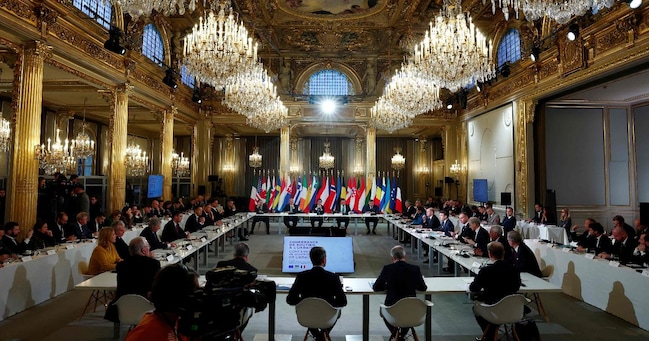
Il vertice a Parigi

4' min read

4' min read

French President Emmanuel Macron did not rule out the possibility of countries sending their own troops to Ukraine even though he admitted there is no agreement on this solution among European partners. Some 20 European leaders gathered in Paris on Monday to send Russian President Vladimir Putin a message of European resolve on Ukraine and counter the Kremlin's narrative that Russia is set to win a war now in its third year. "There is no consensus at this stage on sending troops on the ground," Macron told reporters. "Nothing must be ruled out. We will do everything possible so that Russia does not win."

The proposal, however, did not receive consensus among the European partners. Italy issued a communiqué from Palazzo Chigi: "The conference organised yesterday in Paris by President Macron constituted an opportunity to reaffirm, with the participation of Deputy Minister Cirielli, Italy's full commitment to supporting Ukraine in the struggle to defend its sovereignty and territorial integrity". This was stated in a note by the Italian government, which recalled that 'ever since the Russian aggression two years ago there has been full cohesion of all the Allies in the support to be offered to Kiev. This support - the note underlines - does not contemplate the presence on Ukrainian territory of troops from European states or NATO".

Loading...

On Tuesday the French presidency also took a partial step back: Elysée sources stated that the possible future presence of Western troops in Ukraine, evoked last night in the Paris Conference by French President Emmanuel Macron, would not go beyond the 'threshold of belligerence'.

A chorus of "no"

.

Macron's words were uttered yesterday and today it rained no to his proposal even though he himself had acknowledged that he had not achieved the consensus he had hoped for. The President of Poland Andrzej Duda began this morning, as RBC-Ukraine reports quoting Polish radio. 'The most heated discussion,' says Duda, 'took place around the issue of sending soldiers to Ukraine. And even here there was absolutely no agreement'. Shortly afterwards, a White House official told Reuters, as reported on its website, that the US has no plans to send troops to fight in Ukraine, and that there are also no plans to send Nato troops to fight in Ukraine.

Nato: we have no plans to send troops

.

Then NATO itself intervened, saying it "has no plans" to send combat troops to Ukraine. An alliance official told Afp. "Nato and its allies are providing unprecedented military aid to Ukraine. We have been doing this since 2014 and have shifted gears afterthe large-scale Russian invasion. But there are no plans for Nato combat troops on the ground in Ukraine," the official stressed on the record.

Along the way other precise stances were taken. Like that of the German Chancellor Olaf Scholz who stated that 'no soldiers' will be sent to Ukraine from European or NATO countries. At a press conference Scholz stated that 'what has been decided between us from the beginning continues to be valid for the future', i.e. that 'there will be no troops on the ground, no soldiers sent by European or NATO states on Ukrainian soil'.

London also dissociates

.

The London government also denies direct involvement. The UK has no plans to send military personnel to Ukraine, at least not 'on a large scale'. This was made clear today by the government of Rishi Sunak, indirectly responding to the hypothesis put forward by French President Emmanuel Macron. London has so far always maintained that it has limited itself to sending instructors or military advisers to Ukraine, denying any involvement at the front despite reports of Western 'volunteers' among Kiev troops.

The European Union also freezes any hypothesis of sending troops. "We are aware of public statements by some member states that sending ground troops to Ukraine could be considered. This has not been discussed at EU level," said EU foreign policy spokesman Peter Stano at the Commission's daily press briefing, when asked about the hypothesis raised by the French president yesterday.

Before the official communiqué mentioned above, however, a sharp no had also come from Italy, through the mouth of Foreign Minister Antonio Tajani. The possible sending of Western troops to Ukraine 'is Macron's idea' but 'when we talk about sending troops we must be very careful because we must not make people think we are at war with Russia. We are not at war with Russia, we are defending" Ukraine "and in my personal judgement I am not in favour of sending Italian troops to fight in Ukraine," Tajani said on the sidelines of the Italy-Croatia ministerial coordination committee in Zagreb.

Negative reaction also from Spain. "We do not agree" with the hypothesis put forward by French President Emmanuel Macron to send western troops to Ukraine. This was said by Spanish government spokeswoman Pilar Alegria at a press conference at the end of the Council of Ministers. "We must focus on urgent issues such as speeding up the delivery" of aid to Kiev, said the spokeswoman, who then quoted Prime Minister Pedro Sanchez's words that "unity was and is the most effective weapon Europe has against Putin". Alegria was keen to emphasise that Spain has always been committed to increasing and consolidating support for the Ukrainian people, while at the same time advocating the need to achieve peace.

Russia: direct intervention would lead to war with NATO

Naturally, the Russian government reacts to Macron's proposal. Any sending of Western troops to Ukraine would make a direct conflict between Russia and NATO inevitable. This was said by Kremlin spokesman Dmitry Peskov. Tass reports. Responding at a press conference on the risk of war between Russia and NATO if Western troops were sent to Ukraine, Peskov explained that 'in this case, we cannot speak of probability, but of inevitability, and this is how we assess it'. But adds the Kremlin, sending troops would not be in the interest of the West.

Copyright reserved ©
Loading...

Brand connect

Loading...

Newsletter

Notizie e approfondimenti sugli avvenimenti politici, economici e finanziari.

Iscriviti