
Shared custody, what the text provides for. Child Protection Agency: parents' rights prevail, not children's rights
For Marina Terragni, the double domicile entails 'an aggravation of suffering for minors' and denies the minor's right to enjoy the home as the centre of affection and customs

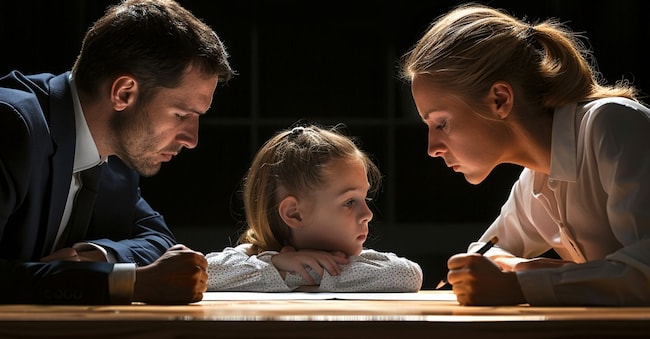
4' min read
Key points
4' min read
"In the bill on shared custody there seems to be a retreat from a careful assessment of children's rights, with the risk that an adult-centred perspective prevails". This was stated by Marina Terragni, Guarantor Authority for Childhood and Adolescence, during a hearing at the Senate Committee on Justice on the draft law on shared custody. The bill S 832, which to many - guarantor authority included - seems to be more oriented to protect the interests of adults than those of children, continues to cause discussion. A collection of signatures on Change.org entitled 'No to the Solomon bill' was also launched on the text, which has already collected 1,638 signatures as of 9 April 2025. Terragni recalls that the right to bigenitoriality 'is first and foremost, a right of the child before the parents'.
From bigenitoriality to mediation, what the bill envisages
The contested bill on shared custody, signed by 14 senators of the majority - first signatory Alberto Balboni (FdI) - provides, among other things, that the child has a double domicile with both parents. The text speaks of perfect bigenitoriality, which many, however, believe could translate into an attack on mothers, given that the promoters include many associations of separated fathers. The risk, claim the measure's detractors, is that the child will have to have two homes and two lives: he or she will have to live for the same amount of time in the mother's home and in the father's home alternately. The allocation of the family home, then, can only be arranged in favour of the children: the parents should alternate according to the childcare periods agreed between them, or established by the judge. The text provides for mandatory family mediation, a parenting plan - joint or separate - in cases of disagreement where family mediation has been refused or failed. The text also provides, in Article 6, that the judge may, "for serious reasons order that the offspring be placed with a third person, preferably from the family circle or, if this is impossible, in a family-type community". The text is being examined by the Senate's Justice Committee in red session. An accelerated procedure: the committee examines and votes on the bill article by article, while in the Assembly only the final vote on the measure as a whole takes place. The feminists of Radfem Italia have raised a public alarm, writing to Prime Minister Giorgia Meloni, denouncing the bill that would 'cut' children in half in the event of separation.
The child's interest is superior to that of adults
."In the introduction to the text of the law," Terragni emphasises, "reference is made to the Charter of Children's Rights in the Separation of Parents introduced by the Supervisory Authority in 2018. However, the concept of bigenitoriality expressed in that Charter does not seem to correspond to the idea of bigenitoriality in the bill. There, bigenitoriality, i.e. the possibility that in the event of separation the child can maintain effective and harmonious relations with both parents, is in the key of the child's interest, which is always superior to that of the adults. A tailor-made suit sewn on a case-by-case basis and with all the necessary flexibility for the benefit of the children, and not a right of the parents to a perfect or almost perfect division, two lives, two homes'.
No to the child with two homes: unthinkable for the youngest
.The text eliminates the concept of the child's 'habitual residence' and provides for an obligation for the child to live in two homes: alternately in the father's and the mother's and with identical permanence. This solution, according to the guarantor Marina Terragni, denies the child's right to enjoy the home as the centre of affection and custom. Double domicile entails an aggravation of suffering for minors," explains Terragni, "who are already suffering from the disintegration of the family nucleus, with the loss of references guaranteed by a continuity of living, with the uprooting from habitual places, from friends, with the fatigue and stress of a life split between two homes, perhaps far apart. The minor cannot become a subject-object towards whom adults claim rights'. The guarantor explained that "eliminating the concept of habitual residence and establishing the obligation of equal domicile in two houses, in addition to the invasion of the State into the private sphere", "overturns the institution of the assignment of the family home intended as the dwelling where the family's life has taken place during cohabitation, the domestic 'habitat' centre of affection and customs. Imposing two domiciles in an equal manner denies the minor's right to enjoy a defined centre and habitat'. And, according to Terragni, "all the more unthinkable for younger children: apart from breast-feeding, bigenitoriality cannot be understood as 'paritarianism' that conceals the difference between the maternal role and that of the father".
Direct maintenance and the risk of different living standards
.As for the replacement of the current maintenance allowance with direct maintenance by the father and mother, this could result - according to Terragni - in different living standards for the child depending on which parent he or she is with at the time. "This objective inequality, almost always to the disadvantage of the mother, could also entail the risk in the future that motherhood will become increasingly rare.


