

The governance of shared water resources is reshaping routes and resources
In the Mediterranean, the Exclusive Economic Zones of individual states often overlap. The UNCLOS conventions are not enough; bilateral and multilateral agreements are needed. And thanks to environmental protection, there is greater information-sharing

For centuries, the sea has been regarded as a thoroughfare, governed by the freedom of navigation. Today, however, demographic pressure, the energy transition and geopolitical rivalry have transformed its waters into a contested frontier. The defining question of our age is no longer who controls the sea, but who is capable of governing it cooperatively. The management of Exclusive Economic Zones (EEZs) has become a barometer of regional stability. Where once imaginary lines were drawn to divide, today efforts are being made to build shared legal frameworks to protect, explore and preserve.
To understand what is at stake, we must first clarify what an Exclusive Economic Zone is. Established by the United Nations Convention on the Law of the Sea, universally known as UNCLOS and adopted in 1982, the EEZ grants a coastal state sovereign rights to explore and exploit marine resources up to two hundred nautical miles from its baseline. On paper, the concept is straightforward. In the reality of the Mediterranean, however, it comes up against a hostile geography. As a semi-enclosed sea, the distances between opposite coasts are often less than the 400 miles required for two complete, non-overlapping EEZs. The result is an intricate mosaic of conflicting claims, where maritime boundaries overlap like pieces of a poorly designed jigsaw puzzle. In this scenario, the rigid and literal application of global rules risks generating constant friction. The solution, as highlighted by the European Union’s most recent maritime security strategies, lies in adapting the principles of UNCLOS through bilateral or multilateral regional agreements.
The race for resources
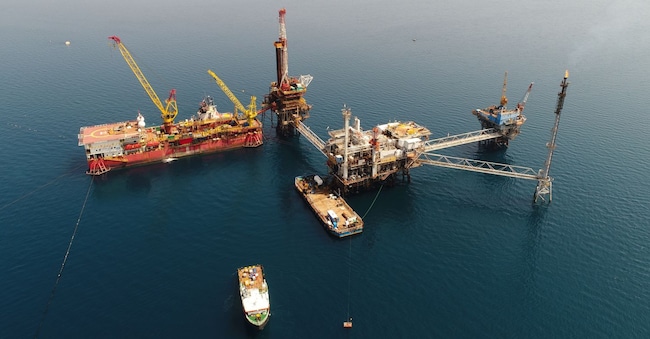
Over the past decade, the eastern Mediterranean has experienced an energy renaissance, with the discovery of massive natural gas fields such as Leviathan and Zohr. These discoveries have promised energy independence and economic growth, but they have also ignited geopolitical tensions, demonstrating how the lack of agreed maritime boundaries can turn a geological blessing into a strategic curse. At the same time, the transition to renewable energy is shifting the focus towards offshore wind power and the extraction of critical minerals from the seabed. However, no institutional investor is committing billions of euros to offshore infrastructure in an area where ownership of the seabed is disputed. Legal certainty is an absolute prerequisite for investment security. This is where economic diplomacy plays a crucial role. Maritime delimitation agreements, such as those gradually reached between various regional actors in recent years, are not merely cartographic exercises: they are genuine economic peace treaties that unlock productive potential.
In this context, the defence and shipbuilding industries play a fundamental enabling role. Governance of the seas is not achieved merely by signing documents; it requires a constant and credible physical presence. Leading industrial players provide the material infrastructure for this form of diplomacy. On the one hand, they design and build the platforms and support vessels needed for sustainable energy exploration and production in deep waters. On the other hand, they supply navies and coastguards with the patrol and surveillance vessels that give effect to the state’s sovereignty. Without these industrial capabilities, any agreement on paper would remain a dead letter, incapable of monitoring its own waters or responding to emergencies. The synergy between national production capacity and the strategy of the Ministry of Foreign Affairs and International Cooperation creates a virtuous circle: maritime stability fosters trade agreements, which in turn justify investment in maritime control and protection capabilities.
Checks
But how does one monitor such a vast and busy area? The answer lies in operational cooperation and joint patrolling. The Mediterranean is too complex to be effectively monitored by a single nation. The threats are hybrid and transnational: they range from the illicit trafficking of migrants and goods to unauthorised hydrocarbon exploration, right through to the risks of environmental accidents or acts of sabotage against critical subsea infrastructure, such as telecommunications cables and gas pipelines. To tackle these challenges, states are increasingly relying on information-sharing mechanisms and joint operations. The European Maritime Safety Agency, through its CleanSeaNet satellite surveillance system, provides a common situational picture, detecting oil spills and suspicious vessel movements in real time. This information is then shared with national authorities and with missions such as Operation EUNAVFOR MED IRINI, which monitors the arms embargo and contributes to the region’s overall stability. Joint patrolling serves not only to crack down on illegal activities; it has intrinsic political value. When the navies of countries with strained relations conduct joint exercises or share operational data, they build habits of cooperation and direct channels of communication that can prevent incidents or misunderstandings from escalating into full-blown crises.

