Design and innovation

Showers and taps, with new technologies water consumption halved

Italian companies race to produce solutions that reduce water use for everyday domestic use
by Giovanna Mancini

3' min read

3' min read

Water is a precious commodity and this is a fact that is now well known to everyone. Yet few people are aware of how much the small gestures of our daily lives - such as opening or closing a mixer to wash or prepare food - can affect water consumption.

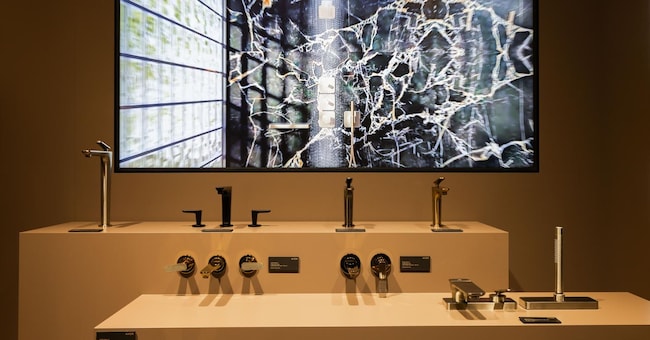
This was well explained by Emiliano Ponzi, Design Group Italia and Accurat, the curators of the installation 'Under the Surface', which was realised on the occasion of the Milan Furniture Fair 2024 and exhibited at the centre of the Salone del Mobile in Milan, where 180 companies presented their products, increasingly designed and dedicated precisely to providing solutions on the subject of water saving.

Loading...

Half the water consumption for taps and showerheads

.

While traditional taps consume around 15 litres of water per minute for a shower and more than 7.5 for a mixer, the most advanced technologies can reduce this consumption in various ways. There are in fact some technologies that mix air and water to ensure a consistent flow even when the water outflow is significantly reduced.

"Showerheads that add a bit of air to every drop," explains research developed for Under the Surface, "save up to 45 per cent of water, a total of about 262 full bathtubs per household each year.

Similarly, tap aerators can cut water consumption by up to 50%. In addition, modern radiators can operate using up to 80% less water than classic tubular models, while still achieving high thermal efficiency levels.

The evolution of technologies also affects sanitary ware, which is evolving to use less water, lowering the average to 4.5 litres for maximum volume. In addition, 'dual flush' models are becoming more popular, allowing the choice of using either 6 or 4.5 litres at a time.

Electrical energy savings

.

But the use of taps, mixers, showerheads and sanitary fixtures does not only imply the consumption of water. we know very well that in order to allow this water to arrive in our homes in the quantity and at the temperature we desire, a lot of electricity is also required. Italian companies have been investing in research for years to try to cut down on this type of consumption as well, which also has the side effect of emitting carbon dioxide. Some companies have in fact developed solutions that cut CO2 emissions by up to 835 kg per year, for a family of four, thanks to energy-efficient showers. Others have adopted more gradual choices, such as reducing lead in products to less than 0.25%, or reducing the raw materials used through more minimalist aesthetics.

The sector as a whole is migrating towards green energy sources and carbon-neutral infrastructures, enhancing on-site production and companies that manufacture 90 per cent of their products locally, explains the research carried out for the Salone del Mobile. Energy waste is also being cut down thanks to nanotechnology integrated into radiator paints, systems that distribute hot water only when really necessary, and smart toilets capable of optimising water and energy consumption with a simple tap on the smartphone, via app.

A certification for sustainability

.

This great effort undertaken by Italian and European companies to make their products more sustainable can also become a significant competitive factor in an increasingly competitive international market. What is lacking, however, to date is an internationally recognised label certifying the higher quality and sustainability of one product over another. Hence the decision of FederlegnoArredo's Assobagno, the association representing the leading Italian manufacturers of bathroom furniture and articles, to sign an agreement with the Unified Water Label Association (Uwla) to promote water-saving labelling in the bathroom sector.

"In the last ten years there has been a great evolution in technology: once traditional mixers consumed 12 litres per minute,' explains Assobagno vice-president Mattia Florindo. Today we are down to 5 litres, more than halving consumption. Now the challenge is to obtain an instrument that identifies this water-saving capacity of our products, particularly taps and sanitary ware'.

At present, there is no international labelling system comparable, for example, to those on energy saving, nor is there a regulated standard that makes clear to the user the characteristics not so much of economic savings (small, compared to electricity costs) as of sustainability.

The partnership with Uwla aims precisely at spreading the 'Unified Water Label' among Italian companies, thus laying the foundation for a more sustainable environmental footprint in the sector. The label provides clear and standardised information on the water and energy consumption of bathroom products, with the aim of encouraging the widespread adoption of water-efficient products.

Copyright reserved ©
Loading...

Brand connect

Loading...

Newsletter

Notizie e approfondimenti sugli avvenimenti politici, economici e finanziari.

Iscriviti