
Snam, the fiftieth ship arrives in Piombino: this is how the floating regasifier works
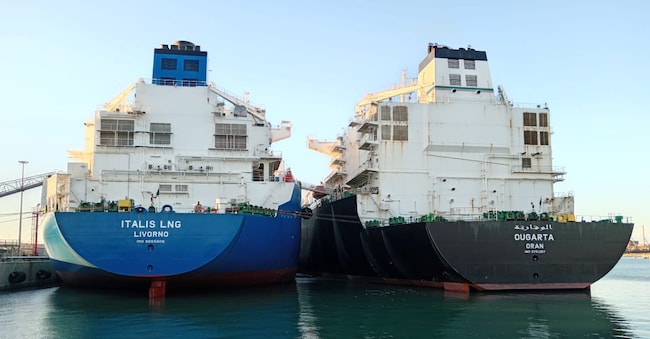
The Ougarta will unload 164,000 cubic metres of liquefied natural gas and will put to sea again on Monday, 23 December. With the latest cargo arriving from Algeria, the total injected by the Fsru is about 4.3 billion cubic metres of LNG

2' min read
2' min read
It is the fiftieth ship to arrive at the port of Piombino where Snam's (Fsru) regasifier, the Italis Lng, is moored. It is the Ougarta, which will unload 164,000 cubic metres of liquefied natural gas and will put to sea again on Monday, 23 December. With the latest cargo arriving from Algeria, to date the total injected into the grid by Italis Lng is about 4.3 billion cubic metres of gas. The volumes arrived so far in Piombino and received by the ship owned by the group led by Stefano Venier come mainly from the USA and Algeria, but also from Qatar, Egypt and Congo.
The Italis Lng identikit
Returning to the Italis Lng, the first of the two regasification ships purchased by Snam on government input in June 2022 and officially entered into commercial operation in July last year, the ship is 293 metres long and 40 metres wide and can store about 170,000 cubic metres of liquefied gas with a regasification capacity of 5 billion cubic metres per year, an amount equal to about one-sixth of the volumes imported in recent years from Russia, or 8% of the national demand.
How the gas transfer occurs
.But how does the gas transfer take place? Once it arrives in the vicinity of the floating regasifier, the LNG carrier at a temperature of -160°C transfers the liquefied natural gas into the terminal's tanks. This process takes place via unloading arms installed on the Italis Lng. These are extended and hooked onto the flanges of the LNG carrier, at which point the LNG is poured into the tanks and stored.
The regasification process
.After storage, we move on to the regasification process, which is achieved by injecting the LNG into a heat exchanger in which a warmer liquid flows, normally seawater, whose natural temperature is sufficient to return the gas to a gaseous state. The room-temperature methane obtained from the regasification process is then compressed and fed into a pipeline from the Fsru to Snam's national transport network.


