
This is how Galileo refuted Ptolemy
The book was found in a collection in the National Central Library in Florence. The discovery is attributed to a young Galileo expert: Ivan Malara, a research fellow at the University of Milan.

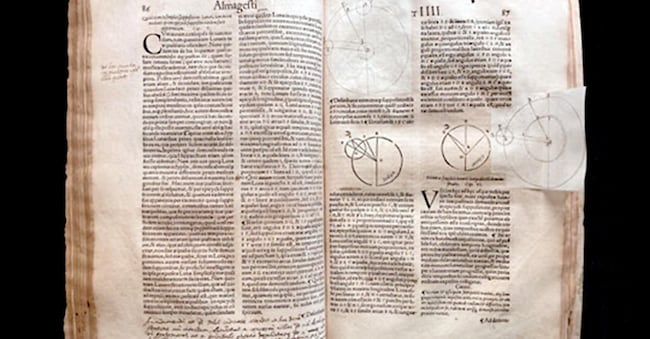
Yes, these are indeed handwritten notes by Galileo Galilei. The public presentation, which took place in Florence, complete with the display of a copy of Ptolemy's Almagest with Galilean annotations (the news had been anticipated by Domenica del Sole 24 Ore) is a resounding novelty, which, among other things, makes it possible to review some fundamental studies on the great scientist's knowledge.
The book was found in a collection of the National Central Library in Florence (where the discovery was christened on 17 February): the discovery is to be attributed (and this is also good news) to a young Galileo expert: Ivan Malara, research fellow at the University of Milan.
This is the work containing the Latin translation of Ptolemy's works, published in Basel in 1551, and housed within the Magliabechian Collection of the Library. The discovery came about as part of a study aimed at clarifying what direct knowledge Galileo had of the Almagest, and in particular, which text he had studied.
'This is not a chance discovery,' said Malara, 'it stems from a research I started about three years ago: I wanted to understand how Galileo studied the Almagest and to do so I started a census of the various editions of the Almagest and in Florence I found this annotated work.
The work consists of 13 volumes and the first five have numerous annotations that the scholar has traced back to a young Galileo. "The handwriting is extremely similar," Malara explained, "it is almost identical and then also from the point of view of content there are some annotations that clearly recall the content of other Galilean ideas.

