
This is how Google plans to send artificial intelligence chips into orbit
Project Suncatcher is a long-term venture: solar-powered satellites, linked together via laser, could one day house computing infrastructure for AI. First, however, they must prove they can withstand the conditions of space.

The next data centre might have neither walls nor a roof: just solar panels, chips and the vacuum of space. This is the vision – yet to be proven – of Project Suncatcher, the research project through which Google aims to determine whether a network of satellites could one day support artificial intelligence workloads in low Earth orbit, where the sun never truly sets: the very conditions needed to power the next generation of computing.
The project forms part of the increasingly energy-intensive race to expand the computing capacity required for artificial intelligence. Moving part of this infrastructure into space could provide more continuous access to solar energy, but it raises many questions: launch costs, maintenance, the lifespan of components and the environmental impact of the satellite constellations.
We’ll have to wait and see; in the meantime, Google is the first to trial this possibility. The prototype satellite, developed in collaboration with Planet and set to launch as part of SpaceX’s Transporter-18 rideshare mission, is tasked with testing whether Google’s Tensor Processing Units can withstand the extreme conditions of space: launch vibrations, cosmic radiation and temperature fluctuations in the absence of an atmosphere.
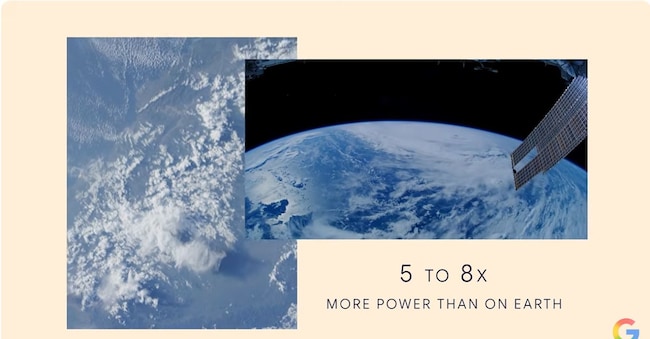
The initiative, first announced last year, is based on an energy-related consideration: in low Earth orbit, a satellite can rely on almost constant sunlight, generating up to eight times more energy than an equivalent plant on Earth. The long-term goal, explains Google, is to connect entire constellations of satellites capable of handling large-scale AI workloads in a distributed manner, powered by virtually unlimited solar energy.
In terms of mechanical strength, the team subjected the satellite to three-axis vibration tests to simulate the frequencies of an actual launch, during which the spacecraft experiences sustained accelerations of up to 10 g and individual components – including TPU chips – can reach peaks of between 50 and 100 g. According to Google, the results were encouraging: the hardware withstood the stresses better than the team itself had anticipated.

