
Europe

At G7 Inclusion and Disability ratified the Solfagnano Charter

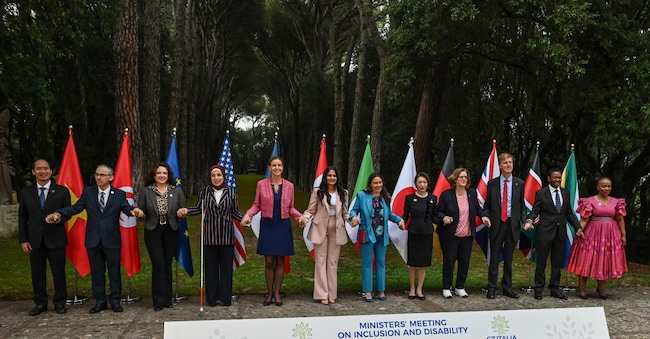
by Monica D'Ascenzo and Angelica Migliorisi

 ANSA/MATTEO CROCCHIONI

4' min read

4' min read

"With this ministerial they took us seriously". Sara Minkara, Special Advisor for Disability to the United States Government, thus concludes the work of the three-day G7 Inclusion and Disability held in Umbria. The first G7 dedicated to these issues places the priority of inclusion of persons with disabilities on the international agenda, so much so that both the South African presidency of the next G20 and the Canadian presidency of the G7 in 2025 have already indicated the centrality of this challenge in the organisation of the work in those venues.

"Removing barriers is not just about people with disabilities. We have to have a holistic approach and this must be a priority in everything we do," stressed Kamal Khera, Minister for Diversity, Inclusion and Persons with Disabilities of Canada, at the final press conference. She added: "Disability is a fact, but inclusion is a choice.

Loading...

"I believe we should build on this milestone to break down the barriers for people with disabilities," said Stephen Timms, Minister of State for Social Security and Disability, while Charlotte Parmentier Lecocq, Minister of State at the Ministry of Solidarity, Autonomy and Equality, emphasised that "people with disabilities must have their rights recognised. This is a strong political discourse'.

"We are vulnerable because the system is not accessible. Vulnerability does not come from disability but from society,' Minkara pointed out in his speech, calling for 'creating a world without barriers'. Of course, he admitted, this is an expensive intervention, but that people with disabilities can contribute to these investments if they are included in the production system. You cannot achieve worldwide prosperity if you do not include persons with disabilities in the economic system," concluded Minkara.

In the European Union, more than one in four citizens have disabilities, totalling more than 100 million, European Commissioner Helena Dalli recalled: "The UN Convention offers a unique mechanism to promote global cooperation on these issues. The guidelines have been taken up in the Solfagnano Charter that is being presented today".

The G7 document

.

"We, the G7 Ministers for Disability Issues and Inclusion, gathered in Solfagnano on 15 and 16 October 2024, under the chairmanship of Alessandra Locatelli, Italian Minister for Disabilities, to reaffirm our unwavering commitment to ensure that all persons enjoy equal rights for full, effective and meaningful participation and inclusion in all aspects of social, cultural, educational, economic, civil and political life. The realisation of the human rights of persons with disabilities is our highest priority". With these words begins the joint communiqué distributed today at the end of the meeting between the twelve ministers who in recent days have met in the G7 held in Umbria.

"Our meeting," the document continues, "builds on the G7 Leaders' Summit held in Borgo Egnazia, Italy, from 13 to 15 June 2024, which mandated us to initiate the Charter of Solfagnano, in which we committed to further mainstream the rights of persons with disabilities in all policy agendas and to take concrete actions to ensure universal access and accessibility; promote independent living; support inclusive education, decent employment and adequate working conditions; ensure the availability and adaptability of community-based services; and advance the use of accessible and inclusive new technologies. We are also committed to promoting the inclusion of persons with disabilities in sports, cultural and recreational activities, as well as in emergency prevention and disaster risk management."

The document also reaffirms "our shared belief in the protection, promotion, monitoring and implementation of the human rights and fundamental freedoms of persons with disabilities, based on existing international legal standards, in particular the United Nations Convention on the Rights of Persons with Disabilities (UNCRPD), including the fundamental principle of "Nothing about us without us", which promotes a cultural change in policies to ensure that the community of persons with disabilities is actively and meaningfully involved in decision-making processes, and that everyone can enjoy their right to participate fully and effectively in civil, social, economic, cultural and political life in our countries".

The ministers also emphasise that their commitment is "geared towards achieving and sustaining a radical shift in perspective that aims to eliminate societal barriers and to place persons with disabilities at the centre of inclusion policies, to maximise autonomy and independence, and to develop talents and capacities so that all persons are encouraged and supported in realising their aspirations and desires. It is also important to recognise the diversity of persons with disabilities and the multiple or aggravated forms of discrimination they may face, while addressing the multiple barriers to inclusion of persons with disabilities".

Ministers are aware of the crucial importance of mainstreaming the issue of inclusion and rights of persons with disabilities in international agendas, including G7-related initiatives, bilaterally and multilaterally, in close cooperation with international organisations, with universal and regional vocation, to promote social change and ensure equal rights for persons with disabilities. "We commit ourselves - continues the document - to promote the mobilisation of the whole society through an inclusive and collaborative approach, appropriate to national contexts, actively involving persons with disabilities, Organisations of Persons with Disabilities (OPDs), public institutions, Civil Society Organisations (CSOs), the private sector, communities and citizens."

In order to support effective change, through the Solfagnano Charter, Ministers intend to promote a positive view among all citizens towards persons with disabilities, based on respect for the rights and dignity of persons with disabilities. They also stress the importance of actively involving, closely consulting, listening to, and acting on the recommendations of persons with disabilities, their families and caregivers, as well as OPDs and associations representing them in decision-making processes, in order to increase the effectiveness of policies and programmes and accelerate social, political and cultural change in our communities.

The Charter of Solfagnano

.

At the ministerial meeting in Solfagnano, which saw ministers from the G7 members come together for the first time to address current challenges related to the rights and inclusion of persons with disabilities, the following issues were identified as priorities to ensure the full and effective participation and inclusion in civic, social, economic, cultural and political life of all persons with disabilities

  • Inclusion as a priority issue on the political agenda of all countries;
  • Access and accessibility;
  • Autonomous and independent living;
  • Talent enhancement and labour inclusion;
  • Promotion of new technologies;
  • Sports, recreational and cultural dimensions of life;
  • Dignity of life and appropriate community-based services;
  • Prevention and management of emergency situations, including climate crises, armed conflicts and humanitarian crises;
Copyright reserved ©
Loading...

Brand connect

Loading...

Newsletter

Notizie e approfondimenti sugli avvenimenti politici, economici e finanziari.

Iscriviti