
Excuse me, are you for or against? Divorce 50 years after the referendum - Dossier
On 12 May 1974, 59.3 per cent of Italians voted against the repeal of the Fortuna law, which entered our legal system in 1970

3' min read
Key points
3' min read
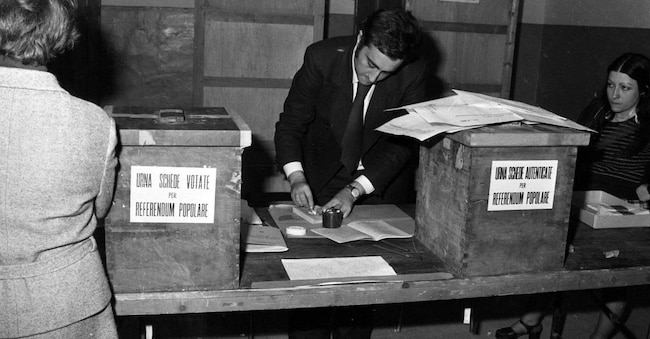
Excuse me, are you for or against? Giving the title to Alberto Sordi's film from '66, it is the question that has divided a black-and-white Italy for years, splitting it over whether the citizens should have their say to keep in force the law that bears the name of a socialist and a liberal, the Fortuna-Baslini No. 898 with which, in 1970, divorce entered our legal system. It was a very divisive entry, with part of the Catholic world, and not only, defending the indissolubility of the marriage bond, and the secular and progressive forces, consisting of Communists, Socialists, Liberals and Republicans, who looked at marriage from the altar, as an institution of law and not as a sacrament. In the secret of the ballot box, in the Camera the Fortuna law obtained 325 votes in favour and 283 against in November 1969. In the Senate a text was passed that provided for the compulsory attempt at conciliation and the raising of the separation period from five to seven years: 164 votes in favour, 150 against. The Chamber of Deputies, which had Sandro Pertini as its president, gave the final go-ahead to a text destined to pave the way for the popular consultation of 1974, desired by the Christian Democrats, who had elected President Giovanni Leone to the Quirinal with the votes of the right, the monarchists and the social movement. In the longest session of parliament - from 24 November to 1 December 1970 - the Fortuna law passed with 319 yes and 286 no votes. There were many Catholic personalities who, 'disobeying' the Italian Bishops' Conference three months before the vote, spoke out against the repeal, from brothers Paolo and Romano Prodi to Pierre Camiti, from Giancarlo Zizola to Leopoldo Elia from Tiziano Treu to Arturo Parisi. The signatures collected were over 1,300,000 against the 500,000 required to give citizens the floor.
The Italians' Word
.But it was precisely with the 1974 abrogative referendum, the first in the history of the Republic, that the Italians proved to be more far-sighted on civil rights than the political class thought.
On 12 May, 87.7% of those eligible took part in the vote and 59.3% voted no, allowing the divorce law to remain in force. Once again, the boot was split down the middle, with the north and centre voting to keep the Fortuna law and the south predominantly anti-divorce. A historic date especially for women who saw their right to leave a bond often made up of oppression recognised, at least on paper. Behind the battle over divorce there is the Italy of the economic boom, there are the youth protests of '68. In schools, factories and squares, workers, students and women's movements are the protagonists of a desire for change.
The equality of spouses in couples
.The no to abrogation acts as a watershed between the old season and the new one made up of slow but progressive achievements in family law. After divorce, the equality of spouses within the couple was affirmed, equal weight for men and women, which the Constitution had recognised as early as 1948, but which was struggling to take hold. The legislature only followed the constituent fathers in '75, when with the reform of family law marital power was sent to the attic, at least from a legal point of view. A double blow on honour killing and reparatory marriage came in 1981. With Law 442, Italy cancelled two articles of the Codice Rocco, thanks to which the penalty for sexual violence was extinguished if followed by a 'reparatory' marriage. While the sentence for killing a woman in a state of rage almost never exceeded three years. Daughters, wives or sisters, who had been guilty of illicit carnal relations, lost their lives.
The decline in marriages and the increase in divorces
.Having achieved the result of the divorce, the legislature then worked to cut the time for the dissolution of the marriage bond. In an initial reform, the time for the final judgment was reduced from five to three years, postponing the definition of ancillary conditions.

